
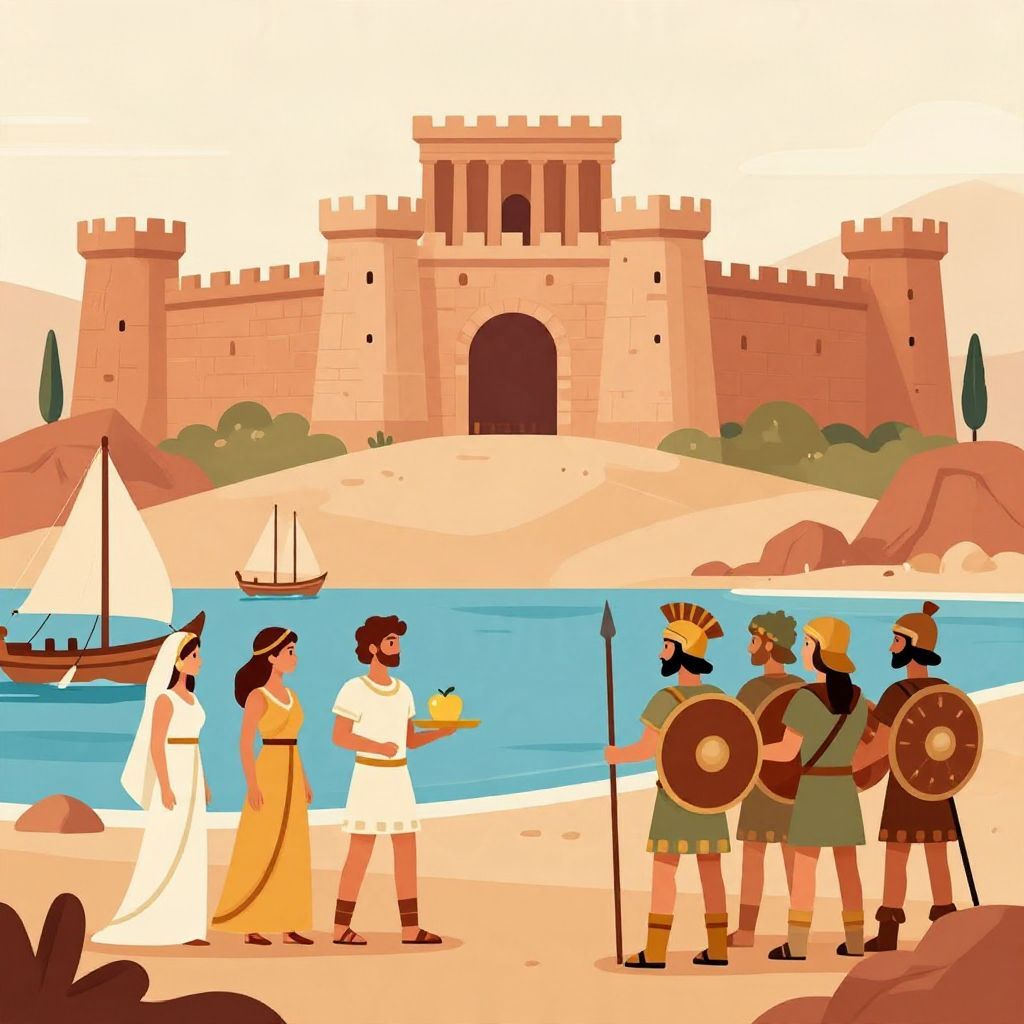
The Trojan War is one of the most famous stories from the ancient world, but the reason it “started” depends on whether you mean myth or history. In Greek tradition, the war began after Paris of Troy took Helen, wife of the Spartan king Menelaus, and carried her to Troy. Yet historians treat this as legend built around a real Bronze Age conflict.
So the best answer is that the Trojan War likely grew out of political rivalry, trade competition, and shifting power in the eastern Mediterranean, later explained through mythic stories about gods, honor, and abduction.
Why Did the Trojan War Start?
The Trojan War started, in the traditional Greek story, because Paris of Troy took Helen from Sparta, provoking a coalition of Greek rulers to recover her and avenge the insult. Historically, however, the war was probably rooted in conflict over wealth, sea routes, and regional power around the late Bronze Age city of Troy, not a single romantic event.
The Mythic Story Behind the War
In Greek tradition, the war begins with a divine dispute and ends with a human one. The goddess Eris, angered at being excluded from a wedding, supposedly offered a golden apple “to the fairest.” Paris was chosen to judge the goddesses, and he awarded the prize to Aphrodite, who promised him Helen. Paris later traveled to Sparta and brought Helen back to Troy, whether by seduction or abduction depending on the version.
This story gave the Greeks a dramatic, memorable cause. It also turned the war into a moral tale about desire, pride, and the consequences of broken hospitality. But as a historical explanation, it is not enough. Myths often preserve social memory in symbolic form, and the Helen story may reflect a real crisis that was later personalized and dramatized.
Why the myth mattered
The legend made the war feel justified to ancient audiences. It explained why many Greek leaders would join a distant campaign and why the destruction of Troy could be seen as revenge. In epic poetry, the war is not just about one woman; it is about honor, reputation, and the order of the world.
What Historians Think Actually Caused the Conflict
Most historians believe the Trojan War, if it was based on a real conflict, was caused by broader political and economic pressures in the late Bronze Age, roughly around the 13th or 12th century BCE. Troy sat near the Dardanelles, a strategic passage between the Aegean Sea and the Black Sea. That location made it valuable for trade, tolls, and regional control.
A fortified city in that position could become a target for rival powers. The war may have been one episode in a wider struggle among kingdoms in western Anatolia and the Aegean world. Instead of a single abduction, the deeper causes were probably competition for influence, access to routes, and prestige among elite rulers.
Troy’s strategic location
Troy was not important because it was a large empire; it mattered because it stood at a crossroads. Control of the area could influence movement between continents and between inland Anatolia and the sea. That made it a potential flashpoint in a world where kings competed through raids, alliances, and siege warfare.
Bronze Age politics
The eastern Mediterranean of this period was full of interconnected kingdoms. Diplomatic gifts, marriage alliances, tribute, and military threats all shaped relations. A local dispute could escalate quickly if powerful rulers joined in. The later Greek story of “all the kings of Greece” gathering against Troy may reflect this kind of alliance politics, even if the details are legendary.
Was Helen the Real Cause?
Probably not in a literal sense. Helen is central to the tradition, but historians do not treat her as the sole or even primary cause of the war. In epic poetry, she functions as a powerful symbol: the loss of Helen represents a loss of honor, legitimacy, and social order. The story may preserve a memory of a diplomatic crisis, hostage-taking, or elite marriage politics.
Ancient societies often used women in royal marriages to seal alliances. If a marriage broke down, or if a noble woman was taken across political boundaries, the consequences could be severe. In that sense, Helen’s story may echo real practices, even if the famous details are literary rather than factual.
Abduction, elopement, or propaganda?
Different ancient versions disagree about whether Helen was abducted, seduced, or willing to go. That disagreement matters. It shows that even in antiquity, people recognized the story as unstable. Some versions may have been attempts to explain or soften the moral problem of a war fought over a woman.
Who Was Paris, and Why Did He Matter?
Paris, also called Alexander in some traditions, is the Trojan prince whose actions trigger the war in myth. He is not a straightforward historical figure but a literary one. His role is important because he embodies the kind of personal decision that can spark collective disaster when rulers place desire above responsibility.
In the story, Paris’s choice of Aphrodite over Hera and Athena creates a chain reaction. The judgment of the goddesses is not history, but it reflects a common ancient theme: human events are shaped by divine favor, pride, and failed judgment. The myth turns political conflict into a tale of moral failure.
Could the Trojan War Have Been a Real War?
There may have been a real conflict at Troy, but the epic version comes from much later oral tradition. Archaeology shows that the site of Troy, usually identified with Hisarlik in modern Turkey, was occupied for centuries and experienced destruction phases. One of those destruction layers may correspond loosely to the period remembered in the Greek tradition.
Still, archaeology cannot confirm Homer’s exact story. The Iliad, composed centuries after the supposed war, reflects a mixture of memory, poetry, and later Greek culture. It preserves some Bronze Age details, but it is not a battlefield report. The most cautious conclusion is that a real conflict likely inspired the legend, rather than the legend preserving a precise historical account.
What archaeology can and cannot tell us
- It can show that Troy was a real settlement with fortifications and destruction phases.
- It can suggest the city was strategically important in the Late Bronze Age.
- It cannot prove that Helen, Achilles, or Odysseus fought there exactly as later stories claim.
- It cannot identify a single “cause” with certainty.
The Role of Honor and Revenge in Ancient Warfare
Even if the war’s deeper causes were political, the Greeks understood warfare through honor. A king’s prestige mattered enormously. If a ruler was insulted, robbed, or shamed, retaliation could become a duty. The Trojan War story uses this logic repeatedly: Menelaus is wronged, Agamemnon leads the expedition, and the Greeks seek to restore honor through force.
This helps explain why the myth endured. It turns a complex international conflict into a recognizable chain of offense and revenge. In the ancient world, where personal status and political authority were closely linked, that was a persuasive way to tell the story.
The Gods as a Way of Explaining Human Conflict
Greek myth also places the gods at the center of the war’s origin. Aphrodite, Hera, Athena, Zeus, and others shape events through promises, jealousy, and intervention. This does not mean the ancient Greeks thought every event was literally caused by the gods in a simplistic way. Rather, divine action in epic often expresses human realities: rivalry, temptation, and the limits of control.
By involving the gods, the story gives cosmic weight to a political conflict. It also suggests that war begins when human ambition and divine favor become entangled. That is one reason the Trojan War story remained so powerful in later literature, art, and education.
How the War Began in the Epic Tradition
According to the full epic cycle, the war did not begin only when Paris took Helen. Earlier events set the stage. The marriage of Peleus and Thetis, the judgment of Paris, and the promise of Helen all formed part of a longer mythic chain. Then Menelaus and his brother Agamemnon gathered Greek allies to recover Helen and punish Troy.
The war therefore begins in stages:
- A divine quarrel leads to Paris’s judgment.
- Paris receives the promise of Helen.
- Helen leaves Sparta for Troy.
- The Greeks form a coalition to respond.
- The siege of Troy begins.
This sequence is mythological, but it reflects a real pattern in ancient warfare: one crisis can activate alliances, obligations, and cycles of retaliation.
Why the Trojan War Story Lasted So Long
The story survived because it answered several questions at once. Why would many kings go to war? Why would a great city fall? Why would a conflict be remembered for generations? The myth offered simple answers rooted in human emotions familiar to every audience: love, jealousy, pride, and revenge.
At the same time, the story preserved a faint memory of a world that had already disappeared by the time Homer’s epics were written down. The palace societies of the Late Bronze Age collapsed around the 12th century BCE, and later Greeks inherited fragments of older traditions. Troy became the symbolic setting for remembering that lost age.
So, Why Did the Trojan War Start?
The Trojan War started in myth because Paris took Helen and provoked the Greeks. In historical terms, it likely began because Troy occupied a strategic position in a competitive Bronze Age world where trade, power, and prestige were constantly contested. The famous story of Helen gave a human face to a much larger conflict.
That is why the Trojan War remains compelling: it sits between history and legend. If you want to explore the setting further, see where Troy was located and how geography shaped the conflict, or read about the Trojan Horse and how later tradition imagined the city’s fall.