
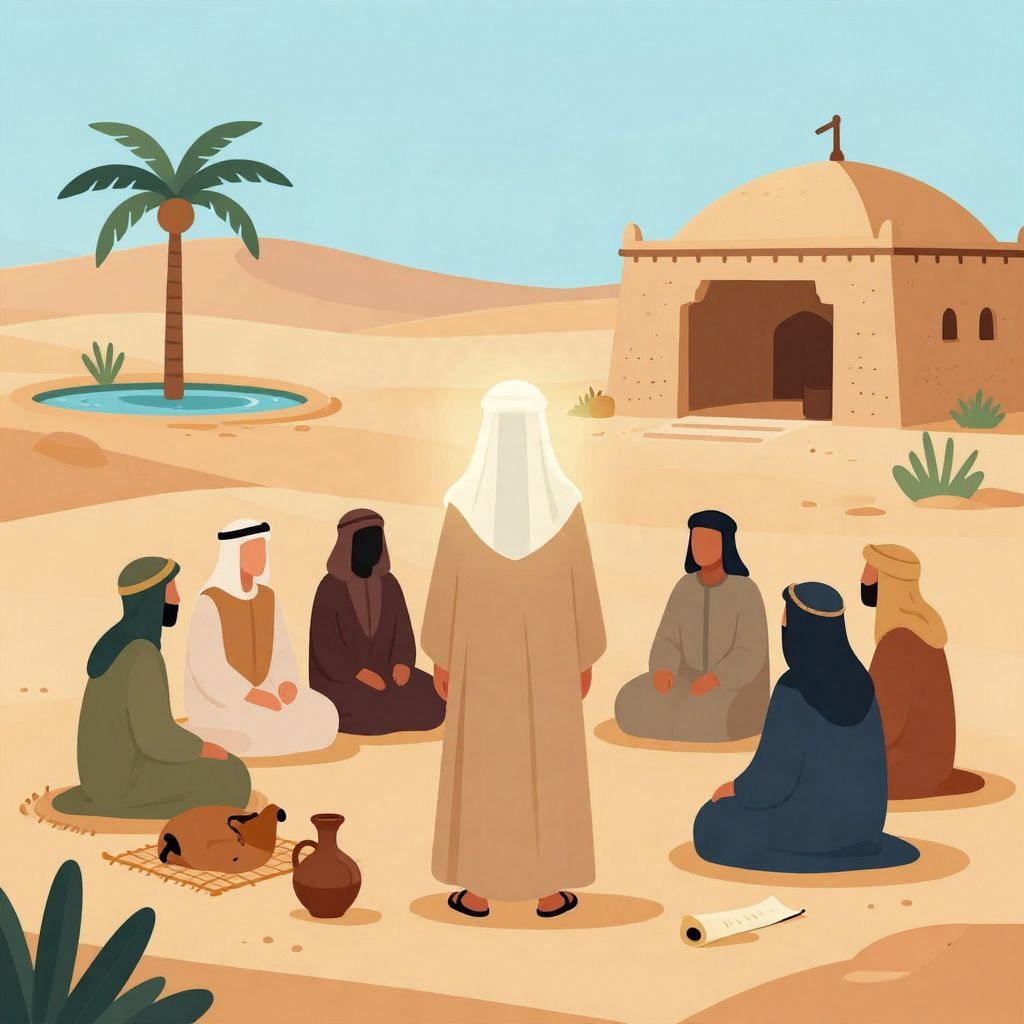
What did Muhammad look like? It is a question many people ask, but the historical answer is limited. Muhammad, the founder of Islam, lived in 7th-century Arabia, and no verified portrait from his lifetime survives. What we know comes from early Muslim traditions, later biographies, and descriptions passed down by his companions.
Because Islamic culture has often discouraged images of prophets, especially in devotional contexts, Muhammad’s appearance is known mainly through words rather than art. Those descriptions are not a modern forensic portrait, but they do give a fairly consistent picture of how he was remembered by the earliest Muslim community.
What did Muhammad look like?
According to early Islamic traditions, Muhammad was of medium height, with a broad chest, strong build, and a face described as handsome and luminous. He is often said to have had dark hair and eyes, a full beard, and a complexion that was neither very pale nor very dark. These details come from later recorded traditions, not from a surviving life portrait.
What the historical sources say
The main descriptions of Muhammad’s appearance come from hadith literature and early biographies, especially traditions attributed to companions who knew him personally. These accounts were written down after his death in 632 CE, so historians treat them carefully. They are valuable as early memory, but they are not the same as a contemporary photograph or eyewitness file.
Common features repeated in the traditions
- Height: often described as medium or slightly above average, not exceptionally tall or short.
- Build: broad-shouldered and sturdy, suggesting a strong physical presence.
- Face: generally described as handsome, with a bright or radiant expression.
- Hair: dark hair, sometimes said to be wavy or slightly curly.
- Beard: a full beard is commonly mentioned.
- Eyes: large, dark eyes are frequently noted in traditional descriptions.
Some traditions also mention a slight redness or whiteness in his complexion, but these terms are difficult to translate precisely into modern categories. In the context of Arabian society, such descriptions likely reflected a range of skin tones common in the region rather than a fixed modern racial label.
Why there is no exact portrait
There is no confirmed image of Muhammad from his lifetime because early Islam developed in a culture that did not rely on portraiture the way some other ancient societies did. More importantly, Islamic religious practice generally avoided making images of prophets, especially for worship or reverence. As a result, written description became the main vehicle for preserving his likeness.
Religious caution around images
Over time, many Muslim communities came to see figurative depictions of prophets as inappropriate, particularly in sacred settings. This did not mean that all Muslim art was image-free, but it did shape how Muhammad was represented. In some later Persian, Ottoman, and other manuscript traditions, artists did depict him, often with veiled faces or symbolic flames, yet these were artistic and devotional conventions, not historical portraits.
How reliable are the descriptions?
The descriptions of Muhammad’s appearance are historically useful, but they have limits. They were preserved through oral transmission and compiled later, which means memory, reverence, and literary style all played a role. Historians therefore read them as evidence of how early Muslims remembered him, not as exact biometric data.
What historians can and cannot conclude
Historians can say that Muhammad was remembered as a physically imposing, attractive man with dark hair and a full beard. They cannot say with certainty the precise shade of his skin, the exact shape of his nose, or whether every detail in every report is literally accurate. The sources are strongest when they overlap on broad traits and weaker when they become highly specific.
That uncertainty is normal for figures from late antiquity and the early medieval world. For many famous people of the period, historians depend on texts, not images, and those texts often mix observation with admiration.
What Muhammad likely looked like in his historical setting
To understand Muhammad’s appearance, it helps to place him in the world of western Arabia in the early 600s. Mecca was a trading and religious center, and people there lived in a Semitic, Arabic-speaking environment shaped by desert travel, commerce, tribal politics, and contact with neighboring regions. Muhammad would have dressed and groomed himself in ways typical of his time and place.
Clothing and grooming
Traditions describe him wearing simple garments such as robes, cloaks, and turbans, which were common in the region. He is also associated with practical habits such as maintaining a beard and keeping a neat appearance. These details matter because they show him not as a distant icon but as a man embedded in the everyday material culture of 7th-century Arabia.
Why later images of Muhammad vary so much
Since there is no universally accepted historical portrait, later artists had to imagine Muhammad’s face and body. That is why depictions vary widely across cultures and centuries. Some show him as a veiled figure, some as a luminous presence, and others, especially in non-devotional or polemical contexts, attempt a fully visible face.
Artistic tradition versus historical evidence
These images tell us more about the societies that made them than about Muhammad himself. A Persian manuscript, an Ottoman miniature, and a modern illustration may each reflect different theological attitudes and artistic conventions. None should be mistaken for a direct visual record of the 7th century.
The best historical answer in one sentence
Historically speaking, Muhammad is most often described as a medium-height, strong, dark-haired, dark-eyed man with a full beard and a handsome, dignified face, but the exact details remain uncertain because no verified contemporary portrait survives.
Why this question still matters
People ask what Muhammad looked like because physical appearance often helps us imagine historical figures as real human beings. In his case, the question also touches on a deeper issue: how religious communities preserve memory when images are limited or contested. The answer lies at the intersection of history, faith, and tradition.
For historians, the most important point is not to force certainty where the evidence is thin. Muhammad’s appearance is known through a layered tradition of remembrance, not through direct visual proof. That makes the historical picture less exact, but not less meaningful.
If you are interested in how historians reconstruct the appearance of major religious figures from limited evidence, you may also like what Moses looked like and what Jesus really looked like. The same caution applies in each case: tradition offers clues, but history requires careful judgment.