
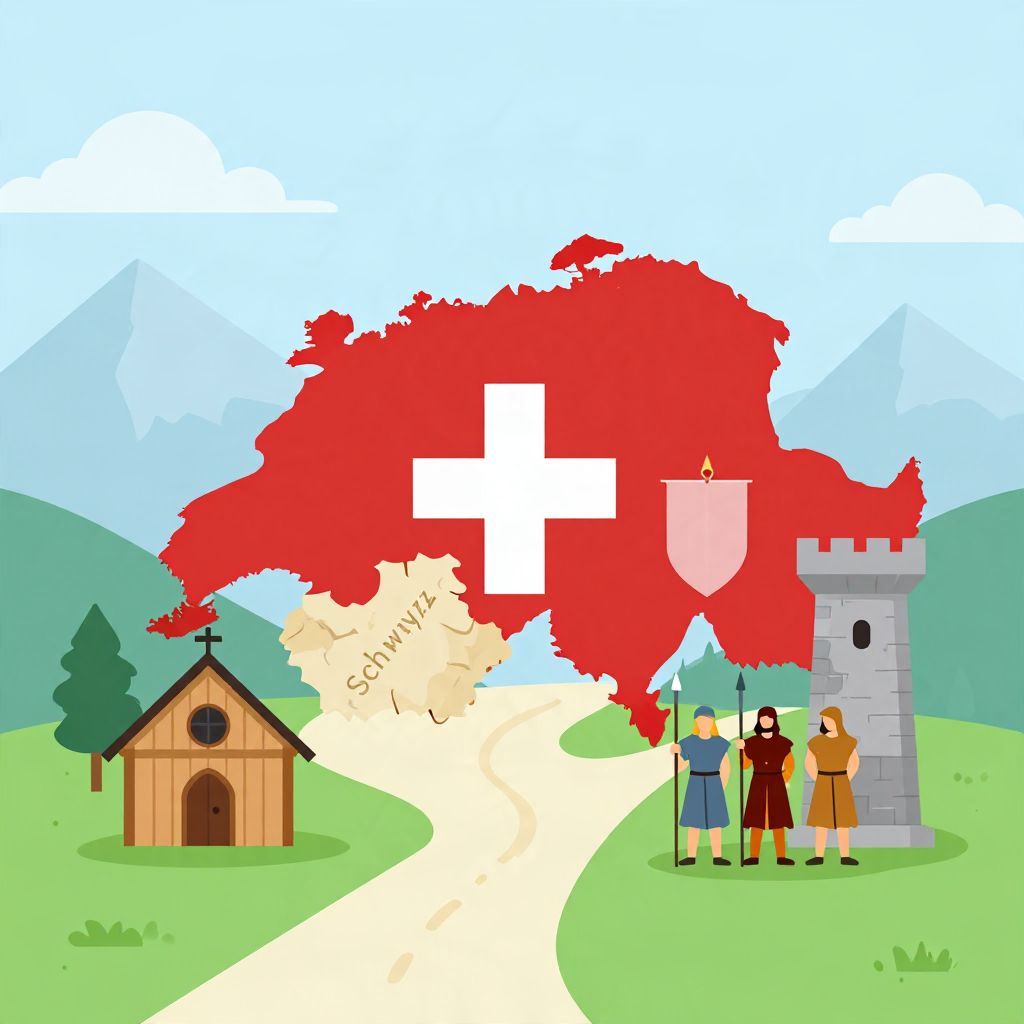
Why is Switzerland “sui”? If you have seen the term used to describe Switzerland, it usually points to the country being unusually distinctive: neutral, multilingual, federal, and historically hard to fit into a single national template. Switzerland did not become “special” by accident. Its identity emerged from geography, medieval alliances, religious conflict, and a long political habit of compromise.
The reasons are historical rather than mystical. Switzerland’s unusual path was shaped by mountain terrain, local autonomy, the rise of the Swiss Confederation, the Reformation, and the decision to preserve independence by balancing great powers instead of becoming one.
Why Is Switzerland Sui?
Switzerland is often seen as “sui generis,” meaning unique, because its modern state grew from a loose confederation of communities that valued local self-rule, neutrality, and multilingual coexistence. Its mountains encouraged regional independence, while centuries of compromise produced a federal system unlike most European nations.
The Geographic Roots of Swiss Distinctiveness
Switzerland’s geography helped create political fragmentation long before the modern state existed. The Alps and Jura mountains divided valleys, limited easy conquest, and made local communities relatively self-reliant. That did not make Switzerland isolated, but it did make centralized rule difficult and encouraged regional identities that remained powerful for centuries.
Mountains, valleys, and local autonomy
In much of medieval Europe, kings and princes could project power across broad plains. In the Swiss interior, however, steep terrain and scattered settlements made administration harder. Alpine passes also mattered economically: communities that controlled routes such as the Gotthard Pass gained bargaining power. Geography did not create Swiss identity by itself, but it made cooperation among local communities more practical than direct rule from a distant capital.
A crossroads, not a backwater
Switzerland was never simply “hidden away.” It sat between major European regions—German-speaking lands, France, Italy, and the Alpine routes linking them. That position exposed it to trade, war, migration, and cultural exchange. The result was not uniformity but layering: different languages, legal traditions, and religious influences coexisted within a relatively small space.
How the Swiss Confederation Formed
The core of Swiss distinctiveness lies in the medieval and early modern Confederation. What became Switzerland began as a series of alliances among communities seeking mutual defense and greater independence from outside rulers, especially the Habsburgs. Over time, these alliances expanded into a durable political structure without becoming a centralized monarchy.
1291 and the founding myth
Swiss tradition often points to 1291 as the founding year, when the so-called Forest Cantons—Uri, Schwyz, and Unterwalden—entered into a defensive pact. Historians generally treat this as an important early alliance, not the sudden birth of a nation in the modern sense. The famous story of an immediate national founding is more legend than literal fact, but the pact did symbolize a growing commitment to collective defense and local rights.
Expansion through alliance, not conquest
During the 14th and 15th centuries, additional towns and regions joined the confederation. Cities such as Lucerne, Zurich, Bern, and others entered through treaties and alliances. This was crucial: Switzerland grew by negotiation and association, not by a single royal conquest. The confederation remained a patchwork of members with different interests, which is one reason Swiss politics later emphasized compromise over uniformity.
Why the confederation mattered
The confederation gave its members a way to resist outside domination while preserving local institutions. It also created a political culture in which shared defense mattered more than ideological uniformity. That habit of cooperation among separate communities became one of the defining features of Swiss history.
Why Switzerland Did Not Become a Typical Centralized Kingdom
Most European states moved toward stronger monarchies or centralized bureaucracies. Switzerland did not follow that path. Its members guarded their privileges, and no dynasty succeeded in turning the confederation into a single kingdom. The result was a state structure that remained decentralized far longer than most of Europe’s.
Resistance to the Habsburgs
The Habsburgs were among the most important forces shaping early Swiss history. Their attempts to assert control over Alpine communities helped drive alliance-building among the cantons. Swiss victories in conflicts such as Morgarten in 1315 and Sempach in 1386 became part of later national memory. The exact military significance of each battle is debated, but their symbolic value was enormous: they reinforced the idea that local communities could defend their freedoms against powerful rulers.
A confederation of cantons
Instead of becoming provinces under a king, Swiss territories developed as cantons—member states with strong local authority. This structure is one of the clearest reasons Switzerland seems “sui generis” today. Even after the modern federal state formed in the 19th century, the cantons retained substantial powers over education, policing, taxation, and other matters. That federal tradition has deep roots in the medieval confederation.
The Reformation and Religious Division
The Protestant Reformation made Switzerland even more distinctive. In the 16th century, major Swiss cities and regions split between Protestant and Catholic confessions. Rather than forcing a single religious settlement, the confederation survived through uneasy coexistence and local variation.
Zwingli, Calvin, and Swiss religious diversity
Ulrich Zwingli in Zurich and John Calvin in Geneva helped shape Protestant thought in the Swiss world, though Calvin was French and Geneva was not part of the old confederation in the same way as the core cantons. Their influence made Swiss cities important centers of Reformation debate. At the same time, many cantons remained Catholic. This religious division did not destroy the Swiss political order, but it made compromise even more necessary.
Peace through balance, not uniformity
In many European states, religious conflict led to civil war, repression, or forced conformity. Switzerland often avoided full collapse by accepting division as a political reality. That pattern later reinforced the idea that Swiss identity was based less on one language, one church, or one ethnicity than on shared institutions and mutual restraint.
Neutrality: A Historical Choice, Not a Timeless Destiny
Swiss neutrality is one of the country’s best-known traits, but it should not be misunderstood as ancient or automatic. It developed gradually, especially in the early modern period, as Swiss leaders concluded that survival depended on staying out of the great power struggles that repeatedly engulfed Europe.
From mercenaries to neutrality
For centuries, Swiss soldiers were famous across Europe as mercenaries. This may seem to contradict neutrality, but it actually reflects an earlier era in which Swiss cantons participated in foreign wars for profit and influence. Over time, however, the destructive effects of external entanglements became clearer. By the 16th and 17th centuries, neutrality increasingly served Swiss interests better than military alliance with one side or another.
Recognition in 1815
Swiss neutrality received major international recognition at the Congress of Vienna in 1815, after the Napoleonic era reshaped Europe. Great powers accepted Switzerland’s permanent neutrality because it helped stabilize central Europe. This did not create Swiss neutrality from nothing, but it formalized a policy that had already become central to Swiss survival and identity.
The Modern Federal State and Swiss Identity
The Switzerland we know today was not fully formed in the Middle Ages. The modern federal state emerged in 1848, after internal tensions and civil conflict made reform necessary. Even then, the solution was not a centralized nation-state in the French or British model. It was a federal compromise designed to preserve local autonomy while creating stronger common institutions.
1848 and the Federal Constitution
The 1848 constitution transformed Switzerland from a loose alliance into a modern federal state. It created a stronger central government, a national parliament, and shared institutions, but it still protected cantonal rights. This balance between unity and diversity remains one of the most distinctive features of Swiss political life.
Why federalism matters
Swiss federalism is not just an administrative detail; it is part of the country’s historical identity. Because power is divided among cantons, citizens often experience government as local and practical rather than distant and abstract. That arrangement reflects centuries of negotiation among communities that never fully gave up their own traditions.
Language, Culture, and the Swiss Sense of Difference
Another reason Switzerland seems unusual is its multilingual character. The country has four national languages: German, French, Italian, and Romansh. This diversity is not a modern accident but the result of historical borders, regional communities, and the decision to build a state around coexistence rather than assimilation.
Not one nation, but many communities
Swiss identity developed across linguistic and cultural lines. German-speaking cantons dominate in population, but French-speaking western Switzerland, Italian-speaking Ticino, and Romansh-speaking areas all belong to the same political framework. The state did not erase these differences; instead, it made them part of the national model. That is one reason Switzerland is often discussed as a country of cultural divergence rather than cultural uniformity.
Symbols of unity without sameness
Swiss symbols—such as the cross, the federal institutions, and the emphasis on civic participation—help create unity without requiring a single language or ethnic origin. In that sense, Switzerland’s identity is political before it is ethnic. It is built on shared rules, not on a single ancestral story.
Myth, Memory, and the Swiss National Story
Swiss history is full of powerful national stories, some more legendary than literal. The tale of William Tell, for example, became central to Swiss patriotic culture, but historians treat it as folklore rather than proven fact. That does not make it meaningless. Myths often express what a society wants to believe about itself.
William Tell and national memory
William Tell symbolizes resistance to tyranny, a theme that fits well with Swiss political tradition. Yet the story should be understood as a cultural myth that helped later generations imagine Swiss freedom, not as a verified origin event. The same is true of some simplified accounts of the 1291 pact. Swiss identity was not born in a single dramatic moment; it evolved through centuries of practical politics.
So, Why Is Switzerland “Sui”?
Switzerland is considered unique because its history produced a state that is unusually decentralized, multilingual, religiously diverse, and politically cautious. Its mountains encouraged local independence, its confederation grew through alliance, its Reformation-era divisions forced compromise, and its neutrality became a long-term strategy for survival. Rather than becoming a centralized empire or kingdom, Switzerland became a federation of communities that learned to coexist.
That is why Switzerland stands out in European history: not because it was untouched by conflict, but because it repeatedly turned conflict into a system of balance. If you want to explore how identity is shaped by history and region, you may also like what cultural divergence means in historical context and how Bosnia and Herzegovina got its name and identity.