
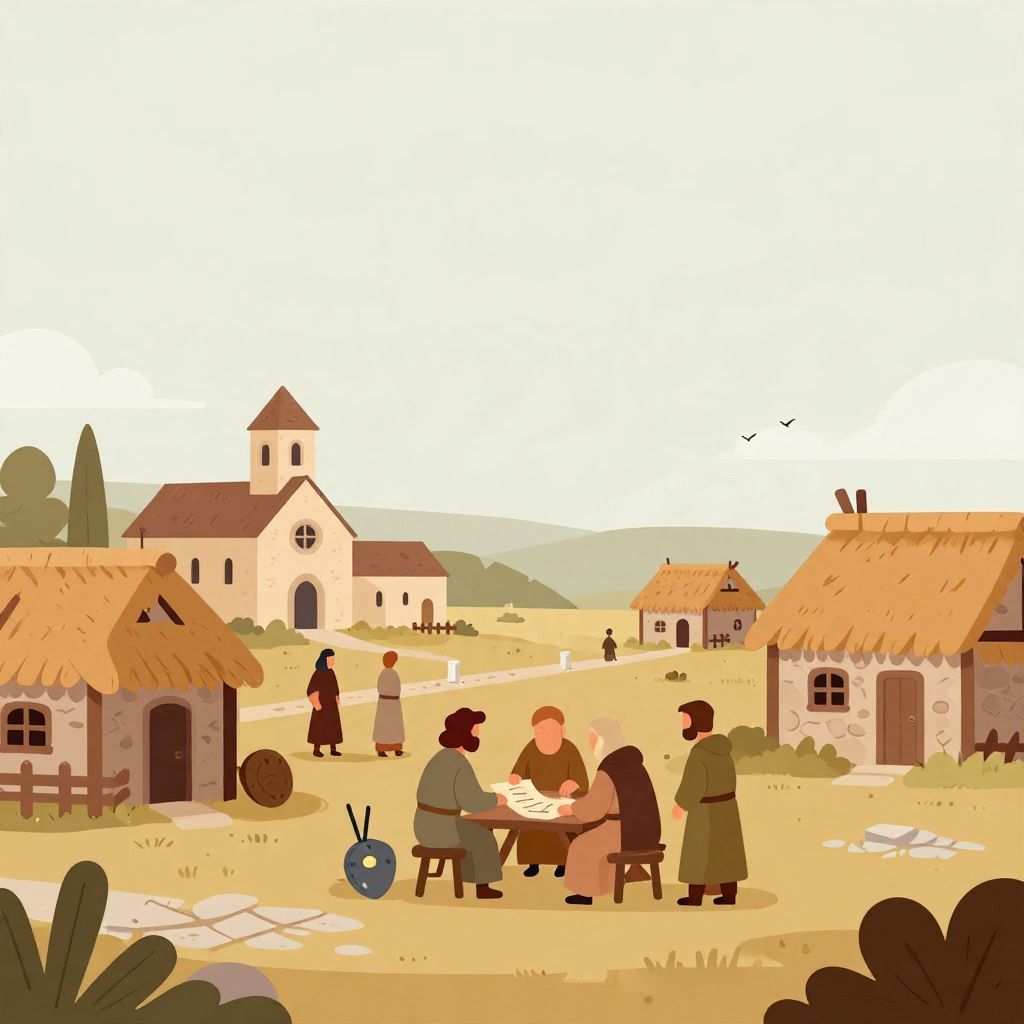
The phrase “Dark Ages” usually refers to the early medieval period in Europe, especially the centuries after the fall of the Western Roman Empire. It is not a precise official date, and many historians now avoid the term because it can be misleading.
Still, if you are asking when the Dark Ages were, the most common answer is roughly c. 500 to 1000 CE, with some older writers using it more broadly for the period between c. 400 and 1500. The exact dates depend on what region and what definition you mean.
When Was the Dark Ages?
The “Dark Ages” is most often used for Europe from about 500 to 1000 CE, beginning after the collapse of Roman authority in the West and ending as kingdoms, towns, learning, and trade revived. The term is now considered outdated by many historians because it suggests a total decline, which is not supported by the evidence.
Why historians use the term cautiously
The phrase “Dark Ages” was never a neutral label. It was coined much later by writers who admired classical Rome and thought the centuries after it were culturally inferior. Modern historians prefer terms like Early Middle Ages because the period was not simply dark, empty, or backward.
The origin of the phrase
Renaissance scholars helped popularize the idea that the centuries after Rome were a time of darkness compared with the “light” of ancient literature and their own revival of learning. Later, Enlightenment writers reinforced that view. But this was a judgment about classical style and education, not a careful historical measurement of progress.
Why the label is misleading
The era saw real change, not just collapse. New kingdoms formed, Christianity spread and adapted, agriculture changed, and art and learning continued in different forms. In some places, life became less urban and less connected to long-distance trade, but other regions remained active and creative.
What dates are usually included?
There is no single agreed start and end date. The most common framework places the Dark Ages in the centuries after the Western Roman Empire weakened and fell, then ends it when medieval Europe became more stable and documented. In practice, historians divide the period differently depending on the topic.
Common starting point: c. 400–500 CE
Many accounts begin around 476 CE, the traditional date for the fall of the Western Roman Empire, when the last western emperor, Romulus Augustulus, was deposed. Others start earlier, around 410 CE, when Rome was sacked, or around the late 4th and early 5th centuries, when imperial control in the West was unraveling.
Common ending point: c. 900–1000 CE
The period is often said to end around the 10th or 11th century, when Europe saw stronger kingdoms, more settled political structures, agricultural expansion, and a clearer documentary record. Some older narratives extend the “Dark Ages” into the 12th century, but that is less common in modern scholarship.
What happened after the fall of Rome?
The collapse of Roman power in western Europe did not create instant chaos everywhere, but it did transform politics, economy, and daily life. Centralized imperial administration weakened, cities shrank in many areas, and long-distance trade became less reliable. Local rulers and regional identities became more important.
The Western Roman Empire breaks apart
By the 5th century, Roman authority in the West was under pressure from internal instability, military problems, and repeated invasions and migrations. Germanic-led kingdoms such as the Visigoths, Ostrogoths, Franks, Lombards, and Anglo-Saxons emerged in different regions. These were not all “barbarian invasions” in a simple sense; many involved settlement, alliance, and the reuse of Roman institutions.
Life changed unevenly across Europe
Some areas experienced sharper decline than others. Italy, parts of Gaul, and Britain saw major disruption, while other regions retained more continuity. The eastern Roman Empire, later called the Byzantine Empire, remained powerful and sophisticated, which is one reason the label “Dark Ages” is especially misleading if applied to all of Europe or the whole Mediterranean world.
Why the early Middle Ages were not simply “dark”
Calling the period dark suggests a lack of culture, learning, and achievement. That is too simplistic. The centuries after Rome produced new political forms, religious institutions, legal traditions, and artistic styles. They also preserved and transformed much of the ancient world rather than merely losing it.
Learning continued in new centers
Monasteries became important places for copying texts, teaching, and preserving literacy. In the Carolingian world under rulers like Charlemagne, scholars encouraged a revival of education and manuscript production. This was not the same as classical Roman schooling, but it was real intellectual life.
Christianity shaped the era
Christian institutions became more deeply rooted across Europe. Bishops, monasteries, saints’ cults, and church networks helped organize society and preserve records. Religion was central to politics and culture, and it provided a common framework across fragmented kingdoms.
Art and architecture also developed
Early medieval Europe produced distinctive metalwork, illuminated manuscripts, stone churches, and decorative styles that were different from Roman art but not inferior. The period’s creativity is visible in objects such as jeweled reliquaries, carved crosses, and richly illustrated books.
A simple timeline of the Dark Ages debate
If you want the shortest possible historical timeline, this is the most useful way to think about it:
- c. 300–400 CE: Late Roman Empire in the West begins to weaken.
- 410 CE: Rome is sacked, a symbolic shock to Roman prestige.
- 476 CE: Traditional date for the fall of the Western Roman Empire.
- 500–700 CE: Early medieval kingdoms take shape across western Europe.
- 800 CE: Charlemagne is crowned emperor, showing a revival of imperial ideas in the West.
- 900–1000 CE: Political consolidation, agricultural growth, and expanding trade become more visible.
Was the Dark Ages the same everywhere?
No. The term is usually applied to western Europe, and even there it fits some places better than others. It should not be used as a blanket description of the entire world. While western Europe experienced fragmentation after Rome, other regions were developing in different ways.
The Byzantine Empire was not in a “dark age”
Eastern Roman civilization continued in Constantinople and across the eastern Mediterranean. It preserved Roman law, administered a complex state, and maintained urban life and scholarship. For that reason, historians usually reserve “Dark Ages” for a limited western European context, if they use it at all.
The Islamic world was rising during this period
From the 7th century onward, the Islamic caliphates became major centers of learning, trade, science, and political power. This matters because the early medieval world was interconnected. Knowledge, goods, and ideas moved across regions, even when western Europe was less urban than before.
Why the term still appears in popular history
“Dark Ages” remains common because it is memorable and easy to understand. It quickly signals a time of transition after Rome. But historians tend to avoid it in professional writing because it oversimplifies a complex era and implies that little of value happened between antiquity and the high Middle Ages.
What historians prefer instead
Most scholars use Early Middle Ages for roughly 500 to 1000 CE in western Europe. This term is more accurate because it describes the period without assuming decline. It also fits better with evidence showing continuity, adaptation, and regional variation.
So, when was the Dark Ages?
The best short answer is that the Dark Ages, as traditionally used, refers to roughly 500 to 1000 CE in western Europe, though some older writers stretched it from about 400 to 1500. Because the term is imprecise and often misleading, many historians now prefer to speak of the Early Middle Ages instead.
In other words, the “Dark Ages” were not a single fixed block of time, and they were not uniformly dark. They were a period of transformation after Rome, when old structures weakened, new kingdoms emerged, and medieval Europe slowly took shape. If you want to explore the idea further, see what the Dark Ages were and how they relate to the fall of the Holy Roman Empire.