
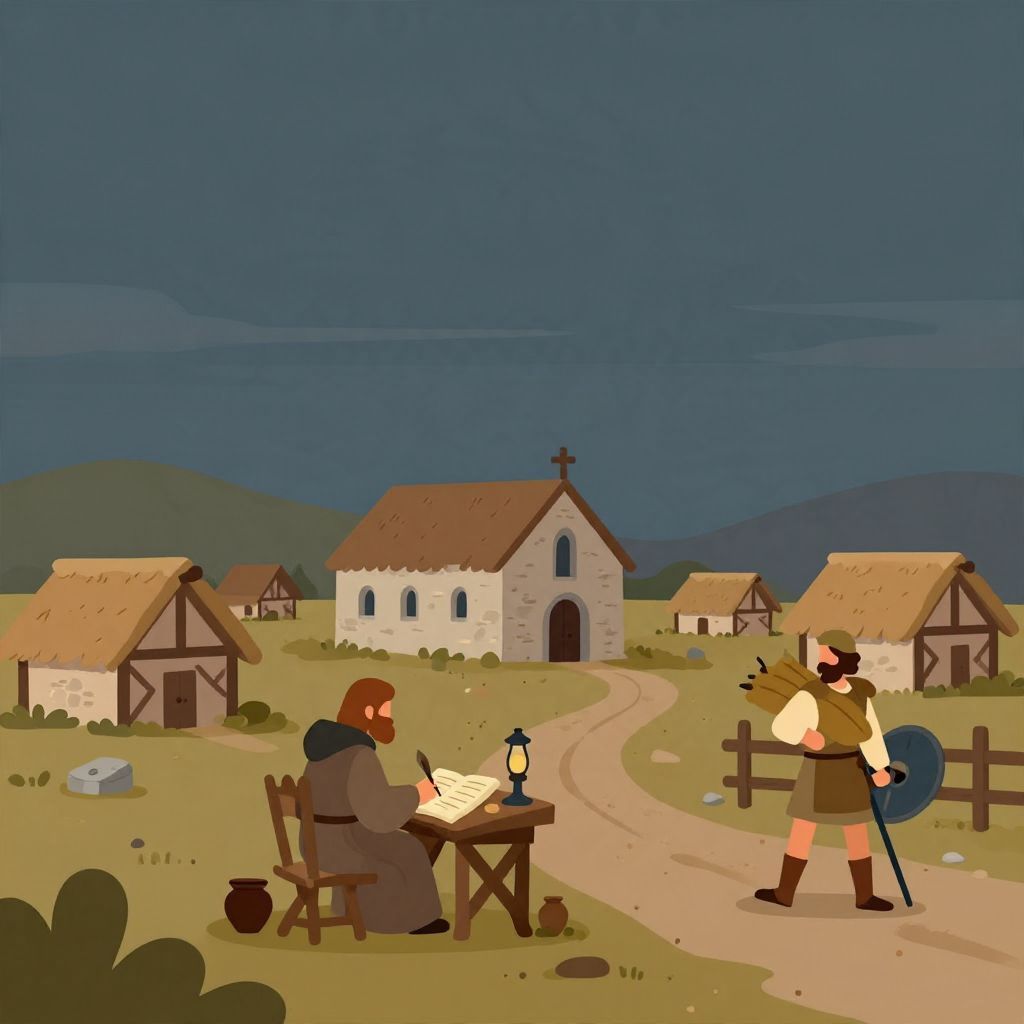
The phrase “Dark Ages” is one of the most debated labels in history. It usually refers to the centuries after the fall of the Western Roman Empire, when political fragmentation, reduced long-distance trade, and fewer surviving written records made parts of Europe seem dimmer in the historical record.
But the term is misleading if taken literally. Life did not stop, knowledge did not disappear, and the period was not equally “dark” everywhere. Historians today use the phrase cautiously, if at all, because it reflects both real disruption and a later judgment shaped by Renaissance and Enlightenment writers.
What Are The Dark Ages?
The “Dark Ages” is a traditional but contested term for roughly the early medieval period in Europe, especially from the 5th to the 10th centuries. It describes a time of political upheaval after Roman rule in the West, when fewer texts survive and some regions experienced economic and urban decline. Modern historians prefer more precise terms such as the Early Middle Ages.
Where Did the Term “Dark Ages” Come From?
The phrase did not come from the people living in the period. It was popularized much later by Renaissance scholars who admired ancient Greece and Rome and looked down on the centuries between antiquity and their own age. They saw those centuries as intellectually and culturally inferior, a “dark” interval between two brighter eras.
Why the label became controversial
Later historians criticized the term because it implies that the whole era was backward or empty of achievement. In reality, the period saw major developments in law, religion, agriculture, language, art, and state formation. The label can still be useful as a shorthand for certain problems, but it can also distort the past if used too broadly.
When Did the Dark Ages Begin and End?
There is no single start or end date, because the transition from the Roman world to medieval Europe happened gradually and unevenly. A common starting point is 476 CE, when the last Western Roman emperor, Romulus Augustulus, was deposed. But Roman institutions had already weakened in many regions before then, and some areas changed much later than others.
Common chronology, with caution
- Late Roman decline: 3rd to 5th centuries CE
- Post-Roman transformation: 5th to 7th centuries CE
- Carolingian and early medieval recovery in parts of Europe: 8th to 10th centuries CE
By the 11th century, many historians would say Europe had clearly entered the High Middle Ages, with stronger kingdoms, revived towns, and expanding trade. The “end” of the Dark Ages is therefore best understood as a gradual transition, not a single event.
What Was Happening in Europe During This Period?
After Roman authority weakened in the West, Europe became politically fragmented. New kingdoms emerged, many founded by Germanic-speaking groups such as the Visigoths, Ostrogoths, Franks, Lombards, and Anglo-Saxons. These rulers did not simply destroy Roman society; in many places they adapted Roman institutions, law, and customs to new political realities.
Political fragmentation and local power
Centralized imperial administration gave way to smaller, competing power centers. Kings, local nobles, bishops, and military leaders often shared authority. In some regions, especially where Roman infrastructure had been strongest, cities declined in size and influence, while rural estates and fortified settlements became more important.
War, migration, and insecurity
The period was shaped by migration, warfare, and shifting borders. Some groups moved into former Roman lands through conquest, settlement, or alliance. Conflict was common, but not constant chaos. Many communities found ways to adapt, and new political orders eventually stabilized in places such as Francia, Anglo-Saxon England, and parts of Italy and Spain.
Was It Really a Time of Decline?
In some ways, yes. Compared with the Roman Empire at its height, parts of Western Europe experienced fewer large cities, less long-distance trade, and a narrower material culture. Literacy also became less widespread in many areas, especially outside the Church and elite circles. Yet decline in one sphere often coexisted with growth in another.
What declined
- Urban life in many western regions
- State taxation and imperial bureaucracy
- Long-distance Mediterranean trade in some areas
- Everyday literacy outside religious institutions
What changed or grew
- New kingdoms and dynasties
- Christian institutions and monastic learning
- Local agricultural systems and manorial estates
- Distinct regional cultures and languages
So the period was not simply one of collapse. It was also a time of transformation, in which the Roman world was replaced by new medieval societies.
Why Did Historians Once Call It “Dark”?
The term reflected a lack of surviving written evidence as much as a judgment about civilization. For some regions, especially in the centuries after Rome’s collapse, fewer texts survive than for the Roman period or the later Middle Ages. That makes the era harder to study and can create the impression of darkness in the historical record.
The problem of surviving sources
Much of what historians know comes from chronicles, letters, church records, legal codes, archaeology, and later copies of older texts. Because fewer documents survive from some early medieval centuries, historians must reconstruct events from incomplete evidence. This does not mean people stopped writing; it means preservation was uneven.
Renaissance and Enlightenment bias
Renaissance thinkers admired classical antiquity and often treated the centuries after Rome as a cultural low point. Enlightenment writers sometimes reinforced that view by contrasting reason and progress with what they saw as superstition and disorder. Modern scholarship is more careful, recognizing both the losses and the achievements of the period.
What Was Life Like in the Dark Ages?
Daily life varied enormously by region and social class. Most people were peasants working the land. Villages were small, travel was difficult, and local lords or landowners often controlled access to land and protection. For many, survival depended on harvests, seasonal labor, and obligations owed to elites or religious institutions.
Food, work, and settlement
Agriculture remained the foundation of the economy. People grew grains, kept livestock, and relied on local resources. In some areas, new farming techniques slowly improved productivity over time, but the process was uneven. Settlements were often clustered around estates, monasteries, or fortified places rather than large cities.
Religion and community
Christianity became a unifying force across much of Europe, though practice and belief differed from place to place. Bishops and monasteries preserved texts, educated clergy, and provided social services. At the same time, older local customs and beliefs often continued alongside Christian worship, especially in rural areas.
What Were the Major Achievements of the Period?
Despite the negative reputation attached to the term, the early medieval centuries produced important cultural and political achievements. These included the spread of Christianity, the preservation and copying of classical texts, the development of new legal traditions, and the creation of kingdoms that later became major European states.
The Carolingian Renaissance
Under Charlemagne and his successors in the late 8th and 9th centuries, parts of western Europe saw a revival in learning, manuscript production, and administrative reform. Scholars standardized writing styles, copied texts, and promoted education for clergy and officials. This was not a modern “renaissance,” but it was a genuine intellectual renewal.
Art, architecture, and craftsmanship
Early medieval art included illuminated manuscripts, metalwork, jewelry, and church buildings. Styles varied across regions, combining Roman, Christian, and local traditions. Far from being culturally empty, the period developed distinctive artistic forms that influenced later medieval Europe.
Law and kingship
Several kingdoms produced written law codes that blended Roman traditions with local custom. Kingship also evolved as rulers sought legitimacy through religion, warfare, and alliances with nobles and bishops. These developments helped lay the groundwork for later medieval states.
Did the Dark Ages Affect All of Europe the Same Way?
No. The term is especially associated with western Europe, and even there the experience differed greatly from one region to another. Italy, Gaul, Iberia, Britain, and central Europe did not all follow the same path. Meanwhile, the Byzantine Empire in the east preserved Roman imperial institutions for centuries, so calling the whole era “dark” is inaccurate.
Byzantium and the wider world
The Eastern Roman, or Byzantine, Empire continued to flourish after the fall of the West, with Constantinople as a major center of government, trade, and culture. In the Islamic world, which expanded from the 7th century onward, scholarship, science, and commerce developed in ways that connected Europe to broader Afro-Eurasian networks. The “Dark Ages” label can hide these wider connections.
Why Do Historians Prefer “Early Middle Ages” Today?
“Early Middle Ages” is more precise and less judgmental than “Dark Ages.” It describes the period without assuming it was uniformly ignorant or stagnant. Historians now emphasize transition, continuity, and regional diversity rather than a simple fall from greatness.
What the modern view emphasizes
- The transformation of Roman institutions rather than total collapse
- Regional differences across Europe
- The role of archaeology alongside written sources
- The achievements of early medieval societies
This approach gives a fuller picture of how Europe changed after Rome and avoids repeating older stereotypes.
Key Facts About the Dark Ages
- The term usually refers to the early medieval period in western Europe.
- It is most often associated with the centuries after the fall of the Western Roman Empire.
- The phrase was coined and popularized much later, not by people of the time.
- It reflects both real disruption and later bias against the period.
- Modern historians generally prefer “Early Middle Ages.”
Conclusion: What Are The Dark Ages, Really?
The Dark Ages were not a blank chapter in history, but a time of upheaval, adaptation, and transformation after Roman power faded in the West. The phrase can describe real losses in urban life, literacy, and political unity, yet it also oversimplifies a period that produced new kingdoms, institutions, and cultural forms. For related context, see what a feudal system was and how cultural divergence works in history.