
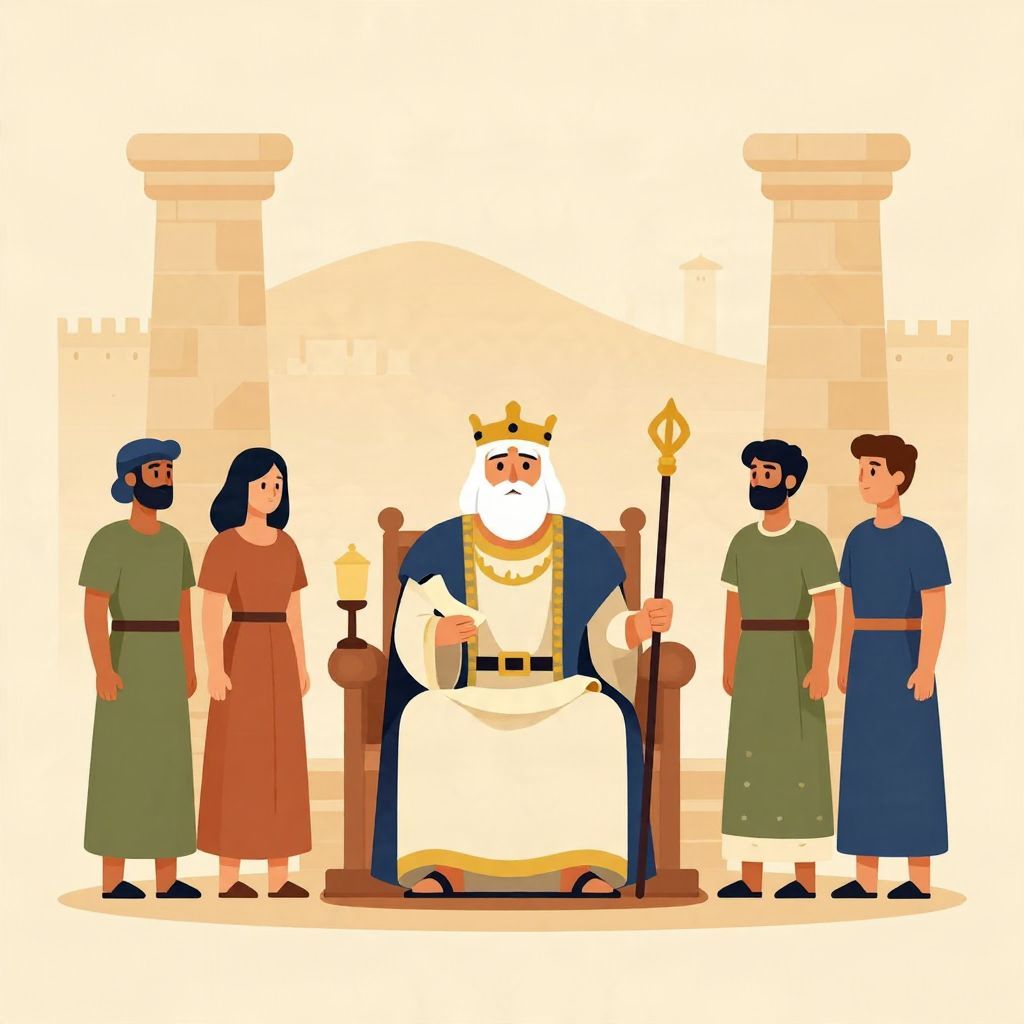
How old was King David when he died? The Bible does not give a direct age, but historians and biblical scholars often estimate that David died at about 70 years old. That figure comes from the biblical chronology in 2 Samuel and 1 Kings, which says he ruled for 40 years and died after a long reign in Jerusalem.
Because the ancient sources are not perfectly precise, David’s exact birth year cannot be fixed with certainty. Still, the traditional age of 70 is the most widely accepted estimate and fits the biblical timeline of his life, kingship, and succession by Solomon.
How old was King David when he died?
King David was likely about 70 years old when he died. The biblical text does not explicitly state his age at death, but it does say he reigned for 40 years—seven years and six months in Hebron and 33 years in Jerusalem. If David became king in adulthood after years of service under Saul, a death around age 70 is the standard historical estimate.
Why historians use the age of 70
The estimate comes from combining several biblical details rather than from a single verse. David was already a young man when he entered Saul’s court, fought Goliath, led troops, and later became king. Since he ruled for four decades and had an adult son, Solomon, ready to succeed him, a death in his seventies is plausible and consistent with the narrative.
What the biblical timeline says about David’s life
David’s life is described across the books of 1 Samuel, 2 Samuel, and 1 Kings. These texts present him first as a shepherd from Bethlehem, then as a warrior, fugitive, king, and aging ruler. While the chronology is not always easy to reconstruct exactly, the sequence gives enough context to estimate his age at death.
Key stages in David’s life
- As a youth, David is introduced as the youngest son of Jesse in Bethlehem.
- In Saul’s service, he becomes known as a musician, armor-bearer, and warrior.
- After defeating Goliath, he rises quickly in public prominence.
- He spends years as a fugitive, fleeing Saul before becoming king.
- He rules first in Hebron and then in Jerusalem.
- In old age, he transfers the throne to Solomon and dies.
This broad arc suggests a long adult life rather than a short reign. The biblical writers were more interested in David’s role in Israel’s history than in recording exact biographical data, so modern readers have to infer his age from the narrative structure.
How the 40-year reign helps estimate David’s age
The clearest chronological anchor is David’s reign length. According to 1 Kings 2:11, David ruled for 40 years: 7 years and 6 months in Hebron and 33 years in Jerusalem. If he became king in his thirties, which is often inferred from the way his earlier life is described, then dying around age 70 is a reasonable conclusion.
A simple timeline estimate
- Teenage or young adult years: David is anointed by Samuel and later appears in Saul’s court.
- Early adulthood: He fights Goliath and gains fame.
- Years of conflict and exile: David lives as a fugitive before Saul’s death.
- Midlife: He becomes king and consolidates power.
- Later years: He faces family conflict, succession issues, and old age.
- Death: He dies after naming Solomon as successor.
That sequence does not prove the number 70, but it makes it the most historically sensible estimate. In ancient royal biographies, exact ages were often omitted unless they served a specific literary or theological purpose.
Was David definitely 70 years old?
No, not definitely. The age of 70 is an informed estimate, not a directly stated fact. Some readers treat it as exact because it appears often in summaries of David’s life, but the biblical text itself leaves room for approximation. The safest historical statement is that David died around age 70.
Why the exact age is uncertain
Ancient Israelite chronology is difficult to reconstruct with precision. The biblical books were written and edited over time, and they focus on theological meaning, covenant, kingship, and national memory rather than modern-style biography. As a result, scholars usually avoid claiming a precise birth year for David.
There is also no independent archaeological record that gives David’s age at death. Archaeology can illuminate the world of ancient Judah and Israel, but it cannot confirm a personal detail like this unless a text or inscription explicitly says so.
David’s age in relation to other biblical events
Thinking about David’s age helps place him within the larger history of ancient Israel. He lived during the transition from tribal leadership to monarchy, a period when Israel’s political structure was changing. His life connects the era of Saul, the establishment of Jerusalem as a capital, and the rise of Solomon’s kingdom.
David and Saul
David first appears while Saul is still king. The stories portray him as a talented young man who enters public life before becoming a national figure. The exact number of years between his anointing and his accession is not given, but the narrative strongly implies a substantial gap filled with service, danger, and exile.
David and Solomon
By the end of David’s life, Solomon is old enough to take over the throne and manage a contested succession. That detail supports the image of David as an elderly king rather than a man who died young. The transfer of power also marks a major turning point in Israel’s royal history.
What sources tell us about David’s death
The main biblical account of David’s final days appears in 1 Kings 1–2. There, David is described as weak in old age and unable to stay warm, which is why attendants bring Abishag the Shunammite to care for him. The passage emphasizes his frailty, political vulnerability, and the urgency of securing Solomon’s succession.
Historical meaning of the succession story
This account is important because it shows that David’s death was not just a personal event. It triggered a political transition and revealed tensions within the royal family. Adonijah’s attempt to claim the throne, followed by Solomon’s confirmation, demonstrates how fragile dynastic succession could be in the ancient Near East.
For historians, this material is valuable not because it gives an exact birthday, but because it places David at the end of a long reign and in a recognizable stage of life: old age, illness, and political decline.
How David’s age is treated in tradition
Jewish and Christian tradition has long repeated the idea that David died at 70. The number has become familiar because it fits neatly with the biblical chronology and because 70 often carried symbolic weight in ancient literature, where it could suggest completeness, fullness, or a finished life.
Symbolism versus biography
It is worth separating symbolic meaning from historical certainty. Even if the number 70 has literary resonance, it also remains a practical estimate. In other words, the tradition may preserve both a likely age and a meaningful number. Historians generally prefer to say “about 70” rather than “exactly 70.”
Why King David remains historically important
David matters because he became the model king in later Jewish, Christian, and Islamic traditions. His reign is associated with the consolidation of monarchy, the capture of Jerusalem, and the shaping of a dynastic ideal. Whether one reads the biblical account as sacred history, national memory, or a blend of both, David stands at the center of ancient Israel’s political story.
Lasting legacy
His death marks the end of one era and the beginning of another. Solomon’s reign is remembered for peace, administration, and temple-building, while David’s life is remembered for conflict, covenant, and kingship. The estimated age at death helps frame that transition: David did not die as a young conqueror, but as an aging monarch whose long career had shaped the kingdom.
Bottom line: how old was King David when he died?
King David was most likely about 70 years old when he died. That is the standard historical estimate drawn from the biblical timeline, especially the statement that he ruled for 40 years. Since the ancient sources do not give an exact age, “around 70” is the most careful and accurate answer. For more on David’s life, see how old David was when he died and how old David was when he fought Goliath.