
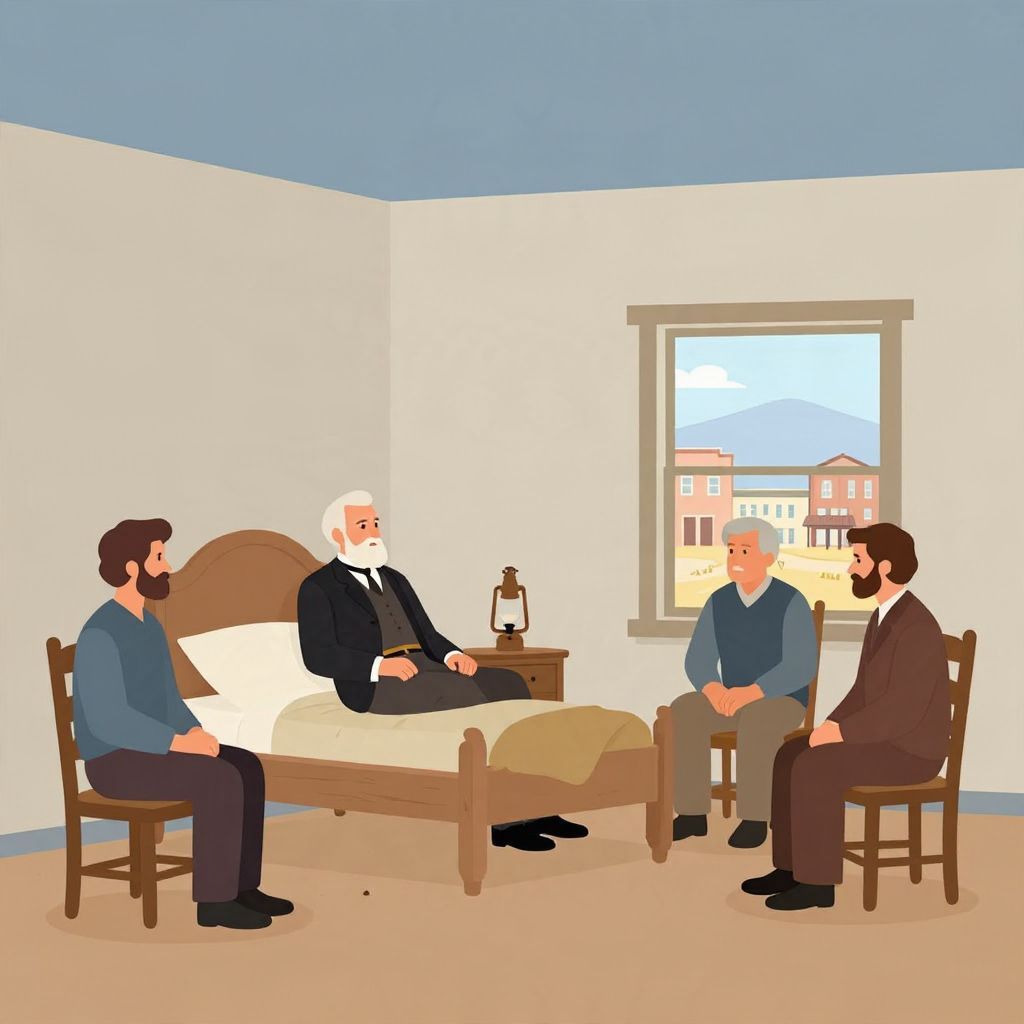
How did Brigham Young die? The short answer is that he died of a combination of illness and age-related decline on August 29, 1877, in Salt Lake City, Utah Territory. He was 76 years old. Historical accounts describe a final illness that left him weakened for days before his death, rather than a sudden accident or violent event.
Young’s death mattered because he was not only a major Latter-day Saint leader but also one of the central builders of Mormon settlement in the American West. His passing marked the end of an era in Utah history and raised important questions about succession, church authority, and the future of the community he had helped shape.
How did Brigham Young die?
Brigham Young died on August 29, 1877, in Salt Lake City after a brief but serious illness, likely involving intestinal inflammation and general physical decline associated with age. He had become ill in mid-August and grew steadily weaker. Contemporary reports do not point to violence or a single dramatic cause; instead, his death appears to have been the result of natural causes in an era before modern medical treatment.
What is known about his final days?
Young’s last illness developed over several days. By late August 1877, he was confined and under close attention from family and associates. Accounts from the period describe pain, weakness, and a worsening condition that ended in death at his Salt Lake City home. Because nineteenth-century medical diagnoses were often imprecise, historians usually avoid claiming a single definitive modern diagnosis.
What can be said with confidence is that his death was not unexpected in the sense of being sudden or mysterious. He was elderly by the standards of the time, had carried enormous physical and administrative burdens for decades, and had long been subject to the stresses of frontier leadership.
What caused Brigham Young’s death?
Most historical summaries describe Young’s death as caused by natural illness, probably involving a gastrointestinal or inflammatory condition, compounded by age. The exact medical label is less certain than the broad picture: he was an aging man whose body failed after a short final sickness. In 1877, physicians lacked the diagnostic tools that would make a precise modern cause of death possible.
Why historians are cautious about the diagnosis
Nineteenth-century death records and newspaper notices often used broad language such as “illness,” “debility,” or “inflammation.” Those terms can point to many conditions. Because of that, historians generally emphasize the documented sequence of decline rather than overstate certainty about a specific disease. The safest conclusion is that Young died of natural causes after a brief terminal illness.
This caution is important. Popular retellings sometimes try to pin historical deaths to a single dramatic cause, but responsible history distinguishes between what is documented and what is inferred. In Young’s case, the evidence supports natural death, not a sensational story.
Who was Brigham Young, and why was his death significant?
Brigham Young was the second president of The Church of Jesus Christ of Latter-day Saints and one of the most influential figures in nineteenth-century Mormon history. After the death of Joseph Smith in 1844, Young emerged as the leader who guided the Latter-day Saints westward and oversaw the establishment of a new center of settlement in the Great Basin.
He is closely associated with the migration to Utah, the organization of Mormon communities, the development of irrigation and settlement in arid country, and the building of a theocratic-style territorial society. His death therefore mattered far beyond one family or one congregation. It affected the leadership structure of a growing religious community and symbolized the closing of the pioneering phase of his rule.
Young’s role in Utah history
- He led the main Mormon migration to the Salt Lake Valley in 1847.
- He served as church president from 1847 until his death in 1877.
- He was territorial governor of Utah from 1851 to 1858.
- He helped shape settlement patterns, local governance, and church authority in the region.
Because of this, his death was not just the passing of a religious leader. It also marked a transition in the political and social life of Utah Territory, where church influence had been deeply tied to daily governance.
What happened after Brigham Young died?
After Young’s death, leadership passed through established church processes rather than through chaos. The presidency of the church was reorganized, and the Quorum of the Twelve Apostles played a central role in continuity. This was important because succession had been a major issue in Mormon history since Joseph Smith’s death in 1844.
The succession question
Young had spent decades strengthening institutional order so the church would not depend on one charismatic founder alone. His death tested that system. The fact that leadership continued without a major split in 1877 showed how much the church had matured organizationally since the crisis years of the 1840s.
That does not mean there were no tensions. Any major leadership transition invites uncertainty. But the broader historical outcome was stability, not collapse. Young’s death therefore demonstrated both the strength and the limits of the system he had helped build.
Did Brigham Young die peacefully?
By the standards of the time, Young’s death appears to have been relatively peaceful, though not painless. He experienced illness and decline, but there is no reliable evidence that he died in sudden distress or under violent circumstances. Family and associates were present, and the event was treated as the natural end of a long life.
It is worth remembering that “peaceful” in the nineteenth century did not necessarily mean comfortable by modern medical standards. Pain relief was limited, and even ordinary illnesses could be severe. Still, the historical record does not portray his death as chaotic or traumatic in the way some famous deaths were.
What myths or misunderstandings surround his death?
Like many major religious and political figures, Brigham Young has attracted myths, exaggerations, and highly partisan interpretations. Some stories about him focus on conflict, while others turn him into a near-legendary pioneer hero. When it comes to his death, however, the evidence is much less dramatic than the legends.
Common misunderstandings
- Myth: He died in a suspicious or violent event.
Reality: The historical record points to natural illness. - Myth: The exact modern medical cause is known with certainty.
Reality: The available evidence supports only a broad diagnosis of terminal illness and decline. - Myth: His death immediately destabilized Utah society.
Reality: His passing was significant, but institutional succession helped preserve continuity.
Separating evidence from legend is especially important in the history of Utah and the Latter-day Saint movement, where strong loyalties and strong criticisms have both shaped the way people remember the past.
Why does Brigham Young’s death still matter?
Brigham Young’s death matters because it helps explain the transition from a pioneer-led religious colony to a more established institutional church and territorial society. His life had been tied to migration, survival, and consolidation. His death forced the community to move from personal leadership to a more durable structure.
It also matters because it reminds us that historical turning points are often quiet. Not every major change comes with a battle or assassination. Sometimes the end of an era arrives through illness, aging, and the practical problem of who will lead next.
Broader historical significance
Young’s death came at a time when the American West was changing rapidly. Railroads, federal power, and new waves of settlement were transforming the region. The passing of such a dominant figure made room for a different kind of leadership, one that would have to navigate a more complex relationship with the United States government and a changing frontier society.
In that sense, his death was both personal and historical: the end of one man’s life, and the beginning of a new phase in the history of Mormon Utah.
Timeline of Brigham Young’s final days
- Mid-August 1877: Young becomes seriously ill in Salt Lake City.
- Late August 1877: His condition worsens; he is increasingly weak and confined.
- August 29, 1877: Brigham Young dies at age 76.
- Afterward: Church and territorial life continue under established leadership structures.
That sequence captures the essential historical facts without adding speculation. Young’s death was the final chapter in a long career that reshaped the Intermountain West.
So, how did Brigham Young die? He died of natural causes after a short illness and age-related decline in Salt Lake City in 1877. The significance of his death lies not in mystery, but in what followed: a leadership transition that helped define the future of the Latter-day Saint movement and the history of Utah. For more on historical figures and the ways their deaths shape memory, see related articles like how Marcus Garvey died and, for a very different kind of historical curiosity, how cockroaches got their name.