
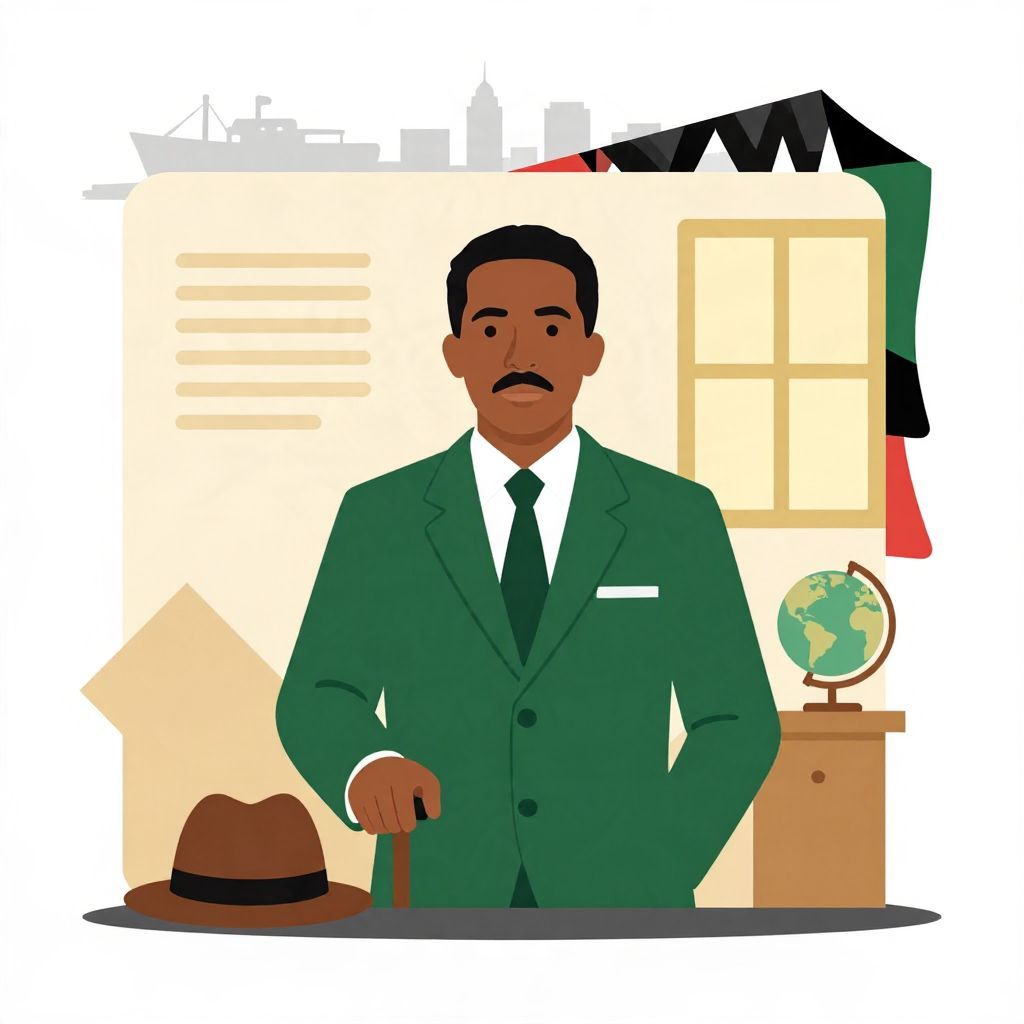
Marcus Garvey died on June 10, 1940, in London, England, at the age of 52. He suffered a stroke and had been in declining health for some time. His death ended the life of one of the most influential Black nationalist leaders of the 20th century, but his ideas continued to shape politics, identity, and anti-colonial movements long after he was gone.
Understanding how Marcus Garvey died also means understanding the difficult final chapter of his life: exile, illness, financial strain, and political isolation. His death was not the result of violence or assassination, though rumors and myths have sometimes surrounded his final years. The historical record shows a more ordinary but still significant end to an extraordinary life.
How Did Marcus Garvey Die?
Marcus Garvey died of complications related to a stroke on June 10, 1940, in London. By that time, he had been living in Britain after years of political conflict, legal trouble in the United States, and declining health. His death was natural, not a murder or political killing, though his life had been shaped by intense struggle and controversy.
What Happened in Marcus Garvey’s Final Years?
Garvey’s last years were marked by exile and reduced influence. After his conviction in the United States on mail fraud charges in the 1920s, he was imprisoned and later deported. He spent his final years in Britain, trying to remain active in politics and public life, but his health and circumstances made that increasingly difficult.
From global movement to exile
In the 1910s and 1920s, Garvey built the Universal Negro Improvement Association (UNIA) into a mass movement with international reach. He promoted Black pride, economic self-reliance, and Pan-African unity. But his rise also brought fierce opposition from critics, government officials, and rivals within Black political life.
After his legal troubles in the United States, Garvey’s public standing weakened. His deportation in 1927 forced him to rebuild his life abroad. He traveled and worked in various places, but he never regained the same level of influence he had enjoyed at the height of the UNIA.
Health problems and limited support
By the late 1930s, Garvey was no longer the commanding public figure he had once been. He faced financial difficulties and poor health, and he spent much of his final period away from the large audiences that had once filled his meetings. These conditions likely contributed to the stroke that ended his life in 1940.
Did Marcus Garvey Die in the United States?
No. Marcus Garvey died in London, England, not in the United States. Although he is often most closely associated with Harlem and the Black political world of the United States, his final years were spent in Britain after his deportation. That detail matters because it shows how international his life had become, even in decline.
Was Marcus Garvey Assassinated?
There is no reliable historical evidence that Marcus Garvey was assassinated. Some people have speculated about foul play because of the political hostility he faced during his life, but the established record indicates that he died from a stroke after years of worsening health. Historians generally treat assassination claims as unsupported rumor rather than fact.
This distinction is important. Garvey was certainly a controversial figure who attracted enemies and intense surveillance, but not every politically important death was violent. In his case, the evidence points to illness rather than conspiracy.
Why Marcus Garvey’s Death Matters
Garvey’s death matters because it closed the life of a man who helped redefine Black political imagination in the modern era. He was not simply a Jamaican nationalist or an American activist; he was a transatlantic figure whose ideas reached the Caribbean, North America, Africa, and beyond. His death did not end his influence.
A lasting influence on Black politics
Garvey’s emphasis on racial pride, self-determination, and economic independence inspired later movements in different ways. Some leaders admired his call for Black empowerment, while others criticized his methods or his politics. Even so, his ideas remained part of the wider conversation about Black liberation throughout the 20th century.
His legacy can be seen in several broad developments:
- Pan-Africanism, which linked African-descended peoples across national borders.
- Black nationalism, especially ideas about self-reliance and political autonomy.
- Anti-colonial thought, which grew stronger across Africa and the Caribbean after World War II.
- Cultural pride movements that challenged racist assumptions and celebrated Black identity.
Influence beyond his lifetime
Garvey’s movement did not survive intact after his death, but his ideas did. Later activists and intellectuals revisited his work, sometimes praising him as a visionary and sometimes criticizing his limitations. That mixed legacy is part of why he remains such an important historical figure.
He also became a symbol of the risks faced by charismatic political leaders who challenge established power. His career shows how movements can grow quickly, face repression, and then outlast their founders in altered forms.
Who Was Marcus Garvey?
Marcus Mosiah Garvey was born in Jamaica in 1887 and became one of the most prominent Black political thinkers of the early 20th century. He founded the UNIA and argued that people of African descent should build power through education, business, organization, and racial solidarity. His message reached millions, though not always in the same way or with the same support.
His rise to prominence
Garvey’s appeal came from his ability to speak to the frustrations and hopes of Black communities living under colonialism, segregation, and economic exclusion. He encouraged pride in African heritage and urged people to reject ideas of racial inferiority. For many listeners, his speeches offered dignity and purpose in a world structured against them.
At the same time, his movement was controversial. Critics questioned his business ventures, his leadership style, and some of his political claims. Government authorities also watched him closely, especially as his mass following grew. These tensions formed the backdrop to his later legal troubles and exile.
What Was the Cause of Death?
The cause of death most commonly given for Marcus Garvey is a stroke. Historical accounts describe him as having suffered a stroke in London, after which he died on June 10, 1940. While precise medical details from that era are not always as complete as modern records, the broad conclusion is well established.
It is also reasonable to say that his death came after a long period of strain. Years of political conflict, imprisonment, deportation, and instability likely took a toll on his overall health. Historians often treat such background conditions as part of the story, even if they are not the immediate medical cause of death.
Where Is Marcus Garvey Buried?
Marcus Garvey was initially buried in London. Later, his remains were moved to Jamaica, where he was reinterred with national honors. That repatriation reflected his importance not just as an activist, but as a major figure in Jamaican and wider Black history.
The movement of his remains also symbolizes the broader journey of his legacy: from local Jamaican roots to an international political presence, and finally to recognition as a historic figure whose influence extended far beyond his own lifetime.
How Historians View His Final Chapter
Historians generally see Garvey’s death as the end of a turbulent but highly consequential life. They do not usually treat it as a mystery. Instead, they focus on the contrast between the power of his movement in the 1920s and the relative isolation of his last years.
Why the myths persist
Myths about famous deaths often arise when the person was politically controversial or widely admired. Garvey fits that pattern. Because he inspired devotion and opposition in equal measure, some later admirers looked for hidden causes behind his death. But the documentary record supports a straightforward explanation: he died after a stroke, in exile, at a relatively young age.
That does not make the story less important. In some ways, it makes it more human. Garvey’s final years remind us that major historical figures can end their lives far from the public stage, even when their ideas continue to travel widely.
Conclusion
Marcus Garvey died of a stroke on June 10, 1940, in London, after years of political struggle, exile, and declining health. His death was natural, but his legacy was anything but ordinary. He remains one of the most influential Black leaders of the modern era, and his ideas still shape discussions of identity, self-determination, and Pan-African politics. For readers interested in related history, this story connects naturally with broader questions about Black nationalism and anti-colonial movements.