
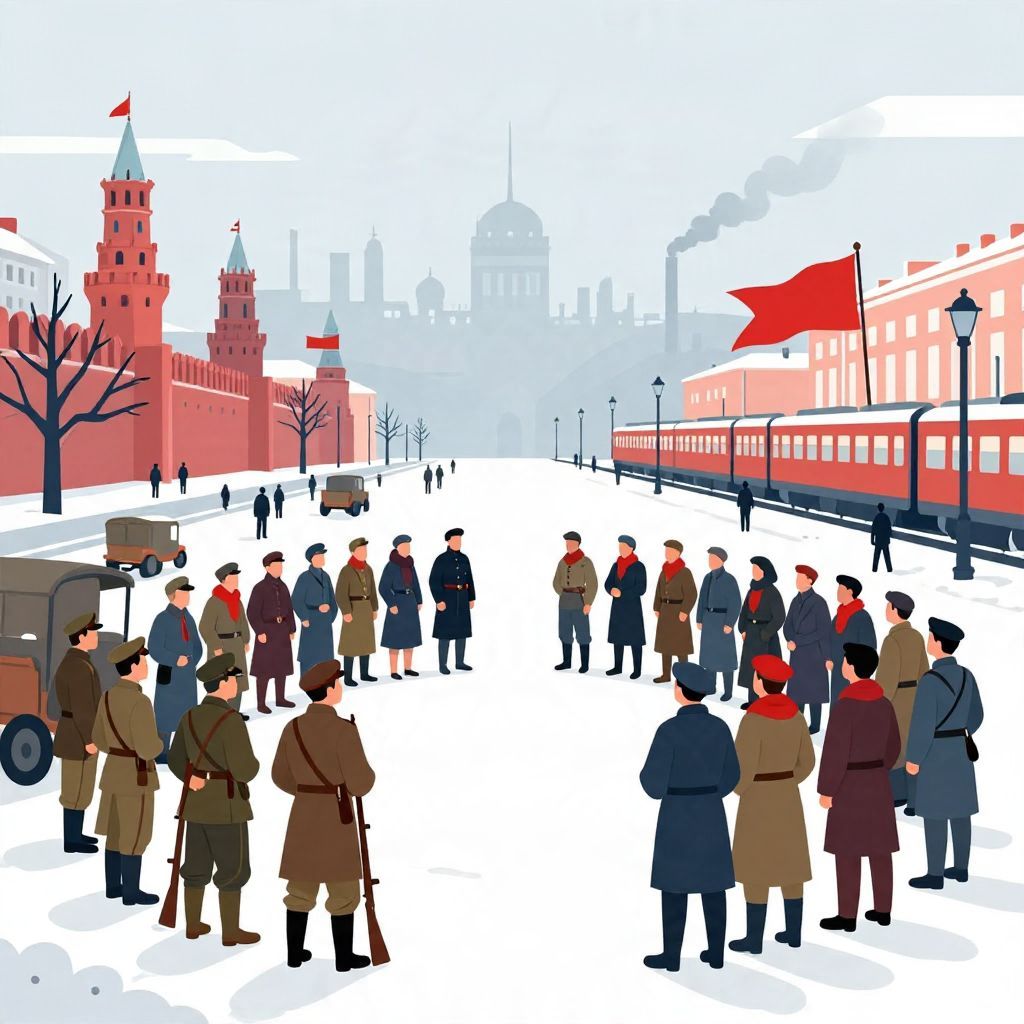
Why did Russia leave the war? The short answer is that Russia withdrew from World War I because revolution, military collapse, economic breakdown, and popular exhaustion made continuing the fight impossible. By early 1918, the new Bolshevik government believed peace was necessary to survive at home, even if it meant giving up huge territories and paying a heavy political price.
This decision was not sudden. It grew out of years of battlefield losses, shortages in the cities, and the collapse of faith in the Tsarist regime. Russia’s exit from the war reshaped both the Eastern Front and the Russian Revolution itself.
Why Did Russia Leave The War?
Russia left World War I because the country was unraveling from within. The army was exhausted, the economy was near collapse, food and fuel were scarce, and the government had lost legitimacy. After the Bolsheviks seized power in October 1917, they made peace with Germany to end the war quickly and secure their revolution.
The war had pushed Russia to the breaking point
Russia entered World War I in 1914 as part of the Allied Powers, fighting Germany and Austria-Hungary. At first, many Russians supported the war, but early defeats exposed deep weaknesses in the army and state. Russia’s industrial base was smaller than that of its enemies, its rail system was overstretched, and supply problems made it hard to arm and feed soldiers.
Military defeats and massive casualties
The Russian army suffered terrible losses in battles such as Tannenberg in 1914 and during the wider campaigns on the Eastern Front. By 1917, millions of soldiers had been killed, wounded, captured, or made ineffective by desertion and demoralization. The scale of loss weakened confidence in the monarchy and created a sense that the war could not be won.
Soldiers were often poorly equipped, short of ammunition, and moved around inefficiently because of logistical failures. As the war dragged on, many troops no longer believed they were fighting for a meaningful cause. Some simply wanted to go home, while others began to support revolutionary ideas.
Economic collapse and shortages at home
The war strained Russia’s economy far beyond its capacity. Transport networks broke down, inflation rose, and food shortages became severe in major cities. Workers faced long hours, low wages, and worsening living conditions, while peasants struggled with labor shortages because so many men had been drafted.
Urban unrest grew as bread became harder to find. Fuel shortages also disrupted factories and daily life. These hardships did not by themselves end Russia’s participation in the war, but they made the government increasingly unable to continue it.
The Tsarist regime lost control
The government of Tsar Nicholas II was widely blamed for the crisis. His decision to take personal command of the army in 1915 tied the monarchy more directly to military failure. Meanwhile, political leadership in Petrograd became unstable and ineffective, and public trust in the regime collapsed.
The February Revolution of 1917
In early 1917, protests over food shortages and war weariness erupted in Petrograd. Strikes and demonstrations spread, and soldiers eventually refused to suppress the unrest. Nicholas II abdicated in March 1917, ending centuries of Romanov rule. The Provisional Government that replaced the monarchy chose to keep Russia in the war, hoping to honor alliances and preserve national credibility.
That choice proved disastrous. The Provisional Government lacked authority, and its commitment to continuing the war made it deeply unpopular. Many Russians wanted peace more than victory. The longer the war continued, the more support the government lost.
The Bolsheviks promised peace
The Bolsheviks, led by Vladimir Lenin, understood that war fatigue had become one of the strongest political forces in Russia. Their slogans about “peace, land, and bread” were effective because they matched what many soldiers, workers, and peasants wanted most. When the Bolsheviks seized power in the October Revolution of 1917, ending the war became one of their first priorities.
Why peace mattered to the Bolsheviks
The Bolsheviks did not leave the war simply out of idealism. They believed that the new revolutionary government could not survive while fighting a devastating modern war. Lenin argued that peace was necessary to preserve Bolshevik rule and allow the revolution to continue. In practical terms, the army was too disorganized to keep fighting, and the state had too little authority to mobilize the population.
Many Bolsheviks hoped that a socialist revolution would soon spread to Germany and other countries, making harsh concessions temporary. That expectation did not come true, but it helps explain why they were willing to accept severe terms.
The Treaty of Brest-Litovsk ended Russia’s role in World War I
Russia formally left the war by signing the Treaty of Brest-Litovsk with the Central Powers on March 3, 1918. The treaty was extremely punitive. Russia gave up large areas of territory and influence, including lands that became part of or were claimed by Germany and its allies. The agreement removed Russia from the war, but at a very high cost.
What Russia lost
- Large territories in Eastern Europe and the western borderlands
- Important agricultural and industrial regions
- Political influence over areas that had belonged to the Russian Empire
- Prestige as a major European power
The treaty was controversial even among Bolsheviks. Some saw it as a humiliating surrender, but Lenin insisted that survival came first. He believed the revolution would be destroyed if the government tried to keep fighting.
Was Russia’s exit inevitable?
Historians generally agree that Russia’s withdrawal resulted from a combination of military, political, and social collapse rather than a single cause. The war exposed the weaknesses of the imperial state and accelerated revolutionary change. Once the monarchy fell, the new government inherited an impossible situation: a demoralized army, a broken economy, and a population that increasingly demanded peace.
Different historical interpretations
Some historians emphasize the structural weaknesses of the Russian Empire before 1914, arguing that the state was already vulnerable and the war merely sped up its collapse. Others stress the role of wartime leadership failures, especially Nicholas II’s decisions and the Provisional Government’s inability to restore order. A third view highlights the Bolsheviks’ political skill in turning war exhaustion into revolutionary support.
These interpretations are not mutually exclusive. Russia left the war because all these pressures converged at once.
The consequences of Russia leaving the war
Russia’s exit changed the course of both the war and Russian history. On the Eastern Front, Germany could shift troops westward, which briefly improved its position. But the larger consequence inside Russia was even more important: the Bolsheviks had traded territory for time, and they used that time to consolidate power during the Russian Civil War.
Effects on Russia
The peace settlement did not bring immediate stability. Instead, it deepened internal conflict. Many Russians opposed the Bolsheviks, and civil war followed. The country also faced foreign intervention, economic ruin, and prolonged violence. In that sense, leaving World War I did not end Russia’s suffering; it transformed it.
Effects on Europe
Russia’s withdrawal altered the balance of the war in 1918. It also helped define the postwar order in Eastern Europe, where borders and governments would be redrawn after the collapse of empires. The treaty was later nullified after Germany’s defeat, but the political upheaval it reflected did not disappear.
In summary: why Russia left the war
Russia left World War I because it could no longer sustain the fight. Battlefield defeats, economic breakdown, food shortages, and the collapse of the Tsarist regime made continued participation impossible. The Bolsheviks then chose peace at Brest-Litovsk to protect their revolution, even though the price was severe. Russia’s exit was therefore both a military retreat and a revolutionary turning point.
If you want to explore the wider context, you may also be interested in related history topics such as the Russian Revolution and World War I.