
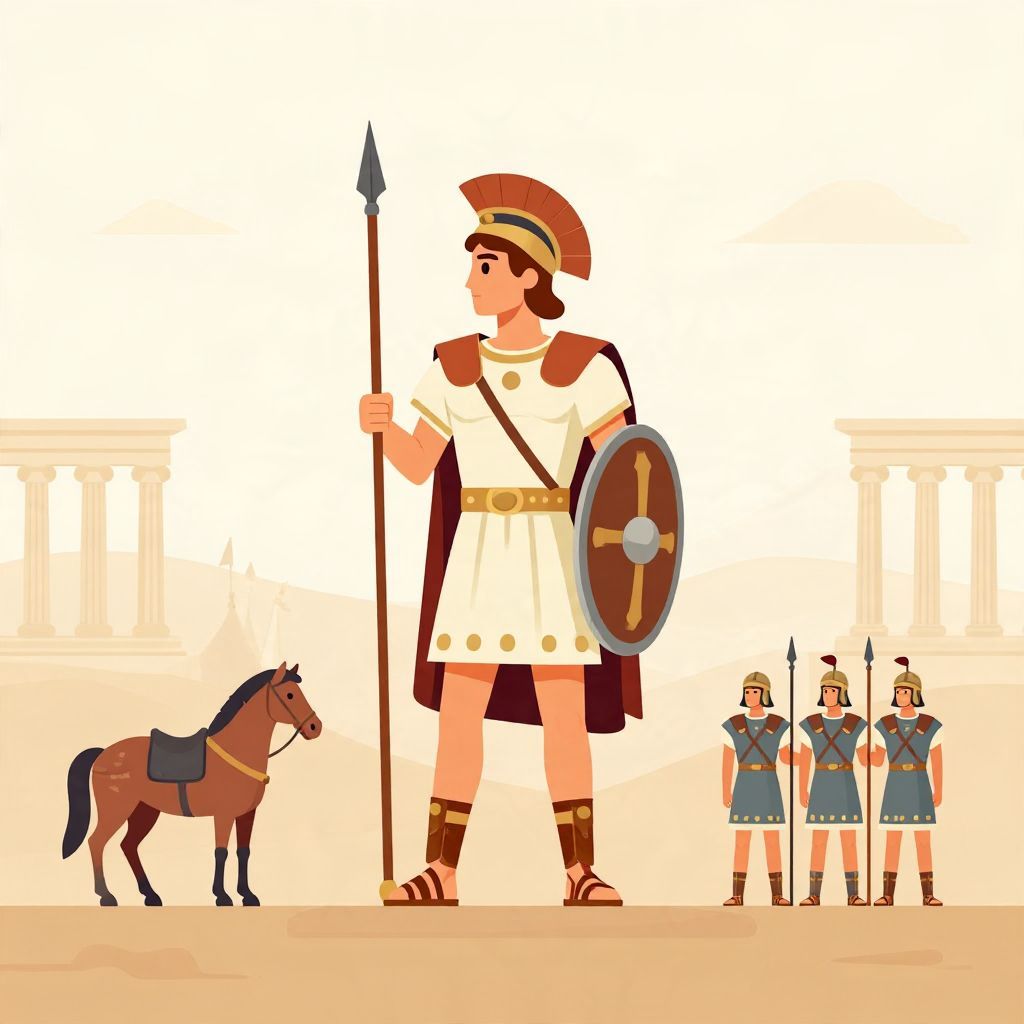
How tall was Alexander the Great? The honest answer is that no ancient source gives a reliable measurement, so his exact height is unknown. Historians can only estimate from the descriptions, portraits, and burial evidence that survive from antiquity.
What we can say with confidence is that Alexander III of Macedon was probably not unusually tall by modern standards. He was likely of average or slightly below-average height for a man of his time, though legends later made him seem larger than life in every sense.
How tall was Alexander the Great?
Alexander the Great’s exact height is unknown, but most historians think he was probably around average height for an ancient Macedonian man, likely somewhere near 5 feet 5 inches to 5 feet 8 inches. There is no surviving ancient record that gives a precise measurement, so any number is an informed estimate rather than a fact.
Why historians cannot give an exact number
Ancient writers were interested in Alexander’s conquests, character, and kingship, not in recording his body measurements. No surviving source says, “Alexander was X feet tall.” That means modern estimates depend on indirect evidence: artistic depictions, descriptions of his appearance, and what is known about the physiques of people in the ancient Mediterranean world.
Those clues are useful, but they are not exact. Sculptures and coins were often idealized. Later biographies also mixed historical memory with admiration, moral lessons, and legend. As a result, Alexander’s height remains a matter of cautious reconstruction, not certainty.
What the ancient sources actually say
Ancient writers describe Alexander as handsome, energetic, and physically striking, but they do not provide a dependable height. Some accounts emphasize his youthful face, his intense eyes, or his distinctive hair rather than his stature. These details helped build the image of a charismatic king, but they do not let us measure him precisely.
Descriptions of his appearance
Several ancient traditions portray Alexander as attractive and commanding, though not necessarily tall. He is often described with fair or reddish hair, a clean-shaven face, and a strong presence. The famous “upward gaze” seen in some portraits may suggest a dramatic style of representation rather than an exact likeness.
Because ancient authors focused on his leadership and achievements, they rarely paused to note ordinary physical measurements. This is one reason why modern discussions of Alexander’s height must rely on inference rather than direct testimony.
What his portraits and statues suggest
Surviving images of Alexander do not settle the question of his height. Coins, busts, and statues show him as idealized, youthful, and heroic. They were meant to communicate royal authority and divine favor, not to preserve a photographic record of his body.
The famous Alexander look
Artists often gave Alexander a distinctive swept-back hairstyle and a slightly tilted head. These features became part of his visual identity across the Hellenistic world. The style made him look dynamic and exceptional, but it does not tell us whether he was tall, short, or somewhere in between.
In the ancient world, rulers were frequently shown with enhanced beauty and dignity. Even when a portrait was based on a real person, it could still smooth away imperfections. So while Alexander’s images help us understand how he wanted to be seen, they do not provide a trustworthy ruler for his height.
Was Alexander short?
Probably not in the sense of being notably short for his society, but he was likely not exceptionally tall either. The popular idea of a very small Alexander comes more from later storytelling than from solid evidence. In fact, the surviving evidence points more toward an average-sized man than a tiny one.
Where the “short Alexander” idea comes from
Some later traditions and modern retellings have exaggerated Alexander’s size, sometimes to contrast his modest physical frame with his enormous ambitions. That literary pattern is common in historical storytelling: a great leader is made to seem physically unremarkable so that his achievements appear even more impressive.
But this is not the same as proof. Ancient biographers sometimes highlighted unusual physical traits when they wanted to build a moral portrait. If Alexander had been strikingly short, we would expect clearer and more consistent emphasis on that point in the sources. Instead, the evidence is vague.
How tall were men in Alexander’s world?
To estimate Alexander’s height, historians also look at average male stature in the ancient Greek and Macedonian world. Nutrition, disease, and living conditions generally made people shorter on average than many modern populations. A man of average height in the fourth century BCE would often seem shorter by today’s standards.
Helpful context for ancient height estimates
- Ancient diets were often less varied than modern diets.
- Childhood illness and physical labor could affect adult height.
- Military elites sometimes had better nutrition than ordinary people.
- Average height varied by region, class, and period.
Because of these factors, a modern estimate of Alexander at roughly 5 feet 5 inches to 5 feet 8 inches is plausible. That range is not a discovered fact, but it fits what historians know about ancient populations and the absence of evidence for an unusually tall ruler.
Why Alexander’s height matters less than his image
Alexander’s historical importance came from his military campaigns, political strategy, and the empire he built after 334 BCE, not from his physical size. Yet people have long been fascinated by how he looked because appearance often shapes the memory of leaders. A king’s body could be read as a symbol of legitimacy, strength, or divine favor.
Physical presence in ancient kingship
In the ancient Mediterranean, kings were expected to project authority in person. Height could matter socially, especially in public settings, but it was only one part of a ruler’s image. Courage, charisma, and battlefield success often mattered more than stature. Alexander’s reputation was built on speed, boldness, and personal leadership, which may have made his physical size seem less important to ancient audiences.
He also cultivated a larger-than-life persona. He led from the front, shared hardships with his troops, and presented himself as a conqueror of extraordinary destiny. That kind of image could make a man seem physically imposing even if he was not especially tall.
Legend, propaganda, and the making of Alexander
After Alexander’s death in 323 BCE, his memory quickly became the subject of competing stories. Successor rulers, later historians, and popular traditions all shaped his image for different purposes. Some emphasized his brilliance and heroism; others highlighted his excesses or human flaws. In that process, ordinary facts about his body were often less important than the symbolic Alexander people wanted to remember.
How myths grow around famous rulers
Famous conquerors often acquire exaggerated traits. They become taller, stronger, wiser, or more monstrous in later retellings. Alexander is a classic example. Over time, he was transformed from a historical Macedonian king into a world-conquering legend whose life seemed almost beyond ordinary human limits.
That is why questions like “How tall was Alexander the Great?” are so difficult. The more famous the figure, the more likely later storytellers are to reshape the details. Height becomes part of the mythmaking process, even when the original evidence is thin.
So what is the best historical answer?
The best answer is that Alexander the Great was probably of average or slightly below-average height for his time, and likely somewhere around 5 feet 5 inches to 5 feet 8 inches. No ancient source confirms an exact number, so any precise figure should be treated as an estimate, not a documented fact.
In other words, Alexander was not remembered because he was physically towering. He was remembered because he conquered an empire, reshaped the ancient world, and became one of history’s most enduring figures. His height remains uncertain, but his historical stature is beyond doubt.
Conclusion
Alexander the Great’s exact height is lost to history, but the evidence suggests a man of ordinary ancient stature rather than a giant or a dwarf. The real story is not his measurement in inches, but how a Macedonian king born in the fourth century BCE became a figure whose legend outgrew the facts. For more on his life and image, see what Alexander the Great looked like and where Alexander the Great was born.