
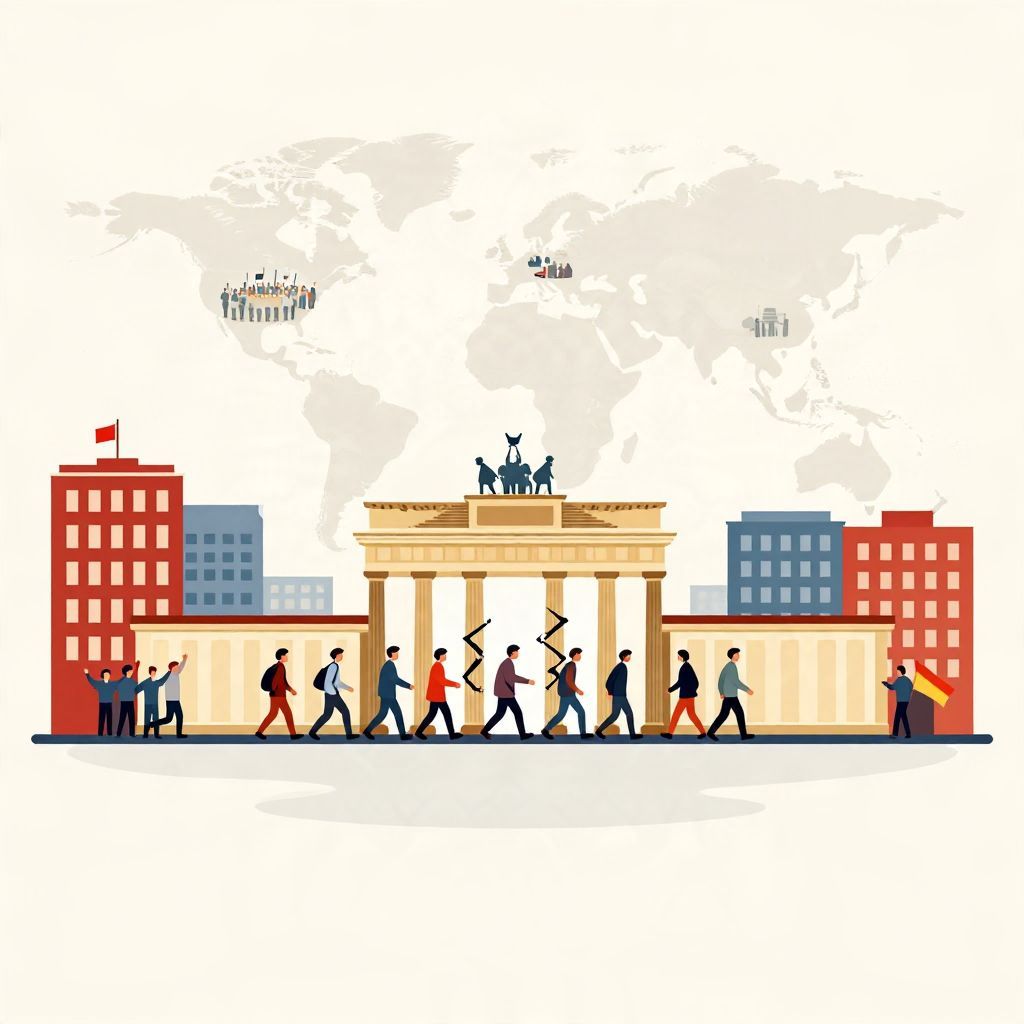
What happened in 1989? In historical terms, 1989 was a turning point year in which the late Cold War order began to break apart. Revolutions spread across Eastern Europe, the Berlin Wall fell, and long-standing communist governments lost their grip on power. At the same time, major events in China, Panama, and the Americas showed that the year’s upheavals were global, not just European.
The result was not one single event, but a chain of political, social, and cultural changes that reshaped the end of the 20th century. Many historians see 1989 as the year the postwar world order began to transform into something new.
What happened in 1989?
In 1989, communist rule collapsed across much of Eastern Europe, the Berlin Wall opened, and the Cold War began its final phase. The year also saw the Tiananmen Square crackdown in China, the U.S. invasion of Panama, and major changes in global politics, media, and culture. It was a year of protest, reform, and rapid historical change.
Why 1989 mattered so much
1989 mattered because it exposed how fragile many authoritarian systems had become. Economic stagnation, public frustration, reform movements, and pressure from ordinary citizens all converged. In the Soviet bloc, leaders who once seemed secure were forced to negotiate, retreat, or fall. The pace of change was so fast that events often outstripped governments’ ability to respond.
It is important, however, not to treat 1989 as a single neat “end point.” The collapse of communist governments did not mean instant democracy or prosperity everywhere. Some countries moved quickly toward elections and market reforms, while others faced instability, violence, or delayed transitions.
1989 timeline of major events
Here is a concise chronology of some of the year’s most significant developments:
- January 1989: Reform pressures continued across the Soviet bloc as governments struggled with economic weakness and public dissatisfaction.
- February 1989: Soviet forces completed their withdrawal from Afghanistan, marking an important retreat from a costly war.
- April–June 1989: Protests grew in China, culminating in the Tiananmen Square crackdown in early June.
- June 1989: Poland held semi-free elections, and Solidarity won a sweeping victory, opening the door to non-communist government.
- Summer and autumn 1989: Protest movements spread through Hungary, East Germany, Czechoslovakia, Bulgaria, and other states.
- 9 November 1989: The Berlin Wall opened after a confusing announcement by East German officials triggered crowds to the border crossings.
- December 1989: A revolution in Romania overthrew Nicolae Ceaușescu, one of the most violent ends to communist rule in Eastern Europe.
The fall of communist governments in Eastern Europe
Poland and the rise of Solidarity
Poland was one of the first and most important breakthroughs of 1989. The independent trade union Solidarity, led by figures such as Lech Wałęsa, had survived years of repression. In 1989, negotiations between the government and opposition produced partially free elections. The results showed overwhelming support for Solidarity, proving that communist parties could lose real political authority when voters were given a choice.
Hungary opens the door
Hungary played a key role in the wider collapse. Reform-minded leaders dismantled parts of the old system, legalized political change, and helped create conditions for a more open society. Hungary’s decision to loosen border controls also had consequences beyond its own territory, because it made it easier for East Germans to leave for the West through neighboring countries.
East Germany and the Berlin Wall
East Germany became the symbolic center of 1989. For decades, the Berlin Wall had stood as the most visible sign of Europe’s division. By autumn, mass demonstrations in cities such as Leipzig showed that public pressure was growing beyond what the state could contain. On 9 November, a mistaken or poorly communicated announcement about travel rules led crowds to border crossings, where guards eventually opened the gates. The Wall’s fall became the defining image of the year.
The opening of the Wall did not instantly solve Germany’s political future, but it made reunification possible. It also signaled that Soviet-backed control in Eastern Europe was no longer guaranteed.
Czechoslovakia, Bulgaria, and Romania
Other Eastern European states changed rapidly as well. In Czechoslovakia, peaceful mass protests helped bring down the communist government in what became known as the Velvet Revolution. Bulgaria saw leadership change from within the ruling party. Romania’s transition was far more violent: protests escalated into revolution, and Nicolae Ceaușescu was overthrown and executed after a rapid collapse of authority in December 1989.
These changes were not identical. Some were negotiated, some were peaceful, and some were bloody. Together, they showed that the old communist order in Eastern Europe was disintegrating from several directions at once.
The Tiananmen Square crackdown in China
While Eastern Europe moved toward liberalization, China followed a very different path. In spring 1989, students and other protesters gathered in Beijing and other cities, demanding political reform, anti-corruption measures, and greater openness. The movement centered on Tiananmen Square, where demonstrations grew for weeks.
In early June, the Chinese government used military force to clear the area. The crackdown caused many deaths, though the exact number remains disputed and is still politically sensitive. What is clear is that the state chose repression over negotiation. The event had lasting consequences for Chinese politics, tightening control while also reinforcing the government’s determination to preserve one-party rule.
Tiananmen is often discussed alongside the revolutions in Eastern Europe because it showed both the possibilities and the limits of protest in 1989. The year did not produce the same outcome everywhere.
Other major international events in 1989
The U.S. invasion of Panama
In December 1989, the United States invaded Panama in Operation Just Cause, aiming to remove General Manuel Noriega, who had become a major political and criminal liability for the Panamanian state and for U.S. interests. Noriega was captured, and the invasion installed a new political order. Supporters argued the action restored stability and protected the Panama Canal; critics saw it as a powerful example of U.S. interventionism.
The Soviet Union’s retreat from Afghanistan
Earlier in the year, Soviet troops completed their withdrawal from Afghanistan after a long and costly war. The withdrawal did not bring immediate peace to Afghanistan, but it marked a major strategic setback for Moscow. It also symbolized the Soviet Union’s reduced willingness and ability to sustain overseas military commitments.
Changes in Latin America and elsewhere
1989 also fit into a wider pattern of political change in Latin America, where military rule had already weakened in several countries during the 1980s. Across the world, the year reflected a broader shift toward elections, reform, and new political alignments, even if those changes were uneven and incomplete.
How 1989 changed the Cold War
The Cold War did not end overnight in 1989, but the year made its continuation in the old form very difficult. The Soviet Union under Mikhail Gorbachev had already introduced reforms such as glasnost and perestroika, which loosened censorship and attempted economic restructuring. Those reforms were meant to strengthen socialism, but they also weakened the state’s control over events.
By 1989, the Soviet leadership was less willing than earlier rulers to send tanks to preserve communist governments in Eastern Europe. That restraint mattered enormously. Once people realized Soviet intervention was unlikely, opposition movements gained confidence, and local regimes lost one of their most important sources of support.
As a result, 1989 is often seen as the beginning of the end of the Cold War division of Europe. The process continued into 1990 and 1991, culminating in German reunification and the dissolution of the Soviet Union.
Social and cultural atmosphere in 1989
Beyond politics, 1989 was part of a broader late-20th-century cultural shift. Television, global news coverage, and increasingly connected media made it possible for people around the world to watch events unfold in near real time. Images of crowds at the Berlin Wall or protesters in Beijing became instantly recognizable symbols.
The year also reflected changing attitudes toward authority, censorship, and public expression. In many places, people were demanding more freedom of speech, more accountability, and more participation in political life. Even where governments resisted, the pressure for openness had become impossible to ignore.
The aftermath of 1989
The aftermath of 1989 was profound. Eastern Europe moved toward democratic elections and market economies, though the transition was often painful. Some countries experienced unemployment, inflation, or political instability during the 1990s. Germany reunified in 1990, reshaping European politics. The Soviet Union itself collapsed in 1991, confirming that 1989 had been the opening act of a much larger transformation.
At the same time, the year’s legacy remains debated. Some view 1989 as a triumph of freedom and nonviolent protest. Others emphasize the social costs of rapid transition, the uneven spread of democracy, and the fact that authoritarian rule survived in some places. Both views are historically important. The year was not a simple victory story, but a dramatic turning point with lasting consequences.
Conclusion
What happened in 1989 was the collapse of an old political order and the beginning of a new global era. From Poland to Berlin, from Beijing to Panama, the year brought revolutions, crackdowns, and decisive shifts in power. If you want to explore more context around late Cold War change, you may also find What Happened In 1989 and Is 1984 Banned In The US? useful starting points.