
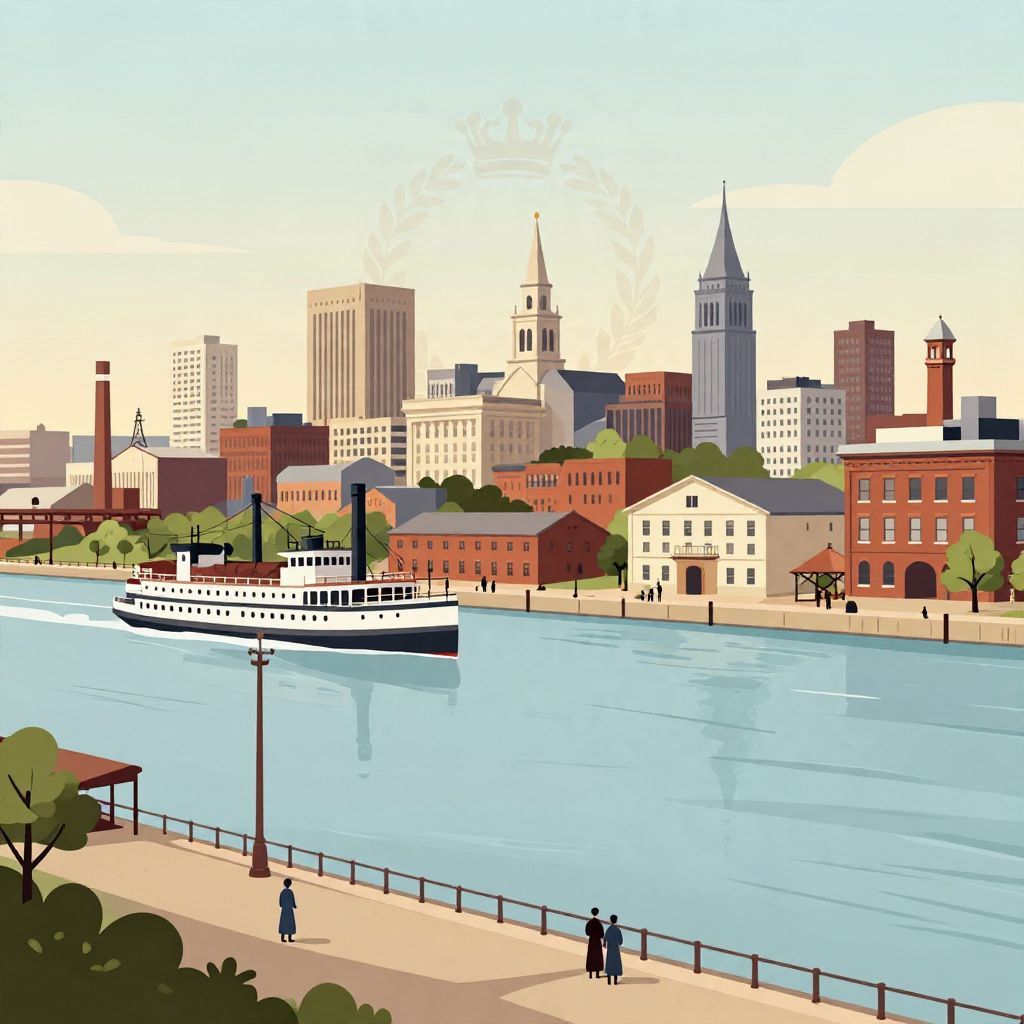
Why is Cincinnati called the Queen City? The short answer is that the nickname grew out of the city’s rapid 19th-century rise as a major river port and commercial center. By the 1820s and 1830s, Cincinnati was one of the fastest-growing cities in the American West, and writers and residents used “Queen City” to express both admiration and civic pride.
The name was not a royal title in the literal sense. It was a flattering way to say that Cincinnati stood above other towns in the region, much as a queen stands above a court. Over time, the nickname stuck, even as the city’s economy, population, and identity changed.
Why is Cincinnati called the Queen City?
Cincinnati is called the Queen City because in the early 19th century it was seen as the leading city of the Ohio Valley and one of the most important urban centers west of the Appalachians. The nickname reflected its size, prosperity, and cultural ambition rather than any official designation. It became a popular way to praise Cincinnati’s prominence and beauty.
The rise of Cincinnati in the early 1800s
Cincinnati’s nickname makes sense only in the context of its explosive growth. Founded in 1788 and first known as Losantiville, the settlement was renamed Cincinnati in 1790. Its location on the Ohio River made it a natural hub for trade, migration, and transportation. By the early 1800s, steamboats, river commerce, and nearby agricultural production helped turn it into a thriving city.
In an era when the United States was pushing westward, Cincinnati became a gateway between the East and the interior. It attracted merchants, artisans, immigrants, and entrepreneurs. Its growth was so striking that visitors often described it as unusually advanced for a western town. That sense of distinction helped produce the “Queen City” label.
A city that seemed to lead the West
In the decades before the Civil War, Cincinnati was among the largest cities in the United States. It developed industries such as meatpacking, milling, printing, and manufacturing, and it became an important center of culture and education as well. Newspapers, churches, theaters, and civic organizations gave the city a polished reputation that set it apart from many frontier communities.
“Queen City” captured this combination of economic power and refinement. The nickname suggested not just size, but leadership. Cincinnati was not merely another river town; it was a city that many people believed represented the future of the American interior.
Where did the nickname come from?
The exact origin of the phrase is difficult to pin down to a single person or date. Like many city nicknames, it appears to have developed gradually through newspaper usage, local speech, and outside commentary. By the 1830s and 1840s, “Queen City” was already in circulation as a description of Cincinnati, though the phrase was not unique to it. Other cities in the United States also claimed the same nickname at different times.
That matters because “Queen City” was not an official title bestowed by a government or monarch. It was a popular honorific. In the 19th century, Americans often used regal language to describe prosperous cities, especially when they wanted to emphasize elegance, leadership, or regional importance.
Why “queen” and not “king”?
The word “queen” in city nicknames often carried a sense of grace, prominence, and centrality. A queen was imagined as the most splendid figure in a realm, and the city that bore the title was meant to appear similarly distinguished. The phrase also fit the period’s habit of personifying cities as female figures, a common feature of civic language in the 19th century.
In Cincinnati’s case, the nickname likely appealed because it sounded both dignified and affectionate. It praised the city without making the claim overly formal or political.
How the nickname reflected Cincinnati’s 19th-century identity
Cincinnati’s reputation in the 1800s was built on more than commerce. The city was known for its cultural energy, its schools and libraries, and its role as a center of reform and innovation. It was also a major stop for immigrants, especially German immigrants, who helped shape its neighborhoods, businesses, and institutions.
This mix of industry and culture made Cincinnati feel unusually sophisticated for a city in the interior of the country. For many observers, it represented a successful blend of frontier opportunity and urban refinement. The nickname “Queen City” expressed that blend in a compact, memorable phrase.
The Ohio River and economic power
The Ohio River was central to Cincinnati’s rise. Before the dominance of railroads, rivers were the great highways of commerce. Goods could move efficiently by boat, and cities on navigable waterways often grew faster than inland settlements. Cincinnati benefited from this geography in a major way.
The city’s location also connected it to the broader Mississippi River system, linking local production to national markets. This made Cincinnati an economic heavyweight in the early republic and antebellum period. A city with that kind of influence was likely to acquire a proud nickname.
Was Cincinnati the only Queen City?
No. Cincinnati is one of several American cities that have been called the Queen City. The nickname was popular in the 19th century and could be applied to any city seen as especially important or elegant. Charlotte, North Carolina, for example, also became known as the Queen City, though for different historical reasons and in a different era of growth.
Because the phrase was not exclusive, its meaning depended on local context. When used for Cincinnati, it pointed to the city’s early prominence in the Midwest and Ohio Valley. The same words could mean something slightly different in another place.
Why the nickname endured in Cincinnati
Some city nicknames fade when the conditions that inspired them disappear. Cincinnati’s did not, partly because it remained a strong regional center and partly because residents embraced the name as part of civic identity. Over time, “Queen City” became less a claim about ranking and more a symbol of heritage.
That endurance matters. Even after Cincinnati was no longer the undisputed industrial giant of the region, the nickname continued to evoke a period when the city believed itself to be at the forefront of American urban development.
Popular legend versus historical evidence
There are several colorful stories about how Cincinnati got its nickname, but historians should be cautious about treating them as settled fact. The most reliable explanation is broad and historical rather than tied to one dramatic moment: the city earned the title because it was widely admired as a leading and graceful urban center in the early 19th century.
That does not mean every local story is false. It means the nickname likely emerged through repeated use rather than a single official naming event. In city history, that is often how nicknames develop. They begin in conversation, journalism, and civic boosterism, then harden into tradition.
What we can say with confidence
- Cincinnati was founded in the late 18th century and grew rapidly in the early 19th century.
- Its river location made it a major commercial center in the Ohio Valley.
- The nickname “Queen City” reflected admiration for its size, prosperity, and status.
- The phrase was not unique to Cincinnati, but it became strongly associated with the city.
- The nickname survived because it became part of Cincinnati’s civic identity.
Why the nickname still matters today
Today, “Queen City” is more than a historical curiosity. It connects modern Cincinnati to the ambitions of its 19th-century residents, who saw their city as a place of progress and importance. The nickname preserves a memory of the period when Cincinnati was one of the most dynamic cities in the United States.
It also shows how cities build identity through language. A nickname can capture geography, economics, pride, and aspiration all at once. In Cincinnati’s case, “Queen City” reflects the moment when a river town became a major urban power and wanted the world to notice.
So, why is Cincinnati called the Queen City? Because in the early 1800s it stood out as the dominant, refined, and fast-growing city of its region, and people used regal language to honor that status. The nickname endured because it still sums up a defining chapter in the city’s history. For more on city nicknames and their origins, see why Boston is called Beantown and broader examples like what makes a city the “City of Love”.