
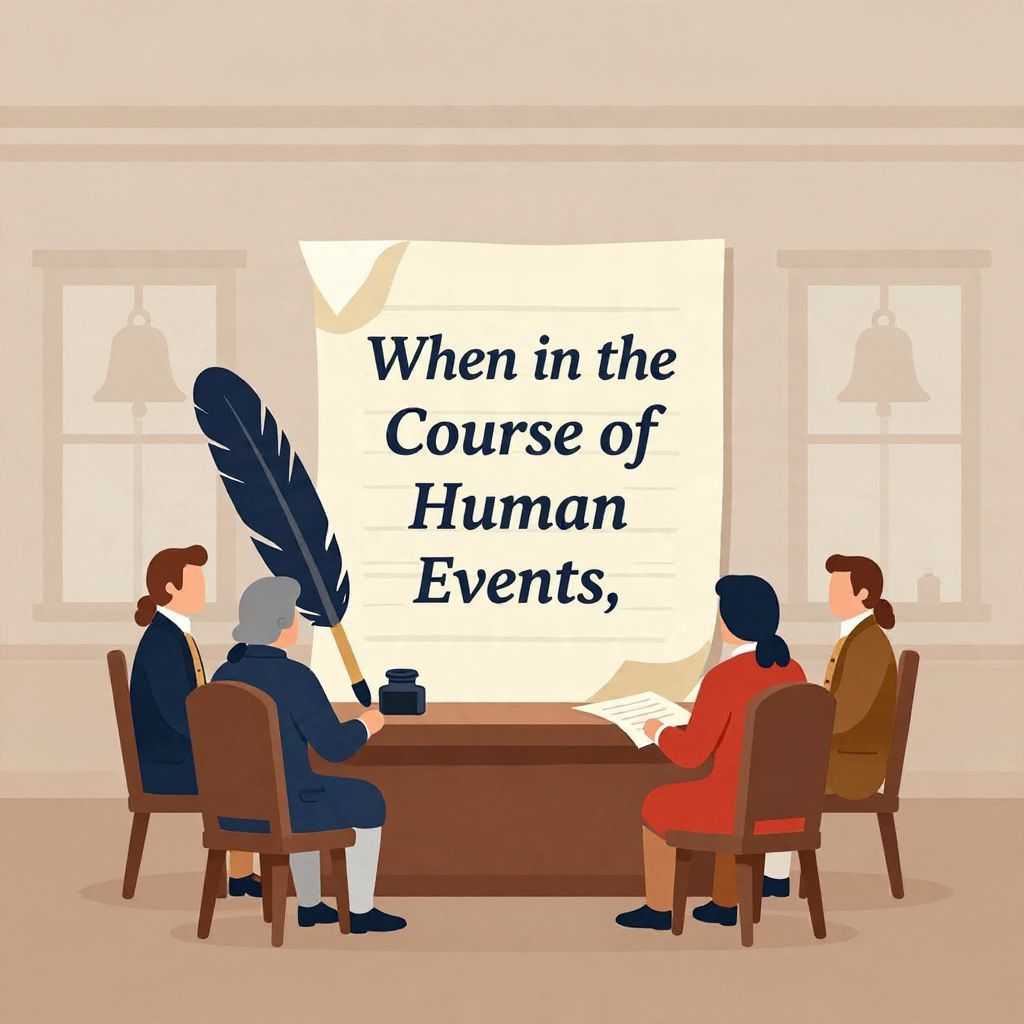
“When in the course of human events” is one of the most famous openings in American political history. It begins the Declaration of Independence, the document adopted by the Continental Congress on July 4, 1776, to explain why the American colonies were breaking away from Great Britain.
The phrase is not just a literary flourish. It introduces a carefully argued statement about natural rights, government, and the right of a people to alter or abolish a political system they believe has become destructive of those rights.
When in the course of human events: what does the phrase mean?
“When in the course of human events” means “at a point in the unfolding of history.” In the Declaration, it signals that the colonies believed a major political turning point had arrived. The phrase leads into a formal argument that independence was justified because the British government had violated the colonists’ rights and failed in its duties.
Where does the phrase come from?
The phrase comes from the opening paragraph of the Declaration of Independence, drafted mainly by Thomas Jefferson in June 1776 and approved by the Continental Congress on July 4, 1776. It is part of the document’s elegant, formal style, which reflects both Enlightenment political thought and the legal language of the 18th century.
The Declaration was not the first step toward independence, but it was the most important public explanation of it. By the summer of 1776, fighting between Britain and the colonies had already been underway for more than a year. The Declaration gave that conflict a political meaning and a moral justification.
Why was the Declaration written?
The Declaration was written because the colonies and Britain had moved from protest to open conflict. After years of disputes over taxation, representation, imperial authority, and military force, many colonial leaders concluded that reconciliation was no longer possible. The document was meant to explain to the world why separation was necessary.
It also served a practical purpose. Independence was a dangerous step. The colonies needed to persuade their own people, potential allies abroad, and skeptical observers that they were not simply rebelling out of anger. They were claiming a right to self-government based on principles they believed were universal.
Key background to the break with Britain
- 1760s: Britain imposed new taxes and administrative measures after the Seven Years’ War.
- 1770: Tensions deepened after confrontations such as the Boston Massacre.
- 1773: The Boston Tea Party triggered harsher British retaliation.
- 1774: The Coercive Acts, called the Intolerable Acts by many colonists, increased resistance.
- 1775: Fighting began at Lexington and Concord, and war spread.
- 1776: Independence became the central political goal for many revolutionaries.
The historical meaning of the opening line
The opening line is best understood as a formal preface to an argument. It does not mean “once upon a time” in a casual sense. Instead, it frames independence as something that occurs when historical conditions have reached a critical point. The phrase suggests that political events have consequences and that history can create moments when change becomes necessary.
In the Declaration, that idea leads directly to one of the most famous principles in political history: when a government becomes destructive of the rights of the people, the people may alter or abolish it and establish a new one. This was a radical claim in 1776, even though it drew on familiar Enlightenment ideas about consent and natural rights.
The Declaration’s larger argument
The Declaration is usually remembered for its opening and for the line about “life, liberty and the pursuit of happiness,” but its structure matters. It begins with a universal principle, explains the rights of human beings, describes the abuses of King George III, and then declares the colonies independent.
How the document is organized
- Introduction: Explains why a people may declare independence.
- Statement of principles: Asserts equality and natural rights.
- List of grievances: Charges the king with repeated abuses.
- Declaration: Announces that the colonies are “free and independent States.”
This structure made the Declaration more than a political announcement. It was a justification, a legal-style indictment, and a statement of national identity all at once.
Who wrote it, and how much was Jefferson’s work?
Thomas Jefferson was the principal drafter, but the Declaration was not written by him alone. The Continental Congress appointed a committee that included Jefferson, John Adams, Benjamin Franklin, Roger Sherman, and Robert Livingston. Jefferson prepared the initial draft, and Congress edited it before adoption.
Scholars generally agree that Jefferson wrote the core draft, while Congress revised parts of it and removed or altered some passages. The final text is therefore both Jefferson’s and the Continental Congress’s. That distinction matters because the Declaration was intended to represent a collective political decision, not just one man’s philosophy.
What did the phrase mean in 1776?
For readers in 1776, the phrase would have sounded formal and elevated, not mysterious. It reflected the style of legal petitions, political essays, and state papers of the period. The colonists were making the case that history had reached a decisive moment in which old ties could no longer stand.
The phrase also reflects a broader revolutionary mindset. Many Americans believed they were living through an extraordinary historical rupture. They were not simply changing rulers; they were claiming the right to found a new political order.
Was the Declaration the start of American independence?
Not exactly. Independence was a process, not a single instant. By the time the Declaration was adopted, many colonies had already moved toward separation through local governments, military conflict, and political resolutions. The Declaration formalized and unified that movement.
In that sense, “when in the course of human events” marks a culmination rather than an origin. It announces that a long chain of events had brought the colonies to a point where independence seemed both necessary and justified.
Why the opening line became so famous
The phrase became famous because it opens one of the most influential political documents in world history. The Declaration has been read as a statement of American independence, a defense of popular sovereignty, and a general argument for human rights. Its opening line captures the seriousness of that moment in a memorable way.
It also survives because it sounds timeless. The words are tied to a specific revolution, but they speak broadly about history, government, and change. That combination has helped the phrase endure in classrooms, speeches, and public memory.
Common misconceptions about the phrase
Some people assume the phrase is a quotation from a famous speech or a Bible verse. It is not. It is the opening of the Declaration of Independence itself. Others think it is merely decorative language, but it actually introduces the document’s central political claim.
Another misconception is that the Declaration created American independence by itself. In reality, independence was already being fought for and debated. The Declaration gave that struggle a formal, public, and international voice.
Why the phrase still matters
The importance of “when in the course of human events” lies in its historical and political meaning. It marks a moment when a group of people claimed the right to judge their government and to establish a new one. That idea influenced later democratic movements in the United States and beyond.
At the same time, historians note that the ideals of the Declaration were not applied equally in 1776. Enslaved people, Native nations, women, and many others were excluded from the political rights the founders celebrated. That tension between principle and practice is central to understanding the document’s legacy.
Historical takeaway
“When in the course of human events” is the opening of the Declaration of Independence, adopted on July 4, 1776, and it introduces a revolutionary argument about rights, government, and the legitimacy of independence. The phrase endures because it captures a moment when history, politics, and ideals converged. For more on the era that followed, see what the Northwest Ordinance was and why the Articles of Confederation were replaced with the Constitution.