
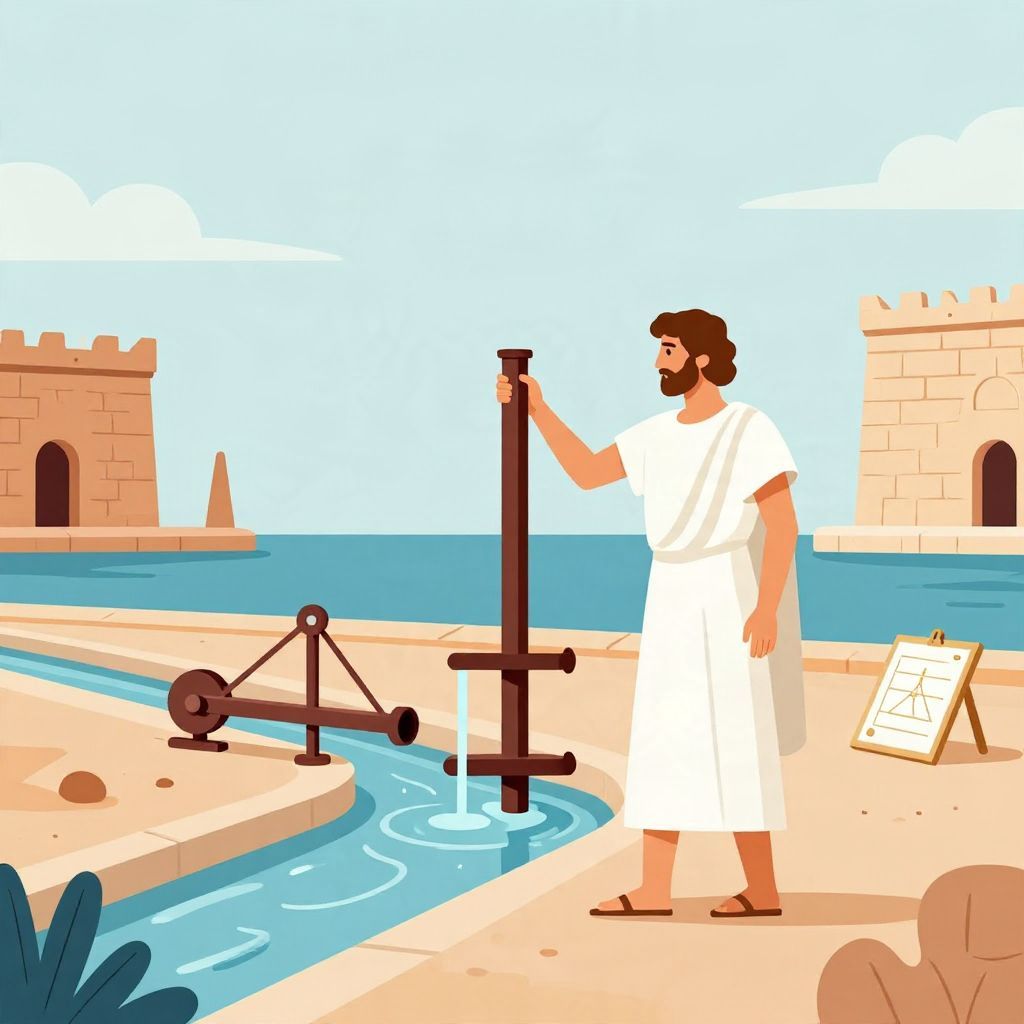
What did Archimedes invent? The short answer is that Archimedes of Syracuse did not leave behind a neat list of patented inventions in the modern sense. He was a Greek mathematician, engineer, and natural philosopher whose work produced several famous devices and methods, some real and some later exaggerated by legend.
He is best known for practical machines such as the Archimedes screw, advanced war engines, and ingenious mechanical principles, along with major discoveries in mathematics and physics. Because ancient evidence is uneven, historians separate what is well attested from what later tradition added to his reputation.
What Did Archimedes Invent?
Archimedes invented or improved several important devices and methods, including the Archimedes screw for lifting water, sophisticated siege engines for defending Syracuse, and mechanical principles that influenced later engineering. He also developed mathematical techniques for measuring area, volume, and buoyancy, though not every famous story about him is securely historical.
The Historical Archimedes: Who He Was
Archimedes lived in the 3rd century BCE, probably from about 287 BCE to 212 BCE. He was born in Syracuse, a Greek city on Sicily, then part of a wider Mediterranean world shaped by Hellenistic kingdoms after Alexander the Great. Much of what we know about him comes from later writers, especially Plutarch, Polybius, and Vitruvius, so some details are clearer than others.
He was not simply a “mad inventor” of legend. He was a serious scholar whose work moved between theory and practice. In antiquity, mathematics, astronomy, mechanics, and engineering were closely connected, and Archimedes excelled in all of them. That is why his name became attached to both elegant proofs and practical machines.
Archimedes’ Most Famous Invention: The Archimedes Screw
The invention most commonly linked to Archimedes is the Archimedes screw, a helical device used to raise water from a lower level to a higher one. It is usually described as a screw inside a hollow cylinder, turned by hand or by a mechanism so that water is trapped and carried upward.
This device is traditionally associated with Archimedes’ travels in Egypt, where water-lifting technology was essential for irrigation and drainage. The exact origin is debated: Archimedes may have invented it, improved an existing idea, or popularized a form already known in the ancient world. What is clear is that the device became strongly associated with his name and remained useful for centuries.
Why the screw mattered
The Archimedes screw solved a practical problem in agriculture, mining, and drainage. It offered a relatively simple way to move water without relying on complex machinery. Its long life is part of its historical importance: the same basic principle is still used in modern pumps, hydroelectric systems, and wastewater management.
His War Machines for Syracuse
Archimedes is also famous for designing defensive machines during the Roman siege of Syracuse in 214–212 BCE. Ancient sources say he created catapults, stone-throwers, and devices that helped the city resist Roman attack for a time. These were not “inventions” in the modern consumer sense, but they were impressive refinements of military engineering.
According to ancient accounts, his machines could hurl projectiles at different ranges and may have been adjusted for varying battlefield conditions. Some stories go further, describing cranes or claws that lifted Roman ships out of the water or capsized them. Historians treat those dramatic accounts cautiously: they may reflect real defensive mechanisms, later embellishment, or both.
What is likely true
- Archimedes probably designed advanced catapults and siege engines for Syracuse.
- His machines likely used careful calculations of force, angle, and tension.
- Roman writers remembered them as unusually effective and frightening.
- Some spectacular details, such as ships being “snatched” from the sea, are harder to verify.
Did Archimedes Invent the Lever?
Archimedes did not invent the lever itself; levers were known long before him. What he did was explain their mechanics with exceptional clarity. His famous principle, often summarized as “Give me a place to stand, and I shall move the Earth,” is probably a later paraphrase rather than a documented quotation, but it captures his insight into leverage.
He showed that a small force can move a larger load if applied at the right distance from a fulcrum. This was a major advance in the scientific understanding of mechanics. In other words, Archimedes did not create the lever, but he transformed it from a practical tool into a subject of mathematical law.
Archimedes’ Scientific Discoveries Often Mistaken for Inventions
When people ask what Archimedes invented, they often mean his broader contributions to science. Some of his greatest achievements were not devices at all, but ideas and methods that changed mathematics and physics.
The principle of buoyancy
Archimedes is credited with the principle that a body immersed in a fluid experiences an upward force equal to the weight of the fluid displaced. This is the famous Archimedes’ principle. It is associated with the story of the king’s crown and the bath, though that story is probably a later anecdote used to illustrate a real discovery.
The principle helped explain why objects float or sink and became foundational for hydrostatics. Even if the crown tale is legendary, the scientific idea behind it is genuine and enormously influential.
Methods for measuring area and volume
Archimedes developed rigorous ways to calculate the area of curved shapes and the volume of solids such as spheres and cylinders. He used methods that anticipated integral calculus, though not in the modern formal language. His work on quadrature and the method of exhaustion showed how geometry could approach precision through limits and approximation.
One of his best-known results is the relationship between the sphere and the cylinder enclosing it. He was so proud of it, later tradition says, that he asked for a sphere and cylinder to be engraved on his tomb. This detail is plausible but not certain.
The Archimedes’ spiral
Archimedes also studied a curve now called the Archimedean spiral. It is not an invention in the ordinary sense, but a mathematical object he analyzed in depth. His work on spirals helped advance geometry and showed his ability to connect abstract reasoning with practical problems such as motion and rotation.
What Archimedes Probably Did Not Invent
Because his reputation grew over centuries, many later inventions and ideas were wrongly attached to him. It is important to separate historical evidence from popular legend.
- Mirrors that burned Roman ships: the “death ray” story is famous, but there is no strong ancient evidence that Archimedes used giant mirrors to set ships on fire.
- The lever: he explained it, but did not invent it.
- Basic pumps and water-lifting devices: he may have improved or systematized them, but some forms existed earlier.
- Modern engineering science: his work laid foundations, but later Greek, Roman, Islamic, and European scholars developed these fields further.
These myths persisted because Archimedes became an ideal symbol of genius: the brilliant thinker who could outsmart armies, solve practical problems, and uncover hidden laws of nature. That image is inspiring, but it can blur the difference between documented achievement and later admiration.
Why Archimedes’ Inventions Mattered in the Ancient World
Archimedes lived at a time when Hellenistic rulers valued technical expertise for war, water management, and prestige. Cities depended on engineers for fortifications, irrigation, harbor works, and machines. In that setting, a gifted mathematician could have enormous practical influence.
His work mattered for three reasons. First, it showed that mathematics could describe the physical world with precision. Second, it improved real technologies used in agriculture and war. Third, it set a standard for scientific reasoning that later thinkers admired and copied.
Aftermath and influence
Archimedes’ writings survived in fragments and copies, and his reputation endured through antiquity, the Islamic world, and medieval and Renaissance Europe. Scholars studied his texts for their mathematical rigor and engineers drew inspiration from his mechanical ideas. His legacy is not just a list of objects, but a model of how theory and practice can work together.
So, What Did Archimedes Invent?
Archimedes is most securely associated with the Archimedes screw, advanced siege engines, and important mechanical and mathematical methods. He did not invent everything later attributed to him, and some of the most famous stories are legendary or exaggerated. But his real achievements were remarkable enough without embellishment.
In historical terms, Archimedes was less a lone inventor of gadgets than a master of applied mathematics whose ideas changed how people understood force, motion, water, and geometry. That combination of theory and invention is why his name has endured for more than two millennia.