
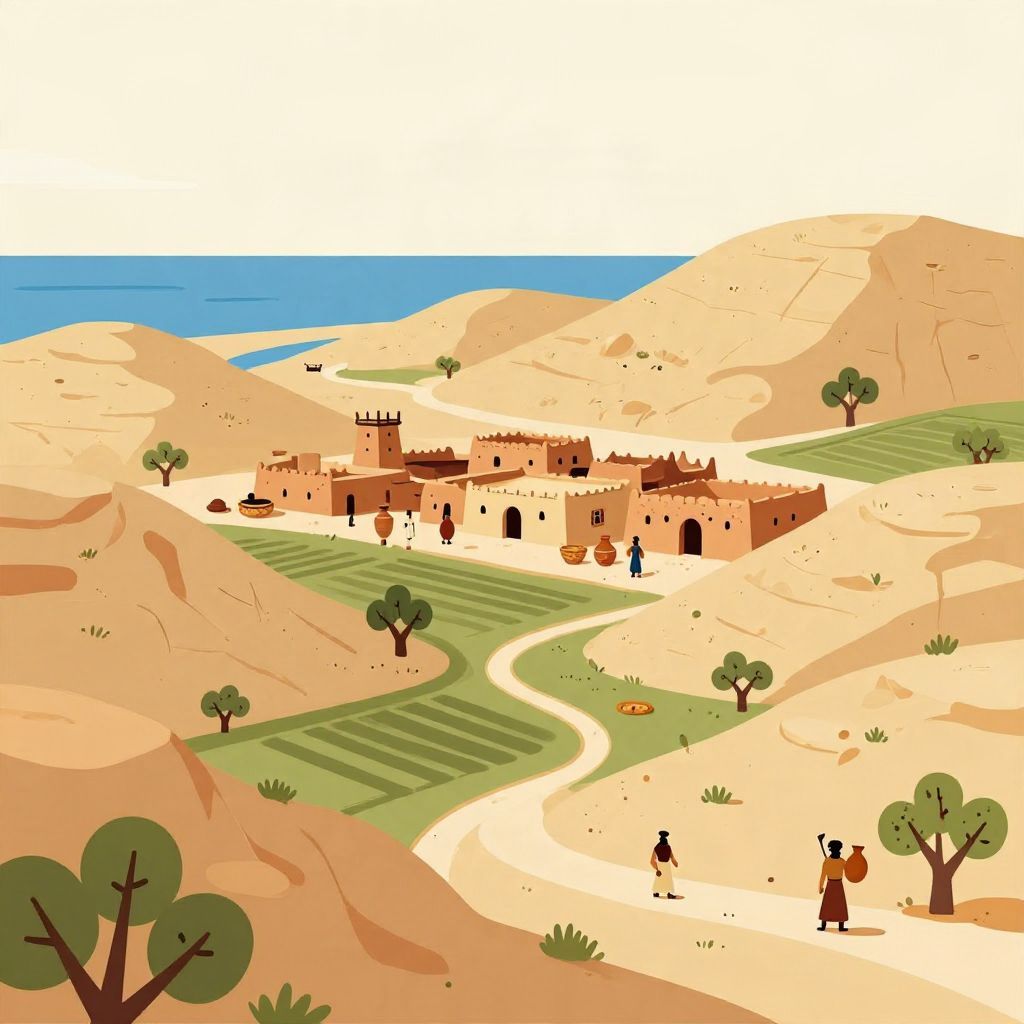
Where was Canaan? In historical terms, Canaan was the ancient Levantine region along the eastern Mediterranean, roughly covering parts of modern-day Israel, Palestine, Lebanon, western Jordan, and southwestern Syria. It was not a single kingdom with fixed borders, but a cultural and geographic zone known from ancient texts, archaeology, and the records of neighboring powers.
The name appears in the Hebrew Bible, Egyptian inscriptions, and later classical sources, but its exact boundaries changed over time. Understanding Canaan means looking at both geography and history: a land of city-states, trade routes, shifting empires, and many peoples who lived there during the Bronze and Iron Ages.
Where Was Canaan?
Canaan was located in the ancient Near East, on the eastern Mediterranean coast and inland hill country. In modern terms, it included much of Israel and Palestine, parts of Lebanon, western Jordan, and adjacent areas of Syria. It was best understood as a historical region rather than a neatly bounded state.
Geographic setting
The region stretched from the Mediterranean shoreline into the central highlands and eastward toward the Jordan Valley and parts of the Transjordan plateau. To the north it blended into areas later associated with Phoenicia and Syria; to the south it approached the Negev and Sinai. Because ancient borders were fluid, scholars describe Canaan as a broad zone of settlement and interaction rather than a fixed map outline.
Why the location matters
Canaan sat at a crossroads between Egypt, Mesopotamia, Anatolia, and Arabia. That position made it strategically important for trade, military campaigns, and cultural exchange. Merchants, armies, and migrants moved through the region for centuries, helping shape its languages, religions, and political life.
What Was Canaan in the Ancient World?
Canaan was a cultural and political landscape made up of many small city-states, farming communities, and port towns. It was not unified under one ruler for most of its history. Instead, local kings and elites often governed individual cities while larger empires, especially Egypt and later Assyria and Babylon, exerted influence or control.
City-states and local rulers
Archaeology and ancient texts show a patchwork of centers such as Hazor, Megiddo, Gezer, Lachish, Ugarit, and Byblos. These settlements connected agriculture, trade, and administration. Some were fortified cities with palaces and temples; others were smaller villages tied to regional markets and local power structures.
Languages and peoples
The people associated with Canaan spoke Northwest Semitic languages, related to later Hebrew, Phoenician, and Aramaic. “Canaanite” was not necessarily a single ethnic label in the modern sense. It was a broad designation used by outsiders and later writers for populations living in the region, many of whom shared overlapping customs, languages, and religious traditions.
When Did Canaan Exist as a Historical Region?
Canaan is most often discussed in the Bronze Age and early Iron Age, roughly from the third millennium BCE through the first millennium BCE. The name appears in different forms in ancient sources over a long span, but the region was especially prominent in the second millennium BCE, when Egyptian influence was strong and city-states flourished.
Bronze Age prominence
During the Middle and Late Bronze Age, roughly 2000–1200 BCE, Canaan was deeply connected to Egypt and the wider eastern Mediterranean world. Egyptian records mention campaigns, tribute, and administration in the region. This was also a period of intensive trade, with goods such as copper, timber, oil, wine, and luxury items moving between ports and inland centers.
Transition to the Iron Age
Around 1200 BCE, many eastern Mediterranean societies experienced upheaval. Some Canaanite city systems declined, others transformed, and new political formations emerged. In the centuries that followed, groups later identified as Israelites, Phoenicians, Arameans, and others became more visible in the historical record. Canaan did not disappear overnight; rather, its older urban order gradually changed.
What Do Ancient Sources Say About Canaan?
Our understanding of Canaan comes from several kinds of evidence: Egyptian inscriptions, Mesopotamian texts, the Hebrew Bible, and archaeology. Each source must be read carefully because each has its own purpose, perspective, and limitations.
Egyptian evidence
Egyptian texts from the second millennium BCE refer to Canaanite places and rulers. These records are valuable because they show that Egypt viewed the region as part of its sphere of influence at various times. The famous Amarna letters, a cache of diplomatic tablets from the 14th century BCE, include correspondence from Canaanite city-rulers to the Egyptian court.
Biblical references
The Hebrew Bible uses “Canaan” as both a geographic and narrative term. It often describes Canaan as the land inhabited by various peoples before the emergence of Israelite settlement and monarchy. These texts are historically important, but they were written and edited over time for theological and national purposes, so they do not function as simple maps or neutral reports.
Archaeological evidence
Excavations across the southern Levant have revealed settlement patterns, fortifications, burial customs, pottery styles, and inscriptions that help reconstruct ancient life. Archaeology does not identify a single “Canaanite capital,” because Canaan was never one centralized state. Instead, it reveals a connected regional culture with local variation.
How Canaan Was Connected to Neighboring Powers
Canaan’s history cannot be separated from the empires around it. Its location made it a corridor for armies and a prize for rulers who wanted access to trade routes and coastal ports. Control shifted repeatedly, and local leaders often had to adapt to outside domination.
Under Egyptian influence
For much of the Late Bronze Age, Egypt dominated or heavily influenced parts of Canaan. Egyptian garrisons, alliances, and tribute systems helped shape the political order. Yet Egyptian control was uneven, and local rulers still exercised significant authority in their own cities.
Later imperial changes
In the first millennium BCE, Assyria and then Babylon and Persia came to dominate the wider region. By then, older Canaanite identities had evolved into new political and cultural forms. Phoenician city-states on the coast, for example, preserved many Canaanite linguistic and cultural traits while developing their own distinct identity.
Canaan, Israel, and the Question of Origins
Canaan is central to the history of Israel because biblical tradition places the Israelites’ emergence in this region. Historians and archaeologists generally see early Israel as developing from within the broader Canaanite world rather than appearing suddenly from outside it. The exact process remains debated, but continuity is widely recognized.
Continuity and change
Many scholars note that early Israelites shared material culture, language, and settlement patterns with other Canaanite populations. Over time, certain groups developed distinct religious and social identities. This does not mean the biblical narratives are without historical value; rather, they reflect a later memory of real changes in population, identity, and power.
Popular misconceptions
It is common to imagine Canaan as a single nation conquered in one event. Historically, that is too simple. The region was diverse, and its transformation took place over generations. Some cities declined, others adapted, and new identities formed gradually in a landscape already shaped by centuries of local life.
What Did Everyday Life in Canaan Look Like?
Most people in Canaan were farmers, herders, artisans, and traders. Life varied by region, but agriculture formed the base of the economy. People grew grains, olives, grapes, and legumes, while coastal and inland trade linked communities to wider markets.
Religion and worship
Canaanite religion included worship of multiple deities associated with fertility, storms, the sea, and kingship. Temples, shrines, and household cult objects suggest a religious world tied closely to nature and local community life. Later Israelite religion emerged in dialogue with, and in distinction from, this broader religious environment.
Trade and craftsmanship
Pottery, metalwork, textiles, and carved objects show a high level of skill and exchange. Canaan’s ports helped move cedar wood, oil, wine, and crafted goods across the Mediterranean. This commercial role helped spread cultural ideas as well as products.
How the Name “Canaan” Changed Over Time
The term “Canaan” did not always mean exactly the same thing. In some ancient contexts it referred to a broad region; in others it could mean specific groups or territories. Later traditions, especially in biblical and post-biblical literature, gave the name moral and theological significance in addition to geographic meaning.
From region to memory
As political structures changed, “Canaan” increasingly became a remembered landscape of origins, promise, conquest, or ancestry. That memory was important in Jewish, Christian, and later historical traditions. But the historical Canaan was first and foremost a real ancient region inhabited by many communities over many centuries.
So, Where Was Canaan in Modern Terms?
If you want the shortest answer: Canaan was in the southern Levant, especially the land along the eastern Mediterranean and its inland highlands. On a modern map, that means mainly Israel and Palestine, with parts of Lebanon, Jordan, and Syria. Its borders were never fixed like those of a modern nation-state.
That is why historians describe Canaan as a region, a cultural sphere, and a historical setting rather than a single country. Its importance lies not only in where it was, but in how it connected civilizations, absorbed change, and helped shape the ancient history of the Near East. For related context, you may also find how old Joshua was when Moses died and what an Iron Cross is useful for broader historical background.