
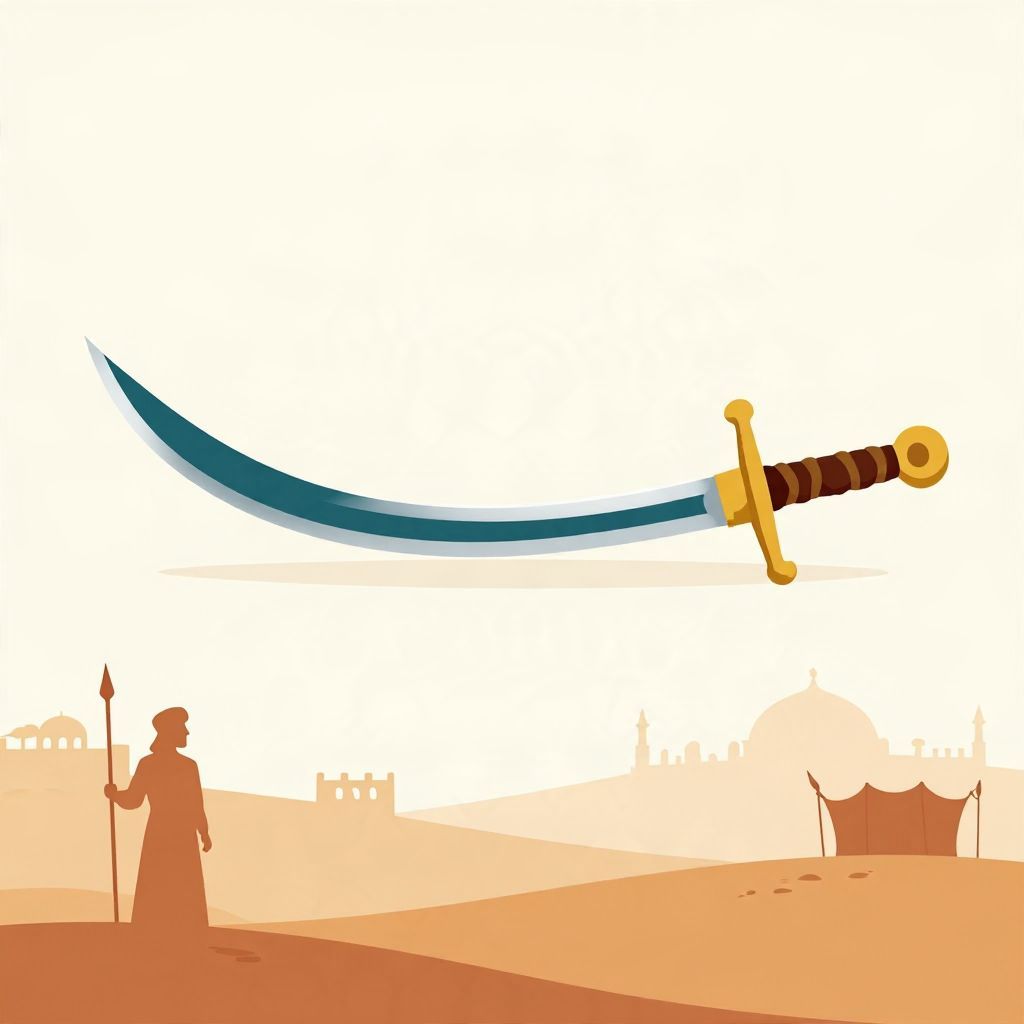
What is a scimitar? The word usually refers to a curved, single-edged sword associated with the Middle East, Central Asia, and parts of South Asia. In historical use, however, it was not one precise weapon with a single design. Europeans often used “scimitar” as a broad label for several kinds of curved swords they encountered in Islamic and Asian societies.
That makes the scimitar both a real weapon type and a historical idea shaped by trade, warfare, and cross-cultural contact. Its story is less about one invention than about how curved swords developed, spread, and were described across different regions and centuries.
What Is a Scimitar?
A scimitar is generally a curved, single-edged sword designed for cutting and slashing rather than thrusting. The term is historically imprecise: it was commonly used in Europe from the late medieval period onward to describe a range of Eastern curved blades, including forms related to the Persian shamshir, the Ottoman kilij, and other regional swords.
The Historical Meaning of “Scimitar”
The word “scimitar” does not come from a single ancient weapon name. It entered European languages through a chain of borrowings, probably from Italian and French forms that ultimately reflected Persian and other Asian sword traditions. By the early modern period, it had become a catch-all term in European writing for exotic-looking curved swords.
Why the term is tricky
Historians are careful with the word because it can blur important differences. A Persian shamshir, an Ottoman kilij, and an Indian talwar are not identical, even if all are curved, single-edged swords. Their shapes, balance, and fighting use varied by region, metalworking tradition, and cavalry tactics.
In other words, “scimitar” is best understood as a descriptive English term, not a technical label used uniformly by the people who carried these swords.
Where Did Scimitars Come From?
Curved swords developed in several parts of Eurasia over many centuries, especially where mounted warfare was important. A curved blade can be effective for slashing from horseback because it helps the blade draw across a target rather than stopping abruptly on impact. This advantage encouraged the spread of curved cavalry swords in the Islamic world, Central Asia, the Indian subcontinent, and beyond.
Early development
There is no single moment when the first scimitar appeared. Instead, curved swords evolved gradually from earlier straight and slightly curved blades. By the medieval period, cavalry cultures from the steppe, Persia, the Ottoman Empire, and Mughal India all used distinctive curved swords suited to their military styles.
These weapons were shaped by practical needs. Armies that relied heavily on horsemen valued speed, reach, and cutting power. Curved blades were often lighter and more maneuverable than broad straight swords, though exact performance depended on the sword’s length, weight, and edge geometry.
Key Regional Types Often Called Scimitars
Because “scimitar” is a broad European term, it helps to look at the major sword traditions it often covers.
Persian shamshir
The shamshir is one of the best-known curved swords associated with the scimitar idea. It developed in Persia and became famous for its pronounced curve and cutting emphasis. The shamshir was especially valued for mounted combat and elegant craftsmanship.
Ottoman kilij
The kilij of the Ottoman world had a distinctive curve and, in many examples, a widened or flared tip that could increase cutting force. Ottoman military power helped spread the prestige of this kind of sword across a wide region.
Indian talwar
The talwar was a common Indian sword form with a curved blade and a grip suited to control in combat. Indian sword-making traditions were diverse, and the talwar was only one of several important regional types. Europeans often grouped such swords under the scimitar label even when local terminology differed.
Other related forms
Other curved swords from Central Asia, North Africa, and the broader Islamic world also contributed to the image of the scimitar. Some were more strongly curved, some less so; some were optimized for cavalry, others for foot soldiers or ceremonial display.
How Was a Scimitar Used?
Scimitars were primarily cutting weapons. Their curve made them especially effective for powerful slashing motions, particularly from horseback. A rider could strike while moving past an opponent, using speed and the blade’s shape to deepen the cut.
That said, curved swords were not useless for thrusting. Many had points capable of stabbing, and skilled fighters could use them in multiple ways. But their design generally favored draw cuts and sweeping attacks over the straight-in thrust associated with some straight swords and rapiers.
Military context
Scimitar-type swords were part of broader military systems that included bows, spears, armor, and cavalry formations. They were not magical weapons that guaranteed victory. Their effectiveness depended on training, tactics, armor quality, terrain, and the larger organization of an army.
Why Did Curved Swords Become So Common?
Curved swords spread because they fit the needs of societies where horse warfare mattered. Steppe traditions, Persian military culture, Ottoman armies, and later South Asian cavalry all helped establish the curved sword as a practical and prestigious weapon. Once adopted, the form also carried social meaning: it could signal rank, status, and martial identity.
Practical and symbolic value
In many societies, swords were more than tools of war. They were also symbols of authority, honor, and elite status. A finely made curved sword could be both a battlefield weapon and a ceremonial object. That dual role helped preserve the scimitar’s cultural importance long after firearms changed warfare.
Scimitars in European Imagination
In Europe, the scimitar became a powerful image of the “East.” Writers, artists, and travelers often used it to evoke Ottoman soldiers, Persian cavalry, or imagined exotic warriors. This literary use sometimes mattered more than technical accuracy.
European depictions were shaped by conflict, trade, and curiosity. Crusading encounters, Mediterranean warfare, and expanding diplomatic contact introduced Europeans to unfamiliar weapons. Over time, the scimitar became a familiar symbol in art and literature, even when the blade shown was not historically precise.
Myth and stereotype
Because of this, the scimitar also became part of Orientalist imagery in later centuries. It was often portrayed as a dramatic, almost decorative weapon of “the East,” which can obscure the real military and craft traditions behind it. Historians therefore distinguish between the actual swords used in specific societies and the European fantasy of the “scimitar.”
Materials, Craftsmanship, and Design
Scimitars were made by skilled smiths using iron and steel, with quality varying widely by region and period. Good blades required careful control of carbon content, forging, heat treatment, and finishing. Some famous swords were prized for both performance and artistry.
Typical features
- Single edge for efficient cutting
- Curved blade to improve slashing motion
- Grip and hilt designed for control at speed
- Varied blade width depending on region and tactical use
Not every scimitar looked the same. Some were slender and elegant, others broad and imposing. Museum labels may use “scimitar” as a convenient category, but the historical reality is a family of related designs rather than one fixed model.
When Did Scimitars Decline?
Scimitars remained important for centuries, but their battlefield role declined as firearms and artillery transformed warfare. By the 18th and 19th centuries, swords were less central to mass combat, though they still mattered in cavalry, officer dress, and ceremonial use.
Even after military usefulness changed, curved swords persisted as symbols of tradition, rank, and identity. In some places they remained in use longer than in others, especially where cavalry and ceremonial martial culture stayed strong.
Why the Scimitar Still Matters
The scimitar matters historically because it shows how weapons spread across cultures and how language can shape our understanding of the past. It is a reminder that military technology was not isolated within one civilization. Ideas about blade shape, mounted combat, and craftsmanship moved across empires and trade routes.
It also shows how a single English word can hide a complex history. To ask “what is a scimitar?” is really to ask about the meeting point of warfare, craftsmanship, empire, and cultural perception.
Quick Facts About the Scimitar
- It is usually a curved, single-edged sword.
- The term is historically broad and imprecise.
- It is most closely associated with Persian, Ottoman, Central Asian, and South Asian sword traditions.
- It was especially effective for mounted slashing attacks.
- European writers often used it as a general term for “Eastern” swords.
So, a scimitar is best understood not as one exact sword, but as a historical category for curved blades that played an important role in the martial cultures of the Middle East, Central Asia, and South Asia. For readers interested in the wider history of weapons and martial traditions, related topics such as the Iron Cross and capoeira offer useful contrasts in how warfare and culture shape historical symbols.