
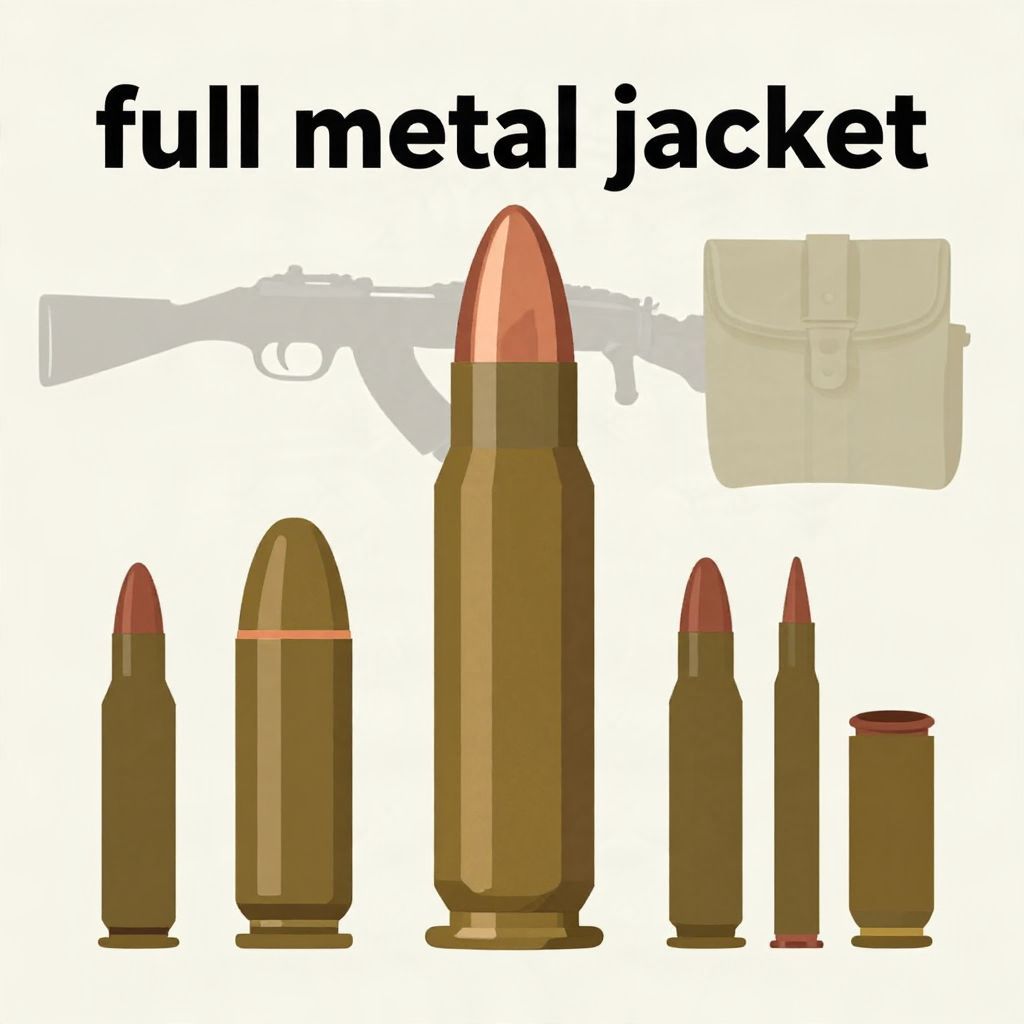
What does full metal jacket mean? In history and firearms terminology, it refers to a bullet whose soft lead core is enclosed, or “jacketed,” by a harder metal shell, usually copper or a copper alloy. The term is practical rather than poetic: it describes a specific ammunition design developed to improve performance in rifles and handguns.
The phrase became widely familiar through military use and later through popular culture, especially the 1987 film Full Metal Jacket. But the term itself long predates the movie, and its historical meaning is rooted in the evolution of modern ammunition, warfare, and the attempt to balance power, accuracy, and battlefield control.
What does full metal jacket mean?
A full metal jacket is a bullet with a soft lead core completely covered by a harder outer layer, usually copper or a copper alloy. This design reduces barrel fouling, improves feeding in firearms, and generally helps bullets hold their shape as they travel. In military history, FMJ ammunition became especially important in the late 19th century.
Where did the term come from?
The term comes from the literal construction of the bullet. “Jacket” refers to the outer metal covering, and “full” means the jacket encloses the entire core rather than only part of it. The phrase is descriptive, not symbolic. It emerged as ammunition makers moved away from simple lead bullets toward more durable designs suited to faster, more powerful firearms.
The shift from lead bullets to jacketed bullets
Before jacketed ammunition, many bullets were made of soft lead alone. That worked reasonably well in older, slower firearms, but it created problems as gun technology advanced. Higher velocities caused lead bullets to deform more easily, leave deposits in the barrel, and perform less reliably. Jacketed bullets solved many of these issues by putting a tougher metal layer around the core.
Why copper became important
Copper and copper alloys were especially useful because they are softer than steel yet harder than lead. They help the bullet keep its shape during firing and flight, while also reducing the amount of lead left behind in the barrel. This made jacketed ammunition attractive to armies and manufacturers in the late 1800s, when military rifles were becoming more powerful and more standardized.
Why did militaries adopt full metal jacket ammunition?
Militaries adopted full metal jacket bullets because they were more reliable in service rifles, easier to mass-produce consistently, and better suited to the demands of modern warfare. They also tended to penetrate more deeply and deform less on impact than soft-point bullets, which made them useful for military purposes where controlled, repeatable performance mattered.
The late 19th-century arms race
The rise of smokeless powder in the 1880s and 1890s changed ammunition design dramatically. Smokeless powder produced higher velocities than older black powder, which increased stress on bullets and barrels. At the same time, European powers were modernizing their armies and standardizing small arms. Jacketed bullets fit this new era of industrialized warfare.
The Hague and Geneva context
International law also influenced ammunition choices. In the late 19th century, European powers debated the use of expanding bullets, which were more likely to cause severe tissue damage. The Hague Declaration of 1899 restricted certain expanding bullets in warfare. Full metal jacket ammunition, which generally does not expand as much, became the standard military answer to those concerns.
How is a full metal jacket bullet different from other bullets?
Not all bullets are built the same way. A full metal jacket bullet is only one of several common designs, and each serves a different purpose. The main difference is how the bullet is intended to behave when it hits a target.
- Full metal jacket (FMJ): lead core fully enclosed by a metal jacket; common in military training and service ammunition.
- Soft point: exposed lead tip designed to expand more on impact; often used in hunting.
- Hollow point: cavity in the nose that encourages expansion; often used in law enforcement and self-defense contexts.
- Round nose or plain lead: older, simpler designs that may be cheaper but can deform more easily and foul barrels more quickly.
Performance and purpose
FMJ ammunition is valued for reliability and penetration, not maximum expansion. Because it usually stays more intact, it can pass through targets more readily than expanding bullets. That is one reason militaries have long preferred it for standard issue ammunition, while hunters and some civilian shooters often choose other bullet types for different goals.
What does full metal jacket mean in military history?
In military history, full metal jacket means more than just a bullet type. It marks a major transition from older ammunition to industrialized, standardized warfare. The adoption of FMJ rounds helped armies equip millions of soldiers with reliable ammunition, making small arms more effective and more uniform across large forces.
Standardization and mass production
By the late 19th and early 20th centuries, armies needed ammunition that could be produced in huge quantities and function in widely distributed rifles. FMJ bullets were easier to standardize than many older designs. That mattered in an age when railways, factories, and imperial armies were changing the scale of war.
Battlefield consequences
Because FMJ bullets often penetrate rather than expand dramatically, they can create wounds that are different from those caused by soft-point or hollow-point ammunition. Historians of warfare note that this helped shape military doctrine and medical treatment in the modern period. Still, the actual effects of a bullet depend on many factors, including caliber, velocity, distance, and what the bullet strikes.
Did the phrase come from the movie?
No. The movie did not create the term. Stanley Kubrick’s Full Metal Jacket (1987) borrowed an existing firearms phrase and used it as a title. The film’s meaning is open to interpretation, but the title clearly evokes military hardness, dehumanization, and the transformation of soldiers under pressure. The ammunition term itself was already well established long before the film.
Why the title fits the film
The movie is set in the Vietnam War era and explores the brutal process of turning recruits into soldiers. A full metal jacket is a bullet designed for hard, efficient performance; as a metaphor, the phrase suggests armor, toughness, and emotional shelling. That symbolic use is popular, but it is secondary to the original technical meaning.
Is full metal jacket ammunition legal and common today?
Yes, FMJ ammunition is widely used today, especially for target shooting, range training, and military-style firearms. It is common because it is often less expensive to manufacture than specialized expanding ammunition and because it feeds reliably in many semi-automatic firearms. Its legal status depends on local laws and the intended use.
Modern civilian use
In civilian shooting sports, FMJ rounds are popular for practice because they are affordable and consistent. Some shooters prefer them because they reduce barrel fouling and function smoothly in many firearms. However, they are not always the best choice for hunting or self-defense, where controlled expansion may be more desirable.
Modern military use
Many armed forces still use FMJ-type ammunition as standard issue, though exact specifications vary by country and weapon system. The basic reason remains the same: FMJ bullets are reliable, economical, and suitable for military logistics on a large scale. Their design reflects a long history of balancing efficiency with battlefield needs.
Common misconceptions about full metal jacket
Because the phrase appears in movies, games, and casual conversation, it is often misunderstood. The most common errors come from confusing the technical term with its metaphorical or cultural uses.
- Misconception: A full metal jacket means the bullet is made entirely of metal.
Reality: It usually has a lead core with a metal outer jacket. - Misconception: The term was invented for the film.
Reality: It was already a standard ammunition term. - Misconception: FMJ bullets are always the most powerful.
Reality: They are designed for reliability and penetration, not necessarily maximum stopping effect. - Misconception: All jacketed bullets are full metal jacket bullets.
Reality: Some bullets are only partially jacketed or designed to expand.
Why the term still matters historically
“Full metal jacket” matters because it captures a turning point in modern military technology. It reflects the move from handmade or simple lead projectiles to industrial ammunition designed for mass armies, global warfare, and standardized weapons. The phrase is also a reminder that technical terms can take on cultural meaning far beyond their original use.
In short, full metal jacket means a bullet with a lead core completely covered by a metal shell, and historically it became important because modern armies needed reliable, standardized ammunition. The phrase later gained wider fame through film, but its roots are in the practical history of firearms. For related history terms, you may also want to explore what “black flag” means in history and what “Neolithic” means.