
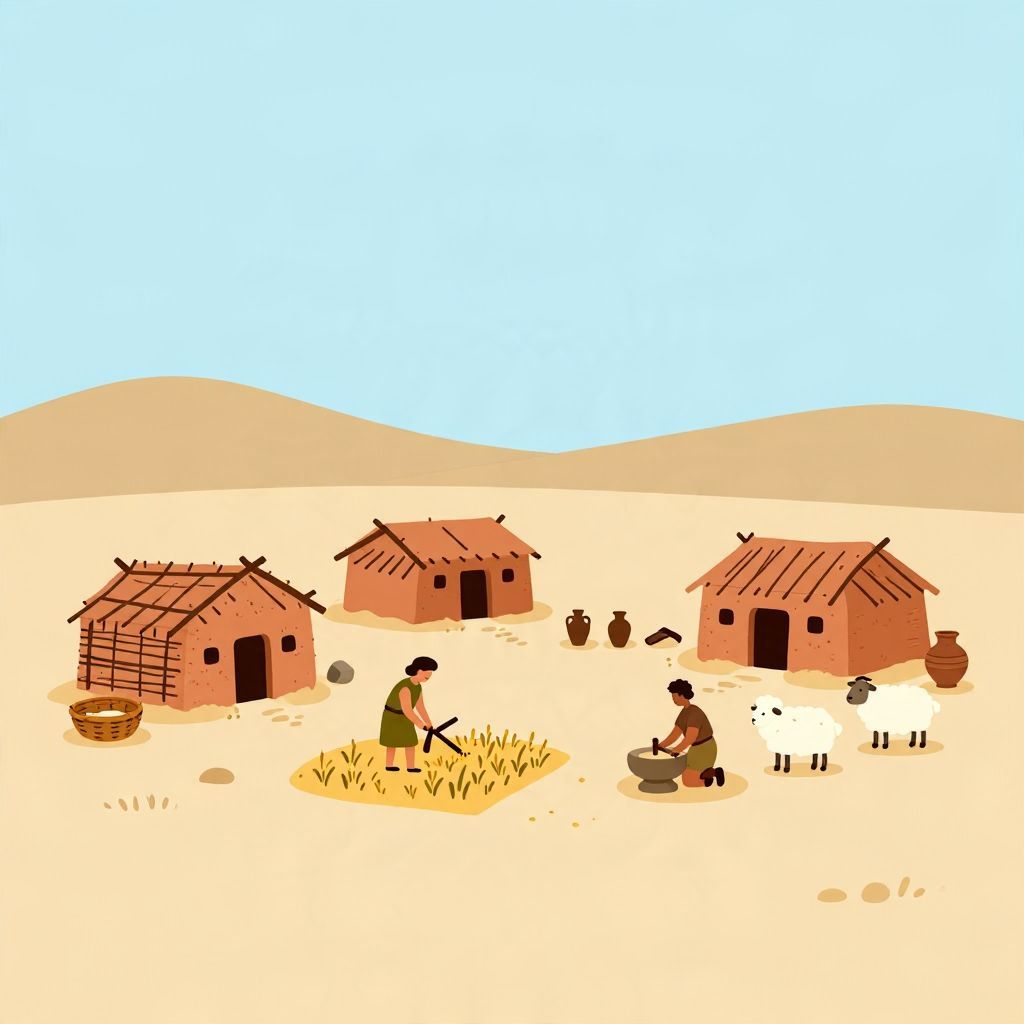
What does Neolithic mean? In history, it refers to the “New Stone Age,” a period when human communities began farming, herding animals, making polished stone tools, and living in more settled villages. It was not the same everywhere or at the same time, but it marks one of the biggest turning points in human history.
The Neolithic is important because it helps explain how small mobile foraging groups gradually changed into agricultural societies with larger populations, permanent homes, and new forms of social organization. That shift reshaped daily life, technology, religion, and eventually the rise of towns and states.
What does Neolithic mean?
Neolithic means “New Stone Age.” Historians and archaeologists use the term for the later part of the Stone Age, when people increasingly relied on farming, domesticated animals, and polished stone tools rather than only hunting and gathering. The Neolithic did not begin everywhere at once, but it generally started around 10,000 BCE in parts of Southwest Asia.
Where did the term Neolithic come from?
The word Neolithic comes from Greek: neos meaning “new” and lithos meaning “stone.” It was coined in the 19th century as part of a system for classifying prehistory into broad stages based on tools and technology. The term is still useful, though modern scholarship recognizes that human societies changed in different ways and at different speeds across the world.
Why historians still use the term
Even though the Neolithic is not a single uniform culture, it remains a helpful label for a major pattern in human development. It identifies societies that adopted farming and settled life, which usually led to larger communities, food surpluses, and new social roles. In that sense, “Neolithic” describes a broad historical transformation rather than one exact lifestyle.
What changed during the Neolithic?
The biggest Neolithic change was the shift from hunting and gathering to food production. People began cultivating plants such as wheat, barley, rice, millet, and maize in different regions, and they domesticated animals including sheep, goats, cattle, pigs, and later horses in some areas. This did not happen overnight. It was a gradual process that unfolded over many centuries.
From mobility to settlement
As farming became more important, many groups settled in villages near reliable water and fertile land. Permanent or semi-permanent homes replaced seasonal camps in many places. Sedentary life made it easier to store grain, care for children, and build larger communities, but it also brought new problems such as disease, conflict over land, and dependence on harvests.
Tools and technology
Neolithic people still used stone extensively, but their tools became more specialized. Polished axes, grinding stones, sickles, and storage vessels are common finds from this period. Pottery also became widespread in many regions, allowing people to cook, store, and transport food more efficiently. Textile production, weaving, and basketry expanded too, though organic materials survive less often in the archaeological record.
When was the Neolithic period?
There is no single universal start date for the Neolithic. In Southwest Asia, often called the Near East, the transition began around 10,000 BCE and continued through the following millennia. In other regions, it arrived much later. For example, farming spread into Europe gradually after about 7000 BCE, while in parts of sub-Saharan Africa, East Asia, and the Americas, the timeline was different again.
Approximate regional timelines
- Southwest Asia: around 10,000 BCE onward
- Europe: after about 7000 BCE, spreading over many centuries
- China: early farming developed in several areas by roughly 7000–5000 BCE
- Mesoamerica: agricultural development occurred later and independently
- Andes and other regions: farming emerged on different local timelines
Because of these regional differences, some historians prefer to speak of “Neolithic-like” developments rather than a single global Neolithic. The term is still widely used, but it should not be imagined as one neatly bounded chapter of world history.
Why did the Neolithic begin?
Scholars do not point to one simple cause. The Neolithic emerged through a combination of environmental change, population pressure, experimentation, and long-term cultural adaptation. At the end of the last Ice Age, climates became warmer and more stable in many regions, which affected plant and animal availability. People learned over time how to manage, cultivate, and eventually domesticate useful species.
Several factors worked together
- Climate change: warmer conditions altered ecosystems and growing seasons
- Population growth: more people may have increased pressure on wild food sources
- Local knowledge: foragers already understood seasonal plants and animal behavior
- Experimentation: repeated harvesting and seed selection encouraged cultivation
- Social change: settled life could support storage, exchange, and larger communities
Importantly, farming was not always an improvement in every respect. Archaeological evidence suggests that early farmers sometimes worked harder, had more dietary limitations, and faced new health risks. The Neolithic was transformative, but it was not a simple story of progress without cost.
What were Neolithic people like?
Neolithic communities were diverse. Some lived in small villages, while others occupied larger settlements with more complex social arrangements. Many people still hunted, fished, and gathered wild foods alongside farming. The idea that everyone instantly became a full-time farmer is misleading. In many places, older subsistence practices continued for a long time.
Daily life in a Neolithic village
Daily life likely revolved around planting, tending animals, collecting water, preparing food, making tools, and maintaining homes. Families worked together, but labor was often divided by age, skill, and social role. Storage became crucial because grain had to be protected from pests, weather, and theft. This made planning and cooperation more important than in highly mobile foraging life.
Housing and community
Neolithic houses were often built from mudbrick, wood, reeds, or stone depending on the region. Some settlements show closely packed homes, communal spaces, and evidence of repeated rebuilding on the same site. These patterns suggest that people had begun to think more in terms of land, inheritance, and community continuity than many earlier mobile groups did.
Did the Neolithic create civilization?
The Neolithic did not automatically create cities or states, but it laid the groundwork for them. Farming surpluses could support larger populations, specialists, craft workers, religious leaders, and eventually rulers. Over time, some Neolithic villages grew into towns, and some towns developed into urban centers. That process took thousands of years and happened unevenly across the world.
Long-term consequences
Once societies could produce and store more food, they could support people who were not directly involved in farming. This helped encourage pottery makers, builders, traders, priests, and administrators. Surplus also made inequality more likely in some places, because control over land and food could translate into power. Yet not every Neolithic society followed the same path toward hierarchy.
What makes the Neolithic different from the Paleolithic and Mesolithic?
The Neolithic is usually compared with earlier Stone Age periods. The Paleolithic, or Old Stone Age, was dominated by hunting and gathering and by chipped stone tools. The Mesolithic, or Middle Stone Age, is often used for transitional societies that adapted to post-Ice Age environments before full farming became widespread. The Neolithic is distinguished by agriculture, domestication, and more settled life.
Simple comparison
- Paleolithic: mainly hunter-gatherers, mobile lifestyles, chipped stone tools
- Mesolithic: transitional adaptations, varied regional lifeways
- Neolithic: farming, domesticated animals, villages, polished stone tools
These categories are useful, but they can oversimplify history. In reality, many communities mixed old and new practices for centuries. Some groups farmed part-time, while others remained foragers much longer. Human history rarely fits perfectly into one label.
Important Neolithic sites and regions
Archaeologists have identified many important Neolithic sites, especially in Southwest Asia, where early farming and village life are well documented. Sites such as Jericho and Çatalhöyük are often discussed because they provide evidence of early settlement, architecture, and changing social life. Other regions, including the Yellow River and Yangtze valleys in China, also show early agricultural development.
Why these sites matter
These places help historians understand how agriculture and settlement developed in practice. They show that the Neolithic was not just about farming crops; it also involved architecture, ritual behavior, trade, craft production, and new ways of organizing space. Burial practices and household remains can reveal social differences, beliefs about the dead, and community identity.
Was the Neolithic the same everywhere?
No. The Neolithic was a broad historical pattern, not a single global culture. Different regions domesticated different plants and animals, developed distinct technologies, and followed different social paths. In some places, pottery appeared before farming; in others, farming came before pottery. The sequence varied, which is why archaeologists study regional Neolithics rather than one universal model.
Why regional variation matters
This variation reminds us that human societies solved problems in local ways. Geography, climate, available species, and existing traditions all shaped change. For example, rice farming developed in East Asia under different ecological conditions than wheat and barley farming in the Near East. The Neolithic is therefore best understood as a family of transitions, not a single invention.
What does Neolithic mean in simple terms?
In simple terms, Neolithic means the stage in human history when people began to farm, raise animals, settle more permanently, and use polished stone tools. It is called the New Stone Age because stone remained important, even as new ways of living emerged. The term marks one of the most significant shifts in the human past.
The Neolithic matters because it changed how people fed themselves, lived together, and built societies. It was the beginning of farming life in many regions, but not a single clean break from the past. For a broader view of how societies change over time, you may also want to explore history topics on My Life Is History and related discussions such as what is cultural divergence.