
The word soccer did not begin in the United States, as many people assume. It was coined in England in the late 19th century as a slang shortening of Association football, the code of football governed by the Football Association.
Its history is a good example of how language, sport, and class culture shaped modern vocabulary. The term spread abroad, then largely faded in Britain while remaining common in countries where another kind of football—especially American football—needed a clearer name.
Where Did the Term Soccer Come From?
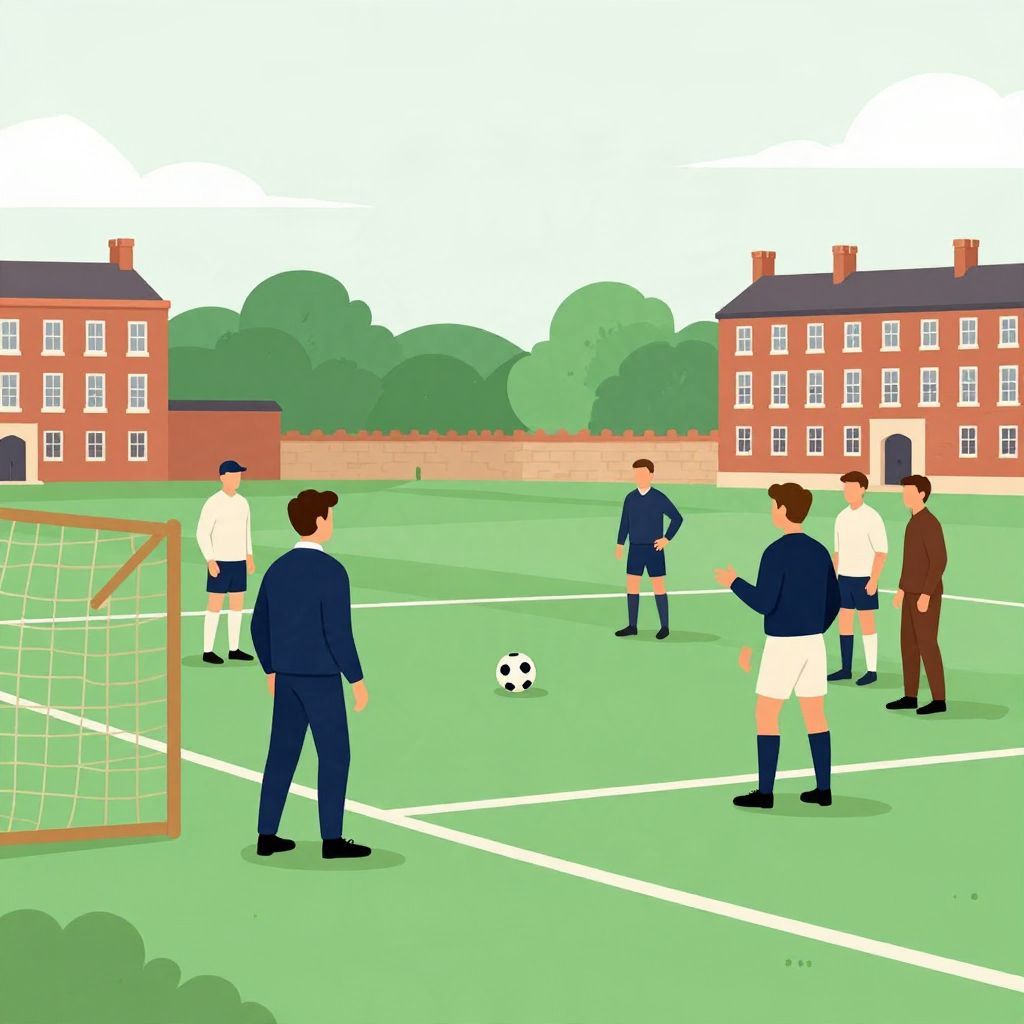
“Soccer” originated in England in the 1880s as Oxford University slang for “Association football.” Students and players shortened “association” to “assoc,” then added the playful -er ending common in British slang. The word was used alongside other nicknames of the period, but “soccer” eventually became the most enduring one outside Britain.
The English Origins of “Soccer”
From “Association football” to “assoc.”
In the 19th century, football in Britain was not yet one single standardized game. Different schools, clubs, and regions played by different rules. To bring order to the sport, the Football Association was founded in London in 1863. Its version of the game became known as Association football to distinguish it from other forms, especially rugby football.
That distinction mattered. By the later 1800s, “football” could mean several different games. People therefore needed a convenient way to say which one they meant. “Association football” was accurate but awkward in everyday speech, so abbreviations quickly appeared.
Why the word ended in “-er”
The strongest evidence points to Oxford student slang in the 1880s. British public-school and university students often clipped words and added -er endings to create informal nicknames. In this pattern, “association” became “assoc,” then “assocer,” and finally “soccer.” The same style also produced other slang forms of the era, which makes the explanation linguistically plausible and historically grounded.
This was not a formal invention by a committee or a single named person. It was a casual spoken nickname that emerged in educated British circles and was later written down. Because slang often spreads informally, its exact first use is difficult to pin to one moment, but the late 19th-century English origin is well established.
Why “Soccer” Was Needed in the First Place
Football was becoming divided
By the late 1800s, “football” in Britain referred to more than one code. The two most important were Association football and Rugby football. Both grew out of older school games, but they had different rules, different governing bodies, and different cultures. People needed language that could separate them clearly.
“Soccer” solved that problem neatly. It was shorter than “Association football” and more specific than the generic word “football.” For a time, both “soccer” and “rugger” were common informal terms in Britain, especially among students and in upper-class speech.
The social tone of the word
In Britain, “soccer” long carried a slightly informal or even upper-class feel because of its university and public-school associations. It was never a technical term invented by officials. Instead, it belonged to the world of slang, where humor and brevity mattered. That origin helps explain why some British speakers later came to dislike it: it sounded less traditional than simply saying “football.”
How “Soccer” Spread Beyond Britain
Exported through the British Empire and global sport
British merchants, teachers, sailors, and colonial administrators helped spread association football around the world in the late 19th and early 20th centuries. As the game traveled, so did its vocabulary. In some countries, “soccer” became the standard word for the sport; in others, local languages adopted different terms or kept “football.”
The word was especially useful in places where another football code existed or later became popular. In those settings, “soccer” clearly identified association football without confusion.
Why the United States kept “soccer”
In the United States, the word became especially important because “football” came to mean American football. As that sport grew in popularity in the late 19th and early 20th centuries, “soccer” became the practical term for association football. The same pattern occurred in Canada, Australia, New Zealand, South Africa, and parts of Ireland, though usage varied by region and era.
So while many Americans think “soccer” is an American invention, the historical record points in the opposite direction: the word was born in England and then preserved abroad more strongly than in its place of origin.
When Did “Soccer” Become Common?
Late 19th century beginnings
The term appears in written English in the 1880s, though it likely circulated orally before that. At first, it was one of several casual labels for the sport. It did not immediately replace “football” in Britain, and it was never the only term used internationally.
20th-century divergence
During the 20th century, usage split. In Britain and much of Europe, “football” remained the dominant term for association football. In countries where another football code became dominant, “soccer” stayed useful and often became standard. This divergence was not the result of a formal language policy; it was the outcome of sporting culture and local competition between codes.
By the later 20th century, many British speakers viewed “soccer” as an Americanism, even though the word had originated in England. That reversal is one of the more interesting twists in the history of sports language.
Myths and Misunderstandings About the Word
Not an American invention
A common myth says Americans invented “soccer” to distinguish their own football from the global game. That is incorrect. The word was already in use in England before American football became dominant in the United States. Americans did not create the term; they inherited and retained it.
Not proof that “football” is the only authentic name
Another misconception is that “soccer” is somehow less legitimate because it is newer or foreign. Historically, both “football” and “soccer” have long pedigrees. “Football” is the older general term, while “soccer” is a later nickname that became globally important because sports culture diversified.
Not a single fixed origin story
As with many slang words, the exact path from “association” to “soccer” cannot be traced with absolute precision. Scholars generally agree on the broad story—English origin, Oxford slang, 1880s usage—but the earliest moment of the word’s life is not documented in a neat, official record. That uncertainty is normal for spoken slang.
Why the History of “Soccer” Matters
The history of the term shows how language changes when institutions, social groups, and popular habits collide. A word that began as a playful abbreviation in England became a global term because football itself spread across borders and split into multiple codes. The story also reveals how meanings can shift: a word once British can later sound foreign in Britain and ordinary elsewhere.
In that sense, “soccer” is more than a nickname. It is a small linguistic record of modern sport, empire, class culture, and international exchange. The term came from late 19th-century England, but its afterlife belongs to the wider world.
If you are interested in related sports history, you may also enjoy reading about the history of football and British sports history.