
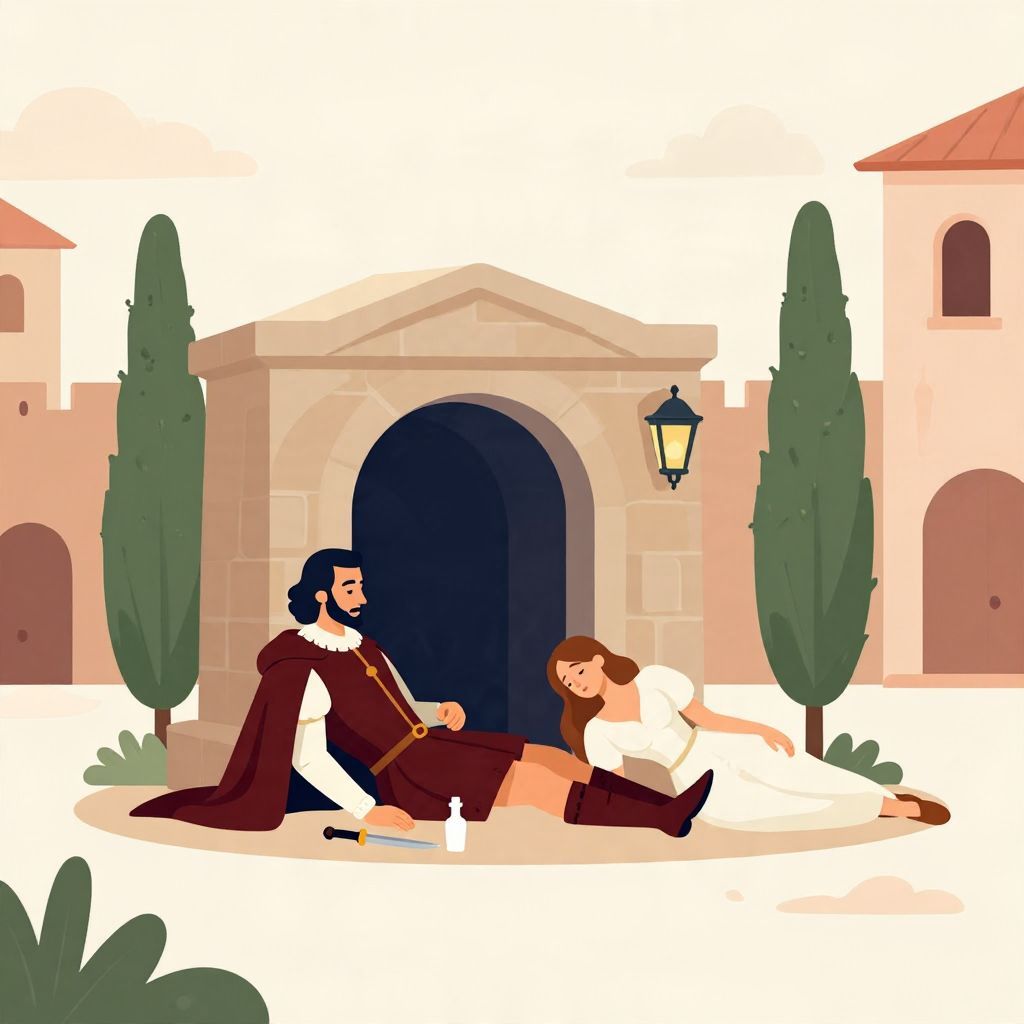
How did Romeo die? In William Shakespeare’s Romeo and Juliet, Romeo kills himself after believing Juliet is dead. He drinks poison in the Capulet tomb, moments before Juliet wakes and finds him beside her. His death is not a historical event but a literary one, written around 1595 and shaped by earlier Italian love stories about doomed young lovers.
Understanding Romeo’s death matters because it is the turning point that drives the tragedy to its final catastrophe. It reveals how haste, misunderstanding, and family conflict can turn private love into public disaster.
How did Romeo die?
Romeo dies by suicide in the Capulet family tomb after drinking poison. He believes Juliet is already dead, but she has only been drugged by Friar Laurence’s potion. When Romeo arrives in Verona, sees her apparently lifeless body, and hears no timely warning, he acts immediately. His death is the tragic climax of Shakespeare’s play, not a historical fact.
What happens before Romeo’s death?
Romeo’s death comes after a rapid chain of events that leaves little room for correction. He and Juliet marry secretly, hoping to overcome the feud between the Montagues and Capulets. After Romeo kills Juliet’s cousin Tybalt in a duel, he is banished from Verona. The lovers then rely on a risky plan that depends on secrecy, timing, and luck.
The failed plan
Friar Laurence gives Juliet a potion that will make her appear dead for about two days. The idea is that her family will place her in the tomb, Romeo will be informed, and the couple will reunite after she wakes. But the message explaining the plan never reaches Romeo. Instead, he hears that Juliet has died, and that false news becomes the immediate cause of his final decision.
Why Romeo believes Juliet is dead
Romeo’s belief is sincere, though mistaken. In the world of the play, he has no way to verify the truth quickly. He is isolated, exiled, and emotionally overwhelmed. Shakespeare uses this moment to show how fragile knowledge can be when communication fails. Romeo’s grief is real, but it is built on an error that cannot be corrected in time.
Why does Romeo kill himself?
Romeo kills himself because he thinks life without Juliet is impossible. His death reflects the play’s intense view of love, in which emotion, identity, and fate are tightly linked. He also acts within a tragic culture of honor and urgency, where lovers and noblemen alike make life-altering decisions quickly. Shakespeare presents the act as both personal despair and the result of a larger social breakdown.
Love, despair, and tragic haste
Romeo has always been impulsive. Earlier in the play, he falls in and out of love quickly, though his feelings for Juliet are deeper and more lasting. By the final scene, he has been pushed into exile, separated from his wife, and cut off from reliable help. When he sees Juliet motionless in the tomb, he chooses death rather than a life he cannot imagine enduring.
The role of fate in the tragedy
Shakespeare repeatedly suggests that forces beyond the lovers’ control are at work. The Prologue famously frames the story as one of “star-crossed” lovers, meaning their fate is doomed from the start. That does not remove human responsibility, but it does create a tragic pattern: one mistake leads to another, until the lovers are trapped by events they cannot reverse.
How exactly does Romeo die in the final scene?
In the tomb scene, Romeo arrives at Juliet’s burial place, confronts Paris, and kills him in a duel. He then enters the tomb, sees Juliet, and believes she has died. He drinks poison he has obtained from an apothecary. The poison works quickly, and Romeo dies before Juliet awakens. His final moments are brief, intense, and irreversible.
A step-by-step sequence
- Romeo returns to Verona after hearing that Juliet is dead.
- He buys poison from an impoverished apothecary.
- He goes to the Capulet tomb.
- He meets Paris, who has come to mourn Juliet.
- They fight, and Paris is killed.
- Romeo enters the tomb, sees Juliet, and drinks the poison.
- Juliet wakes too late to stop him.
The dramatic irony of the scene
The audience knows more than Romeo does, which makes the scene especially tragic. Viewers understand that Juliet is alive, but Romeo does not. Shakespeare uses this dramatic irony to heighten suspense and sorrow. The audience watches a preventable death unfold because the truth reaches the wrong person too late.
What is the historical context behind Romeo’s death?
Although Romeo is fictional, the play belongs to the late Elizabethan period in England, when Shakespeare was writing for the London stage. The story is set in Verona, Italy, a setting that English audiences associated with romance, family honor, and political tension. Shakespeare drew on Italian tales of feuding families and doomed lovers that were already popular in European literature.
Shakespeare’s sources
The broad plot did not begin with Shakespeare. Earlier versions appeared in Italian and English storytelling traditions, including Arthur Brooke’s 1562 narrative poem The Tragical History of Romeus and Juliet. Shakespeare reshaped that material into a faster, more emotionally vivid drama. Romeo’s death is therefore part of a literary tradition rather than a unique invention.
Why Verona matters
Verona is not just a backdrop. In the play, it represents a society where family loyalty, public reputation, and violence are deeply connected. Romeo dies because private love collides with a public feud that keeps producing new injuries. The city’s social order fails to protect the young people who live within it.
What does Romeo’s death mean in the play?
Romeo’s death is the key event that exposes the cost of the feud between the Montagues and Capulets. It is not only the loss of one young man; it is the moment when the older generation’s hostility destroys the next generation. Shakespeare uses the death to argue that hatred, when inherited and unchallenged, can turn love into tragedy.
The death of Paris and the final misunderstanding
Romeo’s death is also tied to another unnecessary loss: Paris. Paris is not the central figure in the feud, but he dies because the situation has become impossible to manage peacefully. The tomb scene shows how one false assumption can produce multiple deaths in a matter of minutes. By the time Juliet wakes, the damage is already complete.
Juliet’s role in the ending
Juliet’s awakening after Romeo’s death intensifies the tragedy. She finds him dead, refuses to leave him, and takes her own life. The lovers’ deaths are paired, but Romeo’s comes first and triggers the final collapse. Shakespeare makes the audience feel the terrible speed of the ending: one death leads directly to another.
Why does Romeo’s death still matter?
Romeo’s death remains famous because it captures several enduring themes: young love, miscommunication, social conflict, and the danger of acting before understanding. The play continues to resonate because its tragedy is not caused by one villain alone. Instead, it grows from a whole network of pressures—family pride, poor timing, secrecy, and emotional extremes.
A lesson about communication
One of the clearest reasons Romeo dies is that information fails to travel safely. The message about Juliet’s potion never reaches him. In that sense, the play is also about the consequences of broken communication. Shakespeare shows that even a good plan can fail when people are cut off from one another.
A lesson about conflict
The feud between the families creates the conditions for disaster. Romeo’s death matters because it shows how private choices are shaped by public violence. The lovers do not die simply because they are unlucky; they die in a world where enmity has become normal. That is why the ending feels both intimate and social at once.
Common misunderstandings about Romeo’s death
Because the story is so well known, it is easy to blur fact and fiction. Romeo was not a historical person, and his death did not happen in real Verona as a documented event. The play is a work of literature, though it draws on older stories and a real Italian setting. It is also important to remember that Shakespeare’s version is only one form of the tale.
Myth versus history
Some readers treat Romeo and Juliet as if they were real historical lovers. They are not. The story belongs to literary history, not political or biographical history. Still, the play reflects real early modern concerns: family honor, dueling, arranged marriage, and the social consequences of conflict. Those details help explain why the tragedy felt believable to Shakespeare’s audience.
Conclusion
Romeo dies by drinking poison in Juliet’s tomb after wrongly believing she is dead. His death is the tragic result of bad timing, failed communication, and a violent family feud, and it remains one of literature’s most powerful endings. If you want to explore the wider story, you may also be interested in articles on Shakespeare’s Romeo and Juliet and the Elizabethan theater.