
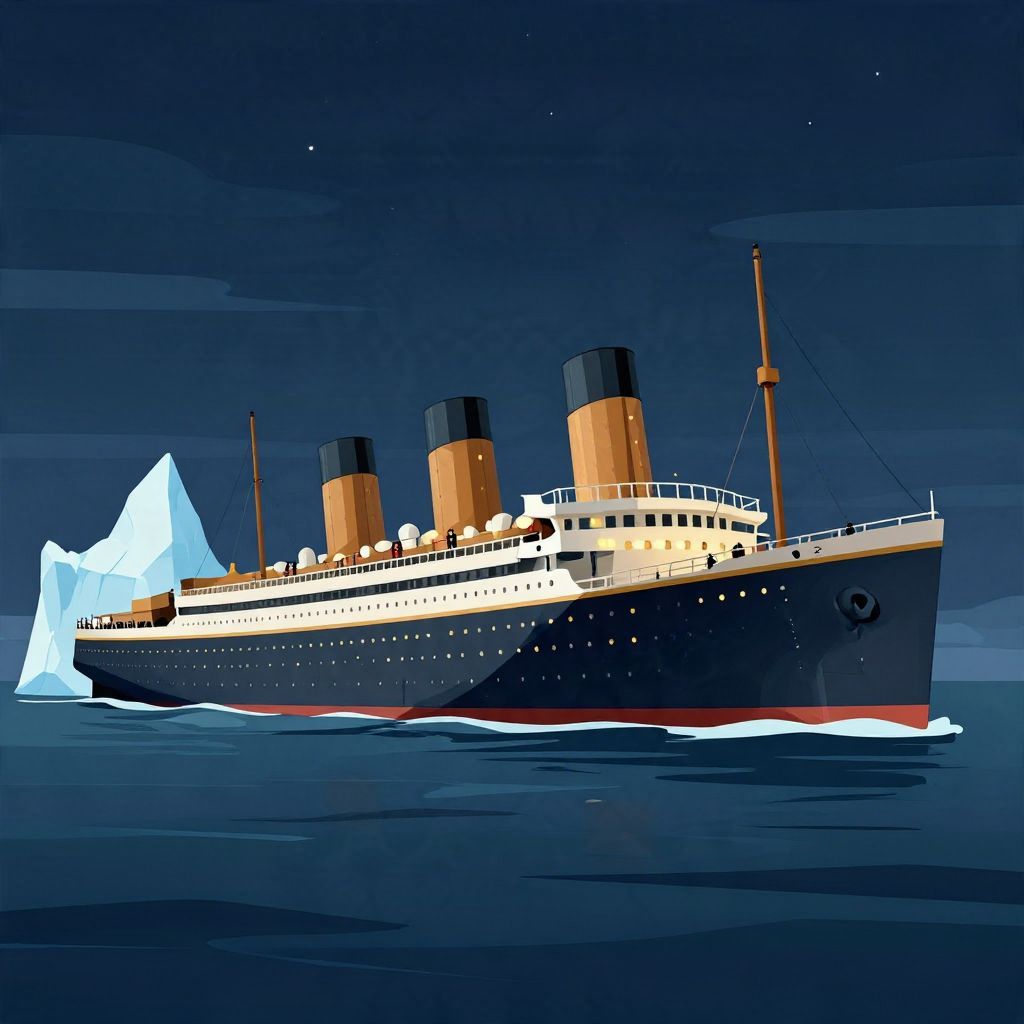
The question of what time the Titanic hit the iceberg is one of the most searched details about the disaster. The best historical answer is that the ship struck the iceberg at about 11:40 p.m. on April 14, 1912, while sailing in the North Atlantic on its maiden voyage.
That time comes from survivor testimony, wireless messages, and the ship’s known timeline. It is not a minute-by-minute certainty in the modern sense, but historians generally agree on the approximate moment. The collision set in motion the chain of events that led to one of the most famous maritime tragedies in history.
What time did the Titanic hit the iceberg?
The Titanic hit the iceberg at about 11:40 p.m. ship’s time on Sunday, April 14, 1912. Most historical accounts place the collision around that moment, with some variation of a few minutes depending on the source. The ship sank just over two and a half hours later, at about 2:20 a.m. on April 15.
How historians know the time
The exact moment is reconstructed from several kinds of evidence rather than from a single clock record. Titanic did not leave behind a digital log of the collision, so historians rely on witness statements, wireless transmissions, and the ship’s known progress that night. The result is a well-supported estimate, not an absolute second-by-second timestamp.
Survivor testimony
Many passengers and crew remembered the jolt, the sound, or the sequence of events after the impact. Some described a faint shudder rather than a dramatic crash, which fits the modern understanding that the iceberg scraped along the hull and opened multiple compartments to flooding. Because people in different parts of the ship experienced the event differently, their recollections vary slightly.
Wireless messages and the timeline
Wireless operators sent distress calls after the collision, and those messages help anchor the chronology. The time between impact, inspection of the damage, the order to prepare lifeboats, and the first distress signals all fit a collision around 11:40 p.m. This broader sequence is why historians treat that time as the standard answer.
What happened after the Titanic struck the iceberg?
After the collision, Titanic’s crew initially did not realize the full scale of the damage. The ship had been designed with watertight compartments, and some officers hoped it might stay afloat long enough for help to arrive. But the iceberg had opened several compartments, and the flooding spread beyond what the ship could survive.
The first minutes after impact
At first, many passengers were unaware anything serious had happened. The ship was large, steady, and brightly lit, and the collision was not immediately dramatic to everyone on board. Crew members and officers soon began checking the damage, and the seriousness of the situation became clear as compartments filled with seawater.
The decision to launch lifeboats
Once the extent of the damage was understood, the crew began preparing lifeboats. This process took time, and confusion, disbelief, and the limited number of lifeboats all shaped the response. The disaster was not caused by the collision alone, but by the combination of impact, inadequate lifeboat capacity, and the ship’s inability to stay afloat after multiple compartments flooded.
Why the time matters in Titanic history
The time of the iceberg collision matters because it helps historians reconstruct the final hours of the voyage. The sinking was not instantaneous. Instead, it unfolded over roughly two hours and forty minutes, which affected the evacuation, the distress calls, and the chances of rescue. Knowing the timeline helps explain why so many decisions were made under pressure and with limited information.
Night conditions in the North Atlantic
The Titanic was sailing through a region where ice warnings had already been received. The night was cold and calm, and the sea was unusually still. Those conditions made icebergs harder to spot because there were fewer waves breaking at their base. The lack of moonlight also made the lookout’s job more difficult.
Speed and visibility
Like many ocean liners of the era, Titanic was trying to maintain a fast schedule. Historians continue to discuss how speed, visibility, and the handling of warnings contributed to the disaster. The exact time of the collision is only one part of the larger story, but it is a key part because it marks the beginning of the final sequence.
Was the Titanic hit immediately or did it scrape the iceberg?
The Titanic did not crash head-on into the iceberg. Instead, the ship is understood to have glanced along the iceberg, scraping its starboard side and causing a series of ruptures below the waterline. This is important because the damage was not a single large hole; it was a set of openings that allowed water to enter several compartments.
Why the damage was so dangerous
Titanic’s design included watertight compartments, but the ship could not remain afloat if too many were flooded. The iceberg damage exceeded that limit. In other words, the ship was not doomed because of one dramatic gash, but because the hull was compromised in a way that gradually overwhelmed its defenses.
How long did Titanic stay afloat after hitting the iceberg?
From the collision at about 11:40 p.m. to the final sinking at about 2:20 a.m., Titanic remained afloat for roughly 2 hours and 40 minutes. That interval is central to the history of the disaster. It was long enough for distress signals to be sent and lifeboats to be launched, but not long enough for all passengers and crew to be rescued.
A brief chronology of the final night
- About 11:40 p.m., April 14: Titanic strikes the iceberg.
- Shortly after midnight: Damage is assessed and the seriousness becomes clear.
- After 12:15 a.m.: Distress messages are sent.
- After 12:40 a.m.: Lifeboats begin launching.
- About 2:20 a.m., April 15: Titanic sinks.
Why there is sometimes confusion about the time
People sometimes see different times in books, films, or online summaries because shipboard timekeeping in 1912 was not as standardized as it is today. Small discrepancies also arise from witness memory, the time zones used in later accounts, and whether a source is referring to the collision, the first damage noticed, or the moment the consequences became obvious.
Ship’s time versus modern timekeeping
The time commonly given for Titanic’s collision is based on the ship’s own clock. That is the most historically useful reference because it matches the events as they were experienced on board. When modern readers compare it with other time zones or later reconstructions, slight differences can appear, but the accepted historical answer remains around 11:40 p.m.
The historical significance of the iceberg collision
The collision became famous not only because Titanic sank, but because the disaster exposed weaknesses in maritime safety, emergency planning, and the belief that large modern ships were nearly unsinkable. The tragedy helped drive reforms in ship safety, wireless communication, lifeboat requirements, and ice patrols in the North Atlantic.
Lessons learned after 1912
The sinking led to major changes in international maritime practice. Ships were required to carry more lifeboats, maintain better emergency readiness, and improve radio watchkeeping. The Titanic disaster became a turning point because it showed that technology, confidence, and size could not replace caution and preparedness at sea.
The answer in one sentence
The Titanic hit the iceberg at about 11:40 p.m. on April 14, 1912, and sank about 2 hours and 40 minutes later. That timeline is the standard historical account and remains the clearest answer to the question.
If you want to explore the disaster further, you may also be interested in how the Titanic broke in half and when the last Titanic survivor died. Together, these details help show how the ship’s final hours unfolded and why the Titanic remains such a powerful historical story.