
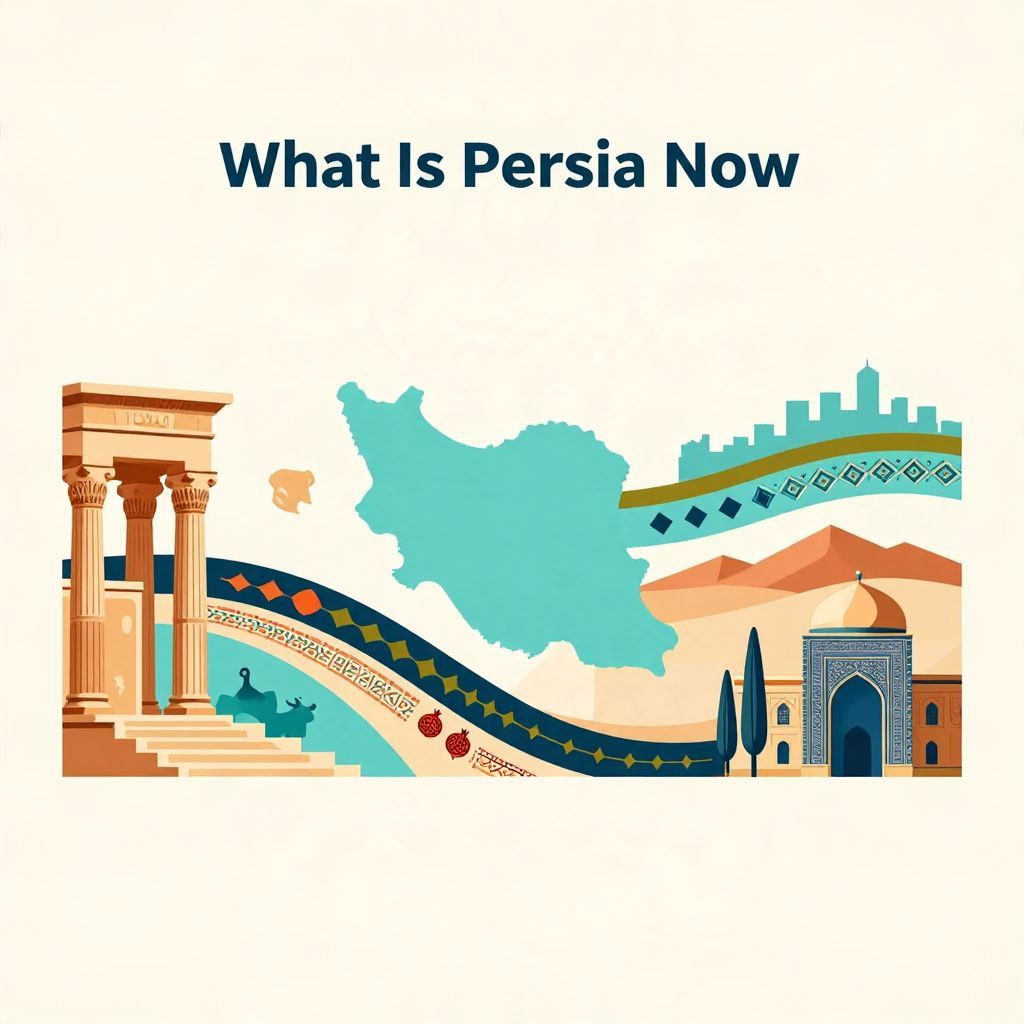
What is Persia now? In modern historical usage, Persia is the older Western name for the country now called Iran. The name “Persia” refers to a long cultural and political tradition that grew from ancient Persian kingdoms and empires, especially in the region of Fars in southwestern Iran.
Today, Persia is not a separate country. It survives mainly as a historical, cultural, and literary term, while “Iran” is the official state name used internationally since 1935.
What is Persia now?
Persia is now Iran. The term “Persia” historically referred to the land and peoples associated with the Persian Empire, but the modern sovereign state is the Islamic Republic of Iran. “Persia” remains common when discussing ancient history, classical literature, art, carpets, and the premodern cultural world of Iran.
Why Persia became Iran
The shift from “Persia” to “Iran” reflects both language and politics. “Iran” comes from an older term meaning “land of the Aryans” in an ancient Iranian-language sense, while “Persia” came through Greek and later European usage from Persis, the Greek name for the region of Fars. In 1935, the Iranian government asked foreign countries to use “Iran” officially.
The older Western name
For centuries, Europeans used “Persia” to describe the region and its rulers, even though local people used names related to Iran. This was not unusual in history: outside powers often used a regional or dynastic label rather than the name used by inhabitants themselves. Over time, “Persia” became standard in English, French, and other European languages.
The modern official name
In the 20th century, the state led by Reza Shah Pahlavi sought to emphasize a modern national identity and a continuity with the country’s own historical name. Since then, “Iran” has been the official name in diplomacy, law, and international organizations. The older name did not disappear, but it became more specialized.
Where was ancient Persia?
Ancient Persia began in southwestern Iran, especially in the region of Fars, which gave rise to the name “Persia.” From there, Persian-speaking dynasties expanded across a much larger area, building empires that stretched from the eastern Mediterranean to Central Asia and beyond. So Persia was both a specific region and, later, a vast imperial world.
From a region to an empire
The Achaemenid Empire, founded in the 6th century BCE under Cyrus the Great, made Persia famous across the ancient world. Its rulers governed a diverse empire with many languages, religions, and local traditions. Later Persian dynasties, including the Parthians and Sasanians, continued to shape the political and cultural history of the Iranian plateau.
Persia and Iran are not exactly the same in every context
Historically, “Persia” can mean different things depending on the period. Sometimes it means the ancient empire centered on Fars; sometimes it means the broader civilization of Iranian-speaking peoples; sometimes it means the modern country before 1935. “Iran” is the broader and more accurate modern term, while “Persia” is often used for historical or cultural emphasis.
What changed in 1935?
In 1935, the Iranian government formally requested that foreign governments use “Iran” instead of “Persia” in official correspondence. This did not create a new country; it changed international naming practice. The move was part of a wider effort to present Iran as a modern nation-state with a distinct identity rooted in its own historical traditions.
Why the name change mattered
Name changes in history often signal political transformation. In this case, the change reflected a desire to reduce reliance on a European exonym and to strengthen a national identity tied to the country’s own language and history. It also helped align the state’s international image with domestic usage.
Is Persia still used today?
Yes, but mostly in cultural and historical contexts. People still say “Persian” when referring to classical poetry, carpets, miniatures, cuisine, architecture, and the Persian language tradition. Many Iranians also use “Persian” to describe their ethnic or cultural heritage, especially in diaspora communities, while “Iranian” refers to citizenship or the broader national identity.
Examples of modern usage
- Persian language: The language is commonly called Persian in English, though in Iran it is often called Farsi.
- Persian literature: Works by poets such as Ferdowsi, Rumi, Hafez, and Saadi are usually described as Persian literature.
- Persian cats, rugs, and art: These labels preserve the historical cultural association.
- Persian Gulf: The term is still widely used in historical and international contexts, though naming can be politically sensitive.
Persia, Iran, and identity
The difference between Persia and Iran is not just a matter of vocabulary. It also reflects the relationship between empire, ethnicity, language, and nationhood. Persia evokes a long civilizational tradition that includes many peoples and dynasties, while Iran is the modern state that contains that heritage. Both terms are historically valid, but they are not interchangeable in every setting.
Ethnic and cultural complexity
Modern Iran is home to Persians as well as Azeris, Kurds, Lurs, Arabs, Baluch, Turkmen, and other communities. Ancient and medieval Persia was similarly diverse. Because of this, historians are careful not to reduce Persian history to one ethnic group alone. The Persian cultural sphere has long been multiethnic and multilingual.
Why some people prefer “Persia”
Some use “Persia” to emphasize continuity with premodern history and to avoid confusion with modern political issues. Others prefer “Iran” because it is the country’s official name and reflects how its people and institutions identify themselves today. The choice often depends on context: ancient history, cultural history, or modern politics.
A brief timeline of Persia to Iran
Here is a simplified chronology of the name and historical development:
- 6th century BCE: Cyrus the Great founds the Achaemenid Empire, making Persia a major imperial power.
- 4th century BCE: Alexander the Great conquers the Achaemenid Empire, but Persian culture continues under later dynasties.
- 3rd century BCE to 7th century CE: Parthian and Sasanian empires shape Iranian civilization.
- 7th century CE onward: Arab-Muslim conquest changes the political landscape, but Iranian culture and language traditions endure and evolve.
- 16th to 18th centuries: Safavid and later dynasties help define early modern Iran as a distinct state.
- 1935: The government requests the international use of “Iran” instead of “Persia.”
What Persia means in history books
In history writing, “Persia” usually signals a specific historical frame. It may refer to the ancient empires, the classical world of imperial administration and Zoroastrian religion, or the rich artistic and literary traditions associated with the Persian language. “Iran” is preferred when discussing the modern nation-state, especially after the early 20th century.
Common historical distinctions
- Ancient Persia: Usually the Achaemenid Empire and related pre-Islamic states.
- Medieval Persia: The Iranian cultural world under Islamic rule.
- Modern Iran: The country from the 20th century to the present.
Why the question still matters
Asking “What is Persia now?” opens a larger historical issue: how names survive, change, and carry identity across centuries. Persia is not a vanished country in the sense of being erased from history. Instead, it is a historical name that still lives in language, culture, and memory, while Iran is the modern political reality.
So the simplest answer is this: Persia is now Iran, but “Persia” remains an important historical and cultural term. Understanding both names helps explain the continuity between ancient empire and modern nation, and it shows how historical identities can endure even when official borders and names change. For related context, see what cultural divergence means and how nationalism shaped modern history.