
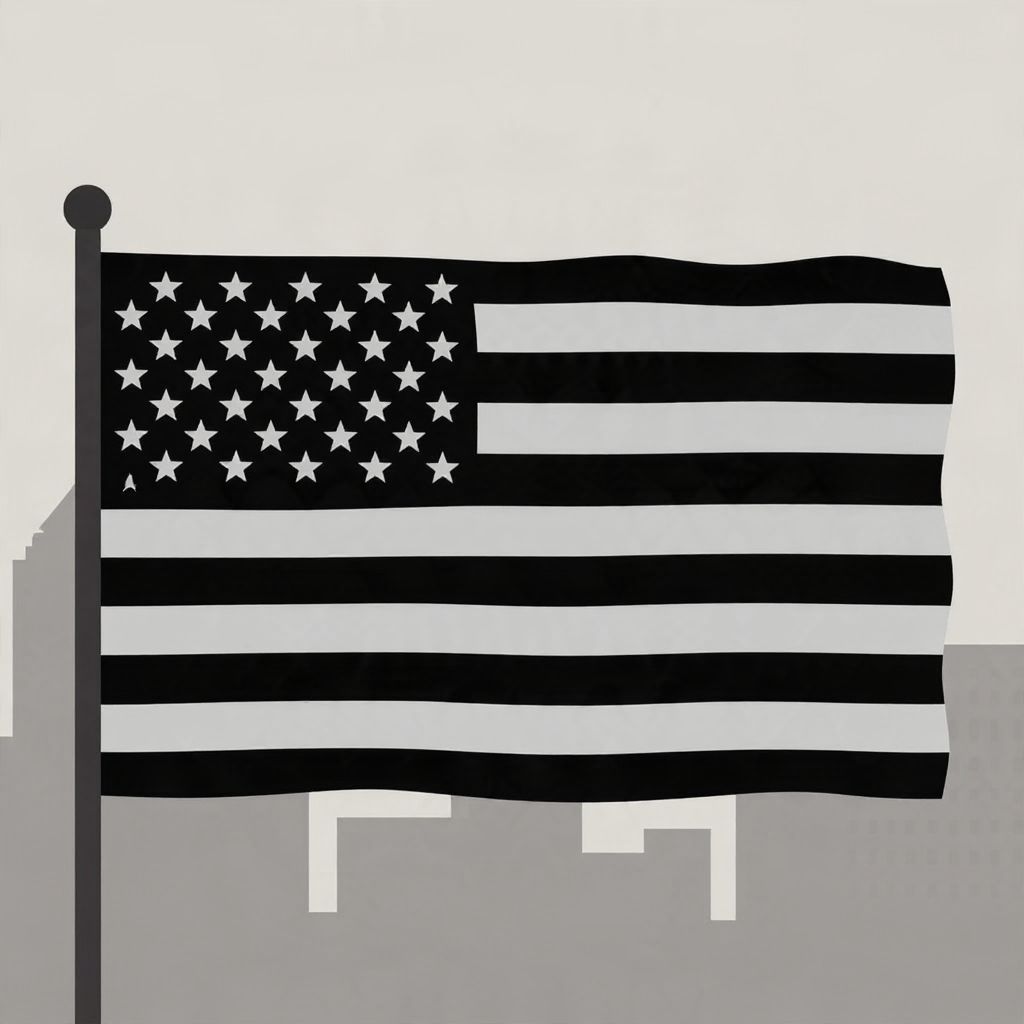
What does a black American flag mean? The short answer is that it usually signals mourning, protest, or defiance rather than an official change to the U.S. flag. In modern American usage, a black-and-white or all-black American flag has become a powerful symbol in several different contexts, and its meaning depends on who is flying it and where.
Because the symbol is not standardized by law, its meaning can range from honoring the dead to expressing resistance, solidarity, or political anger. That flexibility is exactly why the black American flag has become so visible in recent decades.
What does a black American flag mean?
A black American flag most commonly means mourning, remembrance, or protest. It is not an official U.S. government flag, but a symbolic variation of the Stars and Stripes. Depending on context, it can honor fallen service members, signal grief after violence, or express opposition to authority and social conditions.
Where did the black American flag come from?
The black American flag did not begin as one single, officially adopted emblem. Like many political symbols, it developed through repeated use in different movements and settings. Its roots lie in older traditions of using black to represent death, loss, and resistance, then adapting that color to the American flag for modern causes.
Black as a color of mourning and resistance
Across many cultures, black has long been associated with grief and solemnity. In military and civic life, black banners or draped cloth have often marked death, sacrifice, or remembrance. Over time, that older symbolism was fused with the American flag, creating a visual shorthand for loss or hardship.
Black also carries a political meaning. In revolutionary and anti-authoritarian traditions, black has sometimes stood for refusal, rebellion, or the rejection of normal state symbols. That helps explain why the black American flag can mean very different things in different communities.
From patriotic symbol to altered symbol
The U.S. flag itself is a highly regulated national emblem, but Americans have long modified it to make political or emotional statements. By changing the colors to black and white, people keep the flag’s recognizable shape while shifting its message. The result is familiar enough to be instantly understood, yet altered enough to signal dissent or grief.
How the black American flag is used today
Today, the black American flag is most often used in three broad ways: as a memorial symbol, as a protest symbol, and as a sign of solidarity within particular groups. These meanings can overlap, and the same flag may be interpreted differently by different viewers.
1. Mourning and remembrance
One of the most common meanings is mourning. A black or black-and-white U.S. flag may be displayed after a tragedy, during memorial events, or to honor those who have died in military service, police service, or other public roles. In this setting, the flag communicates grief and respect rather than political opposition.
This use is close to older funeral customs, where black cloth or black banners marked death and solemn remembrance. The American flag’s familiar design gives that mourning a national frame, especially when the loss is understood as collective rather than personal.
2. Protest and dissent
The black American flag is also used in protest. People may fly it to express anger at government policy, social injustice, war, or perceived threats to liberty. In this context, black can suggest that the nation is in a state of crisis, or that the usual symbols of patriotism no longer feel adequate.
Because the flag is not officially defined, this protest meaning is flexible. Some people use it to criticize police violence, others to oppose federal power, and others to express a general sense of national decline. The symbol’s ambiguity is part of its strength.
3. Solidarity and identity
In some settings, the black American flag functions as a marker of group identity. It may appear among veterans, tactical communities, political activists, or subcultures that want to present a hard-edged or uncompromising image. In these cases, the flag can signal loyalty to a cause, a shared experience, or a particular worldview.
That does not mean every user shares the same politics. The symbol is broad enough to be adopted by people with very different motivations, which is why it is often misunderstood when seen without context.
Is the black American flag official?
No. The black American flag is not an official national flag of the United States. The only official national flag is the Stars and Stripes in its recognized red, white, and blue form. Any black version is a symbolic alteration, not a legal replacement.
That distinction matters historically. Official flags are created and regulated by governments, while symbolic flags emerge from public use. The black American flag belongs to the second category: a popular emblem whose meaning has evolved through culture, conflict, and repetition.
Flag etiquette and the law
In the United States, flag etiquette is guided by the U.S. Flag Code, but the code is largely advisory for private citizens. People may display modified flags, including black versions, as a form of expression. Because of free-speech protections, such displays are generally treated as symbolic speech, even when they are controversial.
That legal freedom has helped the black American flag spread. It can be used on homes, vehicles, clothing, patches, and digital images without needing official approval.
Why black changes the meaning of the American flag
Color changes carry historical weight. The American flag normally represents unity, national ideals, and civic identity. When it is rendered in black, those associations are altered. The new color can suggest sorrow, anger, exhaustion, or a nation under strain.
Black-and-white versus all-black designs
Not every black American flag looks the same. Some are black-and-white versions of the Stars and Stripes, with the stripes and field reduced to monochrome. Others are nearly all black, with faint or darkened stars and stripes. The visual effect changes the message slightly.
- Black-and-white flag: often associated with mourning, memorialization, or a subdued patriotic statement.
- All-black flag: often associated with protest, defiance, or a more radical rejection of normal symbolism.
- Black-and-white with a colored stripe: sometimes used in specialized causes, where one stripe or line marks a particular service or identity.
These variations are not standardized, so viewers should avoid assuming one fixed meaning from the design alone.
Historical moments that shaped the symbol
The black American flag became more visible in the late 20th and early 21st centuries, especially as visual politics expanded through mass media, sports culture, military culture, and online spaces. Its popularity grew because it was simple, striking, and adaptable.
War, loss, and memorial culture
American wars and national crises have long produced new forms of remembrance. As memorial culture expanded, black versions of patriotic symbols became more common at funerals, commemorations, and public displays of grief. The flag’s black color helped translate private mourning into public language.
Protest movements and symbolic escalation
As protest movements became more visually sophisticated, activists often sought symbols that were instantly recognizable but emotionally charged. The black American flag fit that need. It could be used to challenge authority without abandoning the national frame entirely, which made it especially potent in debates over war, policing, and civil liberties.
Online culture and mass visibility
In the internet age, symbols spread faster and accumulate meanings more quickly. The black American flag has circulated widely in memes, political posts, merchandise, and profile images. That has broadened its use, but also blurred its meaning, since different groups now borrow the symbol for different purposes.
Common misunderstandings about the black American flag
Because it is so flexible, the black American flag is often misread. Some people assume it always means anti-American sentiment, while others assume it always means military mourning. Neither assumption is fully correct.
It does not always mean hatred of the United States
Many people who display a black American flag are not rejecting the country itself. They may be expressing grief, frustration, or a desire to call attention to a national problem. In that sense, the flag can be a critique from within patriotism rather than a rejection of it.
It does not have one universal political meaning
Unlike a formally adopted national emblem, the black American flag has no single authorized interpretation. Its meaning depends on context, timing, and the intentions of the person displaying it. A memorial flag at a funeral and a black flag at a protest are related visually, but not identical historically.
It can be confused with other black flags
Black flags have a long history outside the United States, including pirate imagery, anarchist symbolism, military signals, and religious or political banners. The black American flag is distinct from those traditions, even if it sometimes overlaps with them in tone or audience.
How to interpret a black American flag in context
If you see a black American flag, the safest historical approach is to ask what setting it appears in. Context usually reveals whether the flag is being used to mourn, to protest, or to signal identity.
- Look at the location: a memorial, home, business, protest, or military-related setting can change the meaning.
- Notice the design: all-black, black-and-white, or a version with a colored stripe may suggest different intentions.
- Consider the moment: a national tragedy, local death, or political conflict often shapes the symbol’s message.
- Read nearby symbols: signs, banners, uniforms, or slogans often clarify the intended meaning.
That contextual reading is important because symbols are historical tools, not fixed codes. Their meaning comes from how people use them over time.
Why the black American flag matters historically
The black American flag matters because it shows how Americans reinterpret national symbols during moments of stress. It takes a familiar emblem and turns it into a language of grief, resistance, or solidarity. That makes it more than a fashion item or a political accessory; it is part of the ongoing history of public symbolism in the United States.
Its rise also reflects a broader pattern in modern history: when official language feels inadequate, people often reshape flags, colors, and emblems to speak for them. The black American flag is one of the clearest examples of that process in contemporary America.
In the end, a black American flag usually means mourning, protest, or defiance, but never in a single fixed way. Its power comes from that ambiguity, and its history comes from the many Americans who have used it to express loss, anger, loyalty, and dissent. For related reading, see what the black American flag means and what a black flag means more broadly.