
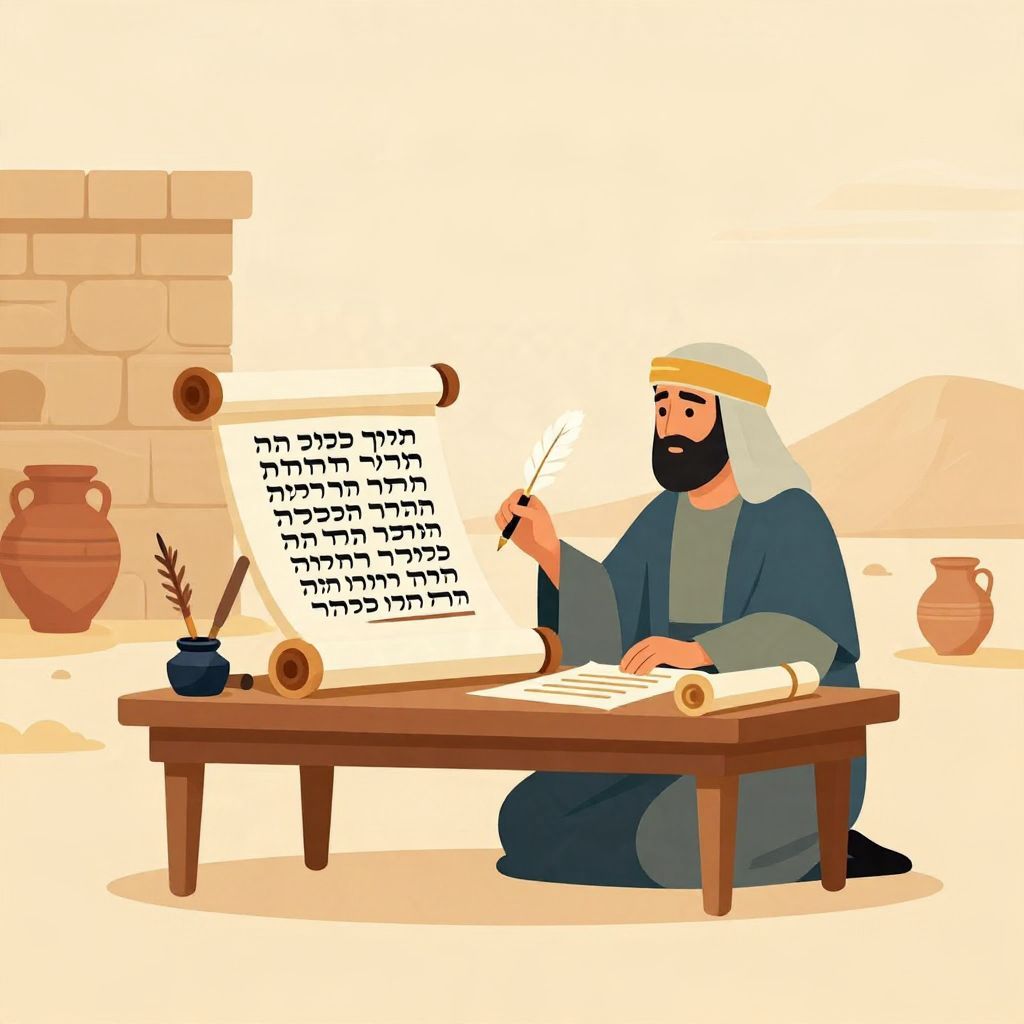
What language was the Old Testament written in? The short answer is that it was written mainly in Hebrew, with small sections in Aramaic. It was not produced in a single moment or by one author, but over many centuries by different writers and editors in the ancient Near East.
Understanding the languages of the Old Testament helps explain how these texts were preserved, copied, translated, and eventually read across different cultures and religions.
What Language Was the Old Testament Written In?
The Old Testament was written primarily in Biblical Hebrew, the main literary language of ancient Israel and Judah. A few passages, especially in books such as Ezra and Daniel, are written in Aramaic, a closely related Semitic language that became widely used in the Near East after the Assyrian and Babylonian empires expanded.
The Main Language: Biblical Hebrew
Biblical Hebrew is the core language of the Old Testament. It belongs to the Northwest Semitic family, alongside Phoenician and Aramaic. Most of the Hebrew Bible—including the Torah, the Prophets, and many of the Writings—was composed in Hebrew, though the style and vocabulary vary depending on the period and genre.
What Biblical Hebrew Was Like
Biblical Hebrew was not identical to modern Hebrew, though modern Hebrew revived many of its forms and words. Ancient Hebrew used a different script from the one most people recognize today, and its grammar reflects an older stage of the language. Poetry, law, narrative, prophecy, and wisdom literature each use Hebrew in slightly different ways.
Some books preserve older forms of the language, while others reflect later stages. That variation is one reason scholars can often discuss the relative age of passages, even when exact dates remain debated.
Why Hebrew Was Used
Hebrew was the language of the Israelite and Judean communities that produced these texts. It was the natural language for law, worship, royal records, prophecy, and national memory. Just as important, Hebrew became a marker of identity in a region where many languages were spoken and where political power often shifted from one empire to another.
Why Are Some Parts of the Old Testament in Aramaic?
Some sections of the Old Testament are in Aramaic because Aramaic became the common administrative and diplomatic language of much of the ancient Near East, especially from the first millennium BCE onward. The Old Testament includes Aramaic passages in Ezra and Daniel, along with a few isolated words and phrases elsewhere.
Aramaic in the Ancient Near East
Aramaic spread widely under the Assyrian Empire and remained influential under the Babylonians and Persians. It functioned much like a regional lingua franca, used by officials, merchants, and communities across a broad area. For Jewish communities living under imperial rule, Aramaic was often part of everyday life.
This helps explain why some biblical books include Aramaic sections. Those passages likely reflect settings where Aramaic was practical for administration or where the text itself was shaped in a multilingual environment.
The Aramaic Sections in the Bible
The best-known Aramaic portions appear in:
- Ezra 4:8–6:18 and Ezra 7:12–26
- Daniel 2:4b–7:28
- Small Aramaic phrases elsewhere, such as place names or expressions
These sections do not mean the whole Old Testament was written in Aramaic. Rather, they show that the biblical collection reflects a multilingual world.
Was the Old Testament Written at One Time?
No. The Old Testament was written and compiled over a long period, roughly from the early monarchy period into the post-exilic era, with editing and transmission continuing afterward. Because of that long development, the language of the text also reflects different historical layers.
Long Composition and Editing
Some traditions may preserve very old material, including poems, legal formulas, genealogies, and oral traditions passed down before they were written. Other material reflects later historical circumstances, especially after the Babylonian exile in the 6th century BCE.
Scholars do not agree on every date or source, and many details remain debated. Still, there is broad agreement that the Hebrew Bible grew over centuries rather than appearing as a single finished book.
Language as a Clue to History
Because language changes over time, scholars study vocabulary, spelling, grammar, and style to understand when a text may have taken shape. This does not produce exact dates for every passage, but it helps distinguish older traditions from later editorial work. In this sense, the Old Testament is both a religious text and a historical record of literary development.
What Script Was Used to Write the Old Testament?
The earliest Hebrew texts were written in an ancient script related to the broader Phoenician alphabet. Over time, Jewish scribes adopted the Aramaic script, which eventually became the standard square script used in later Hebrew manuscripts. The script changed, but the language of most of the text remained Hebrew.
From Ancient Hebrew to Square Script
In the early periods, Hebrew was written in what is often called the paleo-Hebrew script. After the Babylonian exile and during Persian rule, the Aramaic script became more common among Jewish scribes. This shift affected how the text looked on the page, not the language itself.
That is why the Hebrew Bible in later manuscripts appears in the familiar square characters used in Jewish tradition today. The change in script is an important part of the text’s history, but it should not be confused with a change in language.
How Did Translation Affect the Old Testament?
The Old Testament was eventually translated into other languages, most famously into Greek in the Septuagint. This made the Hebrew Scriptures accessible to Jewish communities in the Hellenistic world and later to early Christians. Translation played a major role in the global history of the Bible, but it came after the original Hebrew and Aramaic compositions.
The Septuagint and Greek-Speaking Jews
By the centuries after Alexander the Great, many Jews lived in Greek-speaking environments, especially in Egypt and the eastern Mediterranean. For them, Greek became a practical language of reading and worship. The Septuagint was therefore not a replacement for Hebrew, but a bridge between the older texts and a new linguistic world.
Translation also introduced differences in wording and interpretation. In some cases, later readers encountered the Old Testament through Greek rather than Hebrew, which shaped theology, liturgy, and scholarship for centuries.
Why Translation Matters for the Question
People sometimes ask what language the Old Testament was “really” written in because they encounter it in translation today. The answer depends on whether one means the original composition, later textual transmission, or the version used by a particular religious tradition. Historically, the earliest recoverable forms are Hebrew, with Aramaic sections embedded within the collection.
How Scholars Know the Languages of the Old Testament
Scholars identify the languages of biblical books through manuscript evidence, comparative linguistics, and historical context. Ancient manuscripts from places such as the Dead Sea region, along with related inscriptions and other Semitic texts, help confirm that Hebrew and Aramaic were the main languages of composition.
Manuscripts and Inscriptions
Surviving biblical manuscripts are much later than the earliest compositions, but they preserve the languages used in the tradition. In addition, inscriptions from ancient Israel and neighboring regions show that Hebrew was a living written language in the Iron Age, while Aramaic was widely used across imperial settings.
These sources do not answer every question about authorship, but they strongly support the basic historical picture: the Old Testament emerged from a Hebrew-speaking culture that also lived alongside Aramaic.
Limits of Certainty
It is important not to overstate what scholars can prove. Some passages may have been translated, revised, or adapted from earlier oral forms. In other cases, a text may preserve older material in later language. Historical study can clarify broad patterns, but it cannot always reconstruct every stage with certainty.
Why the Language Question Matters
The language of the Old Testament is not just a technical detail. It reveals the world in which these texts were formed: a small group of ancient communities living amid larger empires, shifting administrations, exile, return, and cultural contact. Hebrew expresses identity and continuity, while Aramaic reflects the practical realities of a multilingual Near East.
It also helps explain why the Old Testament has been read differently across time. Jewish, Christian, and scholarly traditions have all engaged these texts through Hebrew, Aramaic, Greek, Latin, and many modern languages. Each stage of transmission has shaped interpretation.
So, What Language Was the Old Testament Written In?
The Old Testament was written mostly in Biblical Hebrew, with some Aramaic passages. It was composed over many centuries in the ancient Near East, copied in changing scripts, and later translated into other languages. That layered history is part of what makes the Old Testament such an important and enduring collection of ancient literature.
If you want to keep exploring, you may also be interested in the original language of the Bible and what language the New Testament was written in.