
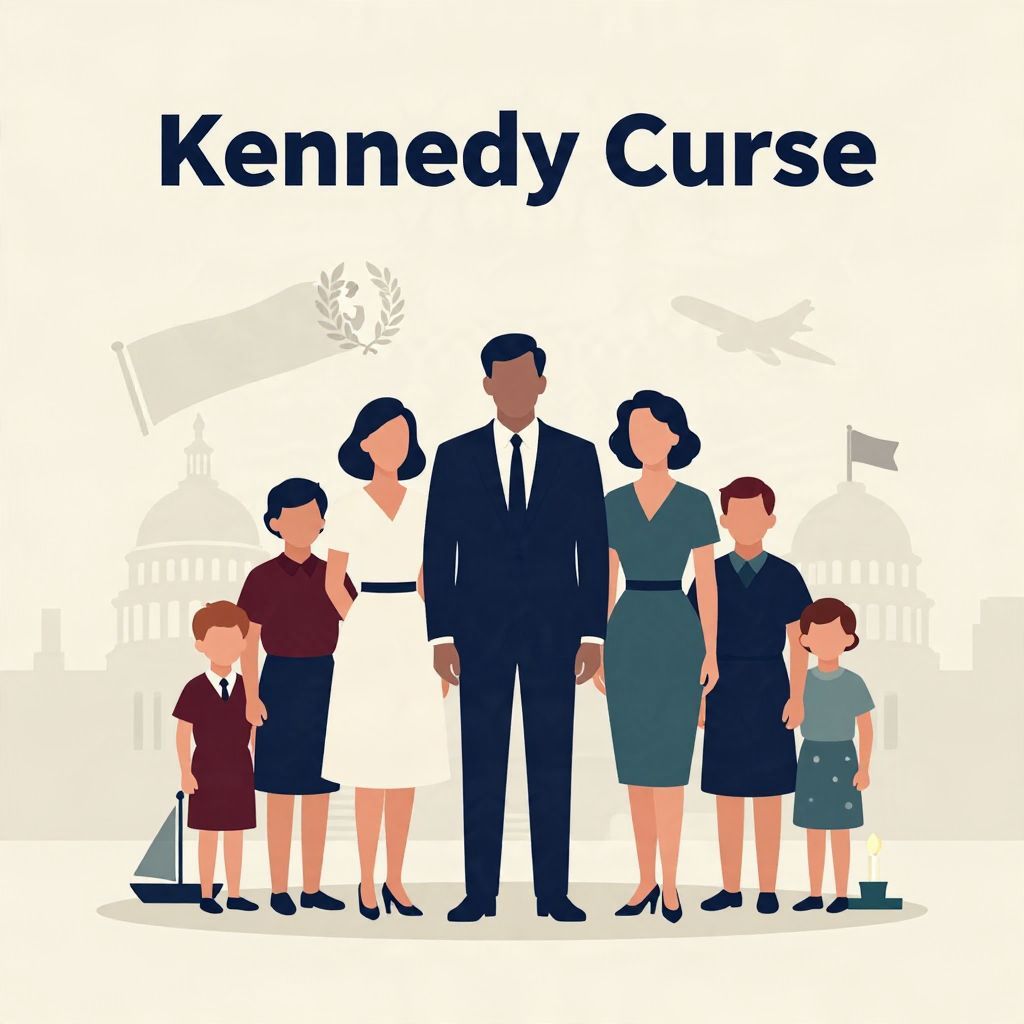
The phrase “Kennedy Curse” refers to a popular belief that the Kennedy family has been struck by an unusual number of tragedies, accidents, and early deaths. It is not a supernatural explanation accepted by historians, but a cultural label that grew out of real events involving one of America’s most famous political families.
To understand what the Kennedy Curse means, it helps to separate documented history from later mythmaking. The Kennedys did experience a series of devastating losses across the 20th century, and those tragedies shaped public memory of the family for decades.
What Is the Kennedy Curse?
The Kennedy Curse is the popular idea that misfortune repeatedly befell the Kennedy family, especially through assassinations, plane crashes, wartime deaths, and other sudden tragedies. Historians generally treat it as a media-driven myth rather than proof of an actual curse, though the family’s losses were real, severe, and unusually public.
The Origins of the Kennedy Curse
The idea emerged gradually, but it became especially strong after the assassinations of President John F. Kennedy in 1963 and Senator Robert F. Kennedy in 1968. Because the Kennedys were wealthy, politically prominent, and constantly in the public eye, each tragedy attracted intense national attention and was often linked to the family’s broader fortune and status.
Why the idea took hold
Several factors helped turn a series of family tragedies into a lasting legend. The Kennedys were seen as glamorous, ambitious, and almost mythic in American politics. When disaster struck, it seemed to many observers to be more than coincidence. In reality, the family’s large size, public careers, military service, and travel also increased the chances that misfortune would be visible and widely remembered.
Key Events Commonly Associated with the Kennedy Curse
There is no official list of events that “prove” a curse, but several losses are frequently cited when people use the phrase. Together, they created the powerful impression that the family was marked by repeated tragedy.
- 1944: Joseph P. Kennedy Jr., the eldest Kennedy son, was killed during a military mission in World War II.
- 1948: Kathleen “Kick” Kennedy died in a plane crash in France.
- 1963: President John F. Kennedy was assassinated in Dallas, Texas.
- 1964: Ted Kennedy survived a plane crash that killed two others and left him seriously injured.
- 1968: Robert F. Kennedy was assassinated in Los Angeles after winning the California primary.
- 1969: Ted Kennedy’s car went off a bridge at Chappaquiddick, Massachusetts, killing Mary Jo Kopechne.
- 1994: Jacqueline Kennedy Onassis died of cancer, a loss that renewed public attention on the family’s long history of hardship.
- 1999: John F. Kennedy Jr., his wife Carolyn Bessette Kennedy, and her sister Lauren Bessette died in a plane crash off Martha’s Vineyard.
Not every tragedy was the same
It is important to note that these events had different causes. Some were acts of war, some were assassinations, some were accidents, and some involved personal decisions and risky circumstances. Grouping them all under one label can make the pattern seem more mysterious than it really was.
Why the Kennedy Family Became the Focus of a Curse Narrative
The Kennedy family’s prominence made it uniquely vulnerable to myth. In the 20th century, the Kennedys were not just a political dynasty; they were a symbol of American aspiration, youth, and success. Their Irish Catholic background, wealth, and political influence added to the sense that they were a modern royal family.
Public fascination and repeated headlines
Each tragedy involving a Kennedy became a national story. Newspapers, television, and later magazines and documentaries revisited the family’s losses again and again. Over time, the accumulation of grief created a narrative in which the family seemed fated to suffer, even though the events were separated by years and had different causes.
Tragedy and memory
Human beings naturally look for patterns in painful events. When a family experiences multiple losses, especially in public view, people often search for a larger explanation. The Kennedy story fits that tendency well, which is one reason the curse idea has remained so durable in American culture.
Historical Background: The Kennedy Family in American Politics
The Kennedy family rose from immigrant roots to extraordinary political power in the 20th century. Joseph P. Kennedy Sr. and Rose Fitzgerald Kennedy raised nine children, several of whom entered public life. Their sons Joseph Jr., John, Robert, and Edward became the most famous members of the family.
From ascent to vulnerability
The family’s rapid rise made their successes highly visible, but it also meant that setbacks were magnified. John F. Kennedy’s presidency from 1961 to 1963 became a symbol of youthful promise. His assassination, therefore, felt to many Americans like the sudden collapse of an era. The later death of Robert F. Kennedy extended that sense of unfinished possibility.
Is the Kennedy Curse Real?
No historical evidence supports the existence of a literal curse. What can be documented is a family history marked by exceptional public exposure, dangerous circumstances, and several genuine tragedies. The “curse” is best understood as a cultural interpretation, not a factual explanation.
Why historians are cautious
Historians avoid supernatural explanations because they cannot be tested or verified. Instead, they look at context: the Kennedys were active in politics, military service, aviation, and public life, all of which carried real risks. Their prominence also ensured that every tragedy received intense attention, while similar losses in less famous families might have gone largely unnoticed.
The role of coincidence and probability
Families can experience clusters of misfortune without any hidden cause. Large families, especially those with many public-facing members, may face a higher number of visible tragedies simply because more people are involved and more opportunities for danger exist. The Kennedy family’s history is striking, but striking does not mean supernatural.
How the Kennedy Curse Shaped American Culture
The Kennedy Curse became part of the broader mythology surrounding the family. It influenced journalism, popular books, films, and political commentary. The phrase is often used as shorthand for the idea that extraordinary privilege can coexist with extraordinary suffering.
A modern American myth
In some ways, the Kennedy Curse functions like older family legends about doomed dynasties. It gives narrative shape to a series of hard-to-process events. But unlike folklore from the distant past, this story is tied to a family that lived in front of cameras and within living memory, which made the myth especially powerful.
Key Facts About the Kennedy Curse
Here are the most important points to remember about the Kennedy Curse:
- It is a popular cultural idea, not a proven historical fact.
- It refers to a series of real tragedies involving members of the Kennedy family.
- The idea grew strongest after the assassinations of John F. Kennedy and Robert F. Kennedy.
- Public fascination with the Kennedys helped turn misfortune into a lasting legend.
- Historians explain the pattern through context, risk, and coincidence, not supernatural causes.
Why the Kennedy Curse Still Matters
The Kennedy Curse remains a powerful phrase because it captures something real about public memory: when a famous family suffers repeated losses, people often search for meaning beyond chance. The Kennedys’ story is therefore both a political history and a study in how Americans turn tragedy into legend.
In the end, the “Kennedy Curse” is best understood as a cultural myth built around genuine loss. If you want to explore the family’s history further, you may also be interested in what car JFK was shot in and why JFK Jr.’s plane crashed.