
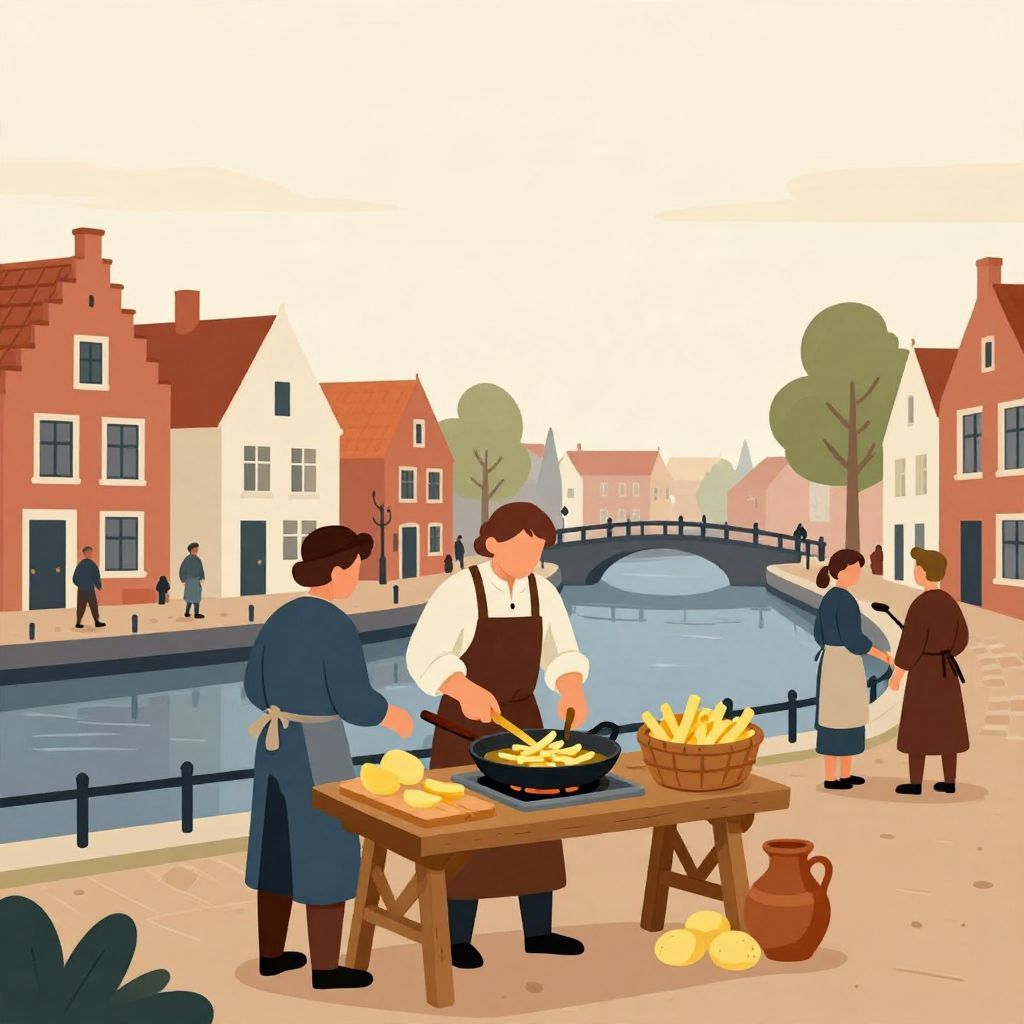
French fries are so familiar today that it is easy to forget they have a history of their own. The question “Where did French fries originate?” sounds simple, but the answer depends on how you define the dish and which evidence you trust.
Most historians place the origin of the French fry in the southern Low Countries, especially present-day Belgium, where people were frying potatoes by the late 17th or early 18th century. The exact story is debated, but the strongest historical case points to the Meuse Valley region rather than France.
Where Did French Fries Originate?
French fries most likely originated in the southern Low Countries, especially what is now Belgium, sometime in the late 1600s or 1700s. The dish grew out of local frying traditions after potatoes became established in Europe. Despite the name, the best historical evidence does not point to France as the place of origin.
The Historical Setting: Potatoes Arrive in Europe
French fries could not exist before potatoes reached Europe from the Americas. Potatoes were introduced in the 16th century after Spanish contact with the Andes, but they spread slowly and unevenly. For a long time, Europeans treated them with suspicion, and they were often grown first as a curiosity or famine crop rather than a staple.
By the 17th century, potatoes had become more common in parts of Western Europe, including the Low Countries. That mattered because the region already had a strong tradition of frying foods in fat or oil. Once potatoes became available, cooks had a new ingredient that could be cut into pieces and fried in a familiar way.
Why the Low Countries mattered
The area now divided mainly between Belgium, the Netherlands, and Luxembourg had access to rivers, trade routes, and urban markets. It also had a food culture that included frying small fish and other ingredients. In that environment, potatoes were not just boiled or baked; they were adapted into local cooking methods, which likely led to the earliest forms of fries.
The Belgian Origin Theory
The most widely accepted historical interpretation is that French fries began in the southern Low Countries, particularly in Belgium. Belgian tradition often links the dish to the Meuse Valley, where villagers reportedly fried potatoes when rivers froze and fish were unavailable. This story is famous, but it is best understood as a later tradition rather than firm documentary proof.
What makes the Belgian case persuasive is not the legend itself but the broader pattern of evidence. The region had potatoes early, a frying culture already in place, and a long association with thin fried potato pieces. Historical references to fried potatoes appear in the area before the dish became internationally associated with France or the United States.
The Meuse Valley story
One popular version says that people living near the Meuse River near Liège, in present-day Belgium, began frying potatoes as a substitute for small fried fish during winter when the river froze. This explanation is appealing because it fits local conditions, but historians treat it cautiously. It may preserve a real memory of the dish’s development, even if the exact event cannot be verified.
Why Are They Called “French” Fries?
The name “French fries” does not necessarily mean the dish originated in France. The term likely became common in English because “French” was often used to describe a style of cutting food into thin strips, especially in 18th- and 19th-century English-language cooking. In that sense, “French” referred to technique, not nationality.
There is also a language complication. In parts of Europe, fried potato strips were associated with French-speaking regions or with French culinary prestige. Over time, English speakers adopted the phrase “French fried potatoes,” which later shortened to “French fries.” The name spread widely even though the dish’s roots were probably Belgian or broadly Low Countries-based.
France’s role in the story
France did help popularize fried potatoes, especially in urban food culture. But popularity is not the same as origin. A dish can become famous in one country and still have been created elsewhere. In this case, the French connection seems to reflect naming and diffusion more than the first invention of the food itself.
What Is the Earliest Evidence?
Direct evidence for the first French fry is limited, which is common in food history. Everyday cooking often leaves fewer records than wars, kings, or treaties. Historians therefore rely on recipe books, local traditions, and references to fried potatoes in regional sources. The evidence suggests that fried potatoes were known in the Low Countries by the 18th century, and possibly earlier.
One challenge is that early recipes do not always describe the modern fry exactly. Some sources mention potatoes cut into slices or small pieces and fried in fat, but not always in the long baton shape now associated with French fries. That means the dish developed gradually rather than appearing in a single moment.
From fried potatoes to the modern fry
- Potatoes became established in Europe after the 16th century.
- Local frying practices in the Low Countries provided the cooking method.
- Cutting potatoes into strips likely emerged over time as cooks refined the dish.
- Later international naming turned the food into “French fries.”
How French Fries Spread Beyond Their Place of Origin
Once fried potatoes became popular in Belgium and neighboring regions, they spread through trade, migration, and urban food culture. In the 19th and 20th centuries, the dish traveled widely in Europe and across the Atlantic. Street vendors, restaurants, and eventually industrial food production helped turn fries into a global food.
In the United States, French fries became increasingly common in the late 19th and early 20th centuries, especially as restaurants and diners standardized menus. Their popularity grew further with the rise of fast food in the 20th century. At that point, the dish was no longer tied to one region alone; it had become an international staple.
Belgian fries and global fries
Belgium still strongly identifies with fries, often serving them in cone-shaped paper or with sauces. That cultural identity matters because it preserves a historical memory of the dish’s regional roots. But the modern global fry—thin, salty, and mass-produced—developed through later industrial and commercial changes far beyond its original kitchen setting.
Legends, National Claims, and Historical Caution
Food origins often become matters of national pride, and French fries are no exception. Belgium, France, and even the United States have all been pulled into the story in different ways. Historians approach these claims carefully, because a dish can be associated with more than one place depending on whether one is asking about invention, naming, or popularization.
The strongest historical conclusion is that the first fries were probably made in the southern Low Countries, not in France. However, because the evidence is incomplete, it is better to say “most likely” than “certainly.” That distinction is important in history, especially for foods that spread through everyday life rather than official records.
What historians can say with confidence
- Potatoes came to Europe from the Americas in the 16th century.
- Frying was already a common cooking method in the Low Countries.
- Fried potato pieces likely appeared there by the 17th or 18th century.
- The name “French fries” is misleading and does not prove French origin.
- The modern fry spread internationally much later than its probable origin.
Why the Origin Question Still Matters
French fries are more than a side dish; they are a good example of how food history works. Ingredients travel across oceans, cooking methods adapt to local habits, and names can mislead later generations. The fry’s story shows how a simple food can carry traces of colonial exchange, regional identity, and modern globalization all at once.
It also reminds us that some historical questions do not have a single neat answer. Instead, they have a best-supported explanation. In this case, the best-supported answer is that French fries originated in the southern Low Countries, especially Belgium, where potatoes were first turned into fried strips before the dish spread across Europe and the world.
So, if you are asking where French fries originated, the most historically grounded answer is Belgium or the broader southern Low Countries, not France. For more food-origin history, you may also enjoy where pineapples originated and where Thanksgiving originated.