
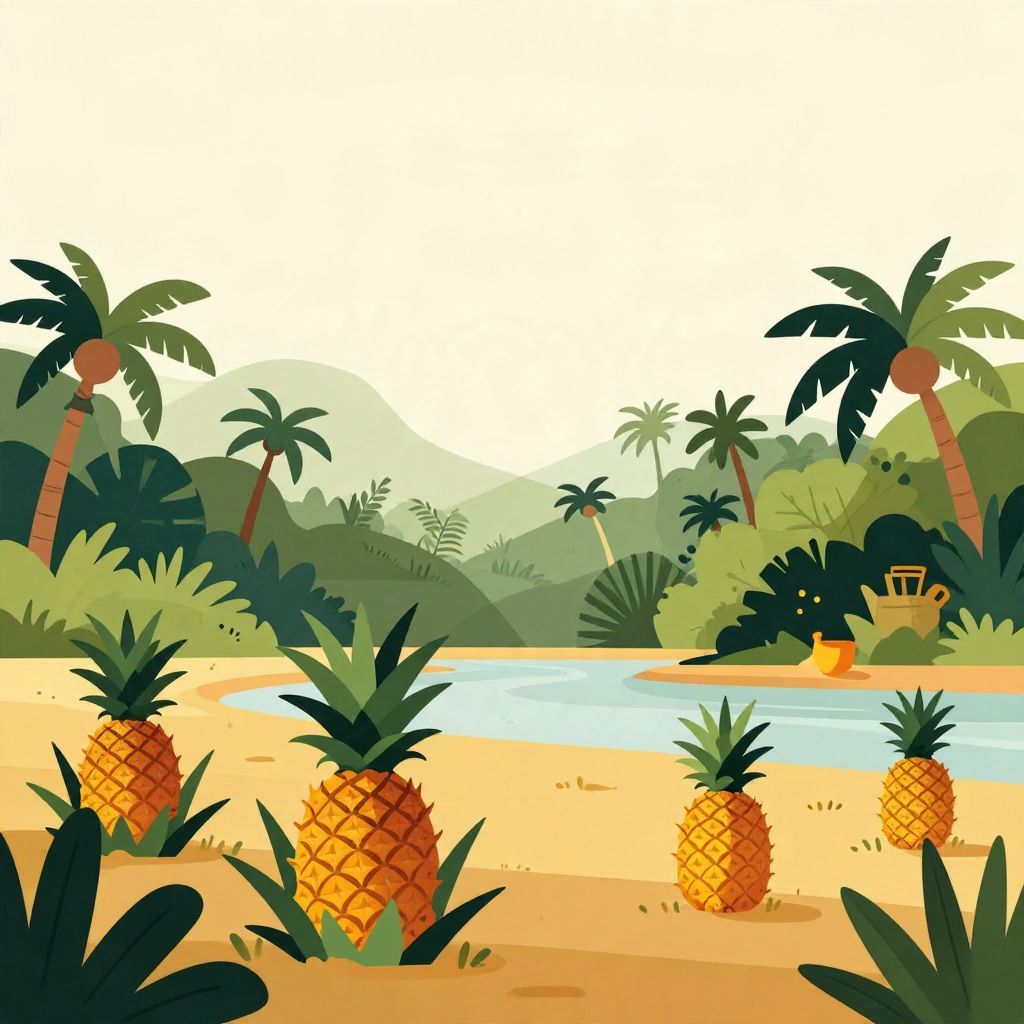
Where did pineapples originate? The short historical answer is that pineapples are native to South America, especially the region of southern Brazil, Paraguay, and nearby areas. Long before Europeans encountered them, Indigenous peoples in tropical South America cultivated and spread the fruit across the continent and into the Caribbean.
From there, the pineapple became one of the most traveled plants in the early modern world, carried by explorers, traders, and colonizers into Africa, Asia, and eventually the Pacific. Its history is a story of Indigenous agriculture, oceanic exchange, and global fascination with an exotic-looking fruit.
Where did pineapples originate?
Pineapples originated in tropical South America, most likely in the area around southern Brazil and Paraguay, where wild and early cultivated forms grew before spreading widely through Indigenous trade networks. By the time Europeans arrived in the Americas, pineapples were already established across much of the Caribbean and parts of Central and South America.
The South American homeland of the pineapple
The pineapple is not an Old World fruit introduced to the Americas; it is an American plant with deep roots in the tropical lowlands of South America. Botanists generally identify the species Ananas comosus as native to the region that includes modern-day southern Brazil and Paraguay, with related wild forms in adjacent areas. Exact “first origin” is hard to pin down because the plant was domesticated long before written records in the region.
Why this region matters
The pineapple thrives in warm, frost-free climates, which makes the tropical and subtropical zones of South America its natural ecological home. Indigenous communities in these regions selected, planted, and moved the fruit over generations. As a result, the pineapple was not simply “found” in one place; it was shaped by long human cultivation across a broad landscape.
Wild ancestors and domestication
Like many crops, the pineapple likely began as a wild or semi-wild plant that was gradually improved through selection. People would have favored fruit that was larger, sweeter, less fibrous, and easier to grow. Over time, cultivation changed the plant enough that the pineapple became a dependable food source and a valuable trade item.
How Indigenous peoples spread pineapples before Europeans arrived
By the late pre-Columbian period, pineapples had spread far beyond their original ecological zone. Indigenous peoples carried them through trade, migration, and cultivation into the Caribbean and parts of Central America. This spread happened centuries before the fruit entered European markets, and it shows how sophisticated Indigenous agricultural systems were in the Americas.
Caribbean cultivation
When Europeans first reached the Caribbean in the late 15th century, they encountered pineapples growing there already. That means the fruit had crossed considerable distances through Indigenous exchange networks. The Caribbean became one of the most important early contact zones for the pineapple because it was there that Europeans first saw, tasted, and described it.
Food, medicine, and cultural use
For Indigenous peoples, the pineapple was more than a novelty. It served as food, a source of sweetness in a tropical diet, and part of local agricultural knowledge. In some communities, plants were also used in ritual or medicinal contexts. These uses varied by region and culture, but they show that the pineapple had a meaningful place in everyday life long before global fame.
How Europeans first encountered the pineapple
Europeans encountered pineapples in the Americas during the age of exploration, especially after Christopher Columbus’s voyages. The fruit quickly attracted attention because it looked unusual, tasted sweet, and seemed unlike anything familiar in Europe. Early chroniclers often described it as a remarkable tropical delicacy.
Why the fruit impressed Europeans
The pineapple stood out for several reasons: its spiky crown, rough exterior, fragrant flesh, and intense sweetness. To Europeans accustomed to temperate-climate produce, it seemed exotic and luxurious. Because it was difficult to transport fresh over long distances, the pineapple soon became associated with rarity, wealth, and prestige.
The name “pineapple” itself
The English word “pineapple” originally referred to the pine cone because of the fruit’s resemblance to it. The name was later applied to the tropical fruit. In many other languages, the fruit’s name reflects its appearance or its association with the Ananas plant rather than the pine cone comparison used in English.
From South America to the wider world
Once Europeans recognized the pineapple’s value, they tried to grow it outside the Americas. This was difficult at first because the plant needed tropical conditions and careful cultivation. Still, through colonial networks, the pineapple eventually spread to Africa, India, Southeast Asia, and the Pacific.
Colonial transport and plantation agriculture
Portuguese and Spanish imperial routes played a major role in moving the pineapple across oceans. The fruit adapted well to many tropical regions, especially where colonial agriculture already relied on enslaved labor and plantation systems. In this way, the pineapple’s global spread was tied not only to curiosity and commerce but also to colonial power and forced labor.
Arrival in Africa and Asia
By the 16th and 17th centuries, pineapples were being cultivated in parts of Africa and Asia. These regions offered climates suitable for the plant, and local farmers incorporated it into existing agricultural systems. Over time, the pineapple became an important tropical crop in many places far from its South American origin.
The pineapple as a symbol of luxury
In Europe and North America, the pineapple became a status symbol because fresh fruit was rare, expensive, and difficult to keep in good condition. Wealthy households and elite hosts displayed pineapples at banquets, and the fruit came to represent hospitality, abundance, and refinement.
Why it was so expensive
Before modern refrigeration and global shipping, transporting a pineapple across the Atlantic was a challenge. Many fruits spoiled before reaching their destination. Growing pineapples in greenhouses or specialized hothouses was possible, but costly. This scarcity made the fruit a luxury object rather than an everyday food in elite settings.
From rarity to common fruit
As cultivation techniques improved and trade expanded, pineapples became more widely available. Today they are grown in many tropical and subtropical regions and shipped around the world. What was once an exotic colonial luxury is now a familiar supermarket fruit, though its historical associations with hospitality and celebration remain strong.
What historians and botanists agree on
There is broad agreement that the pineapple is native to South America and was domesticated there by Indigenous peoples. The main uncertainty lies not in the continent of origin, but in the exact pathway and timeline of domestication. Because the fruit spread before written records in many regions, scholars rely on archaeology, linguistics, botany, and early European descriptions to reconstruct its history.
What is well established
- The pineapple is an American plant, not originally from Europe, Africa, or Asia.
- Its native range is centered in tropical South America.
- Indigenous peoples spread and cultivated it before European contact.
- Europeans first encountered it in the Americas and later carried it around the world.
What remains less certain
- The precise location of the earliest domestication.
- The exact date when cultivated pineapples first appeared in different regions.
- How much of the spread occurred through deliberate trade versus migration and local exchange.
Why the pineapple’s origin story matters
The pineapple’s history is about more than a fruit. It reflects the agricultural knowledge of Indigenous South Americans, the movement of crops across pre-Columbian networks, and the global transformations set in motion by European expansion. Its journey also reveals how plants could become symbols of power, luxury, and empire.
So, where did pineapples originate? They originated in tropical South America, especially the southern Brazil-Paraguay region, and were spread widely by Indigenous peoples long before Europeans made them a global fruit. For more food-history context, you might also enjoy related articles on the history of sugar and the Columbian Exchange.