
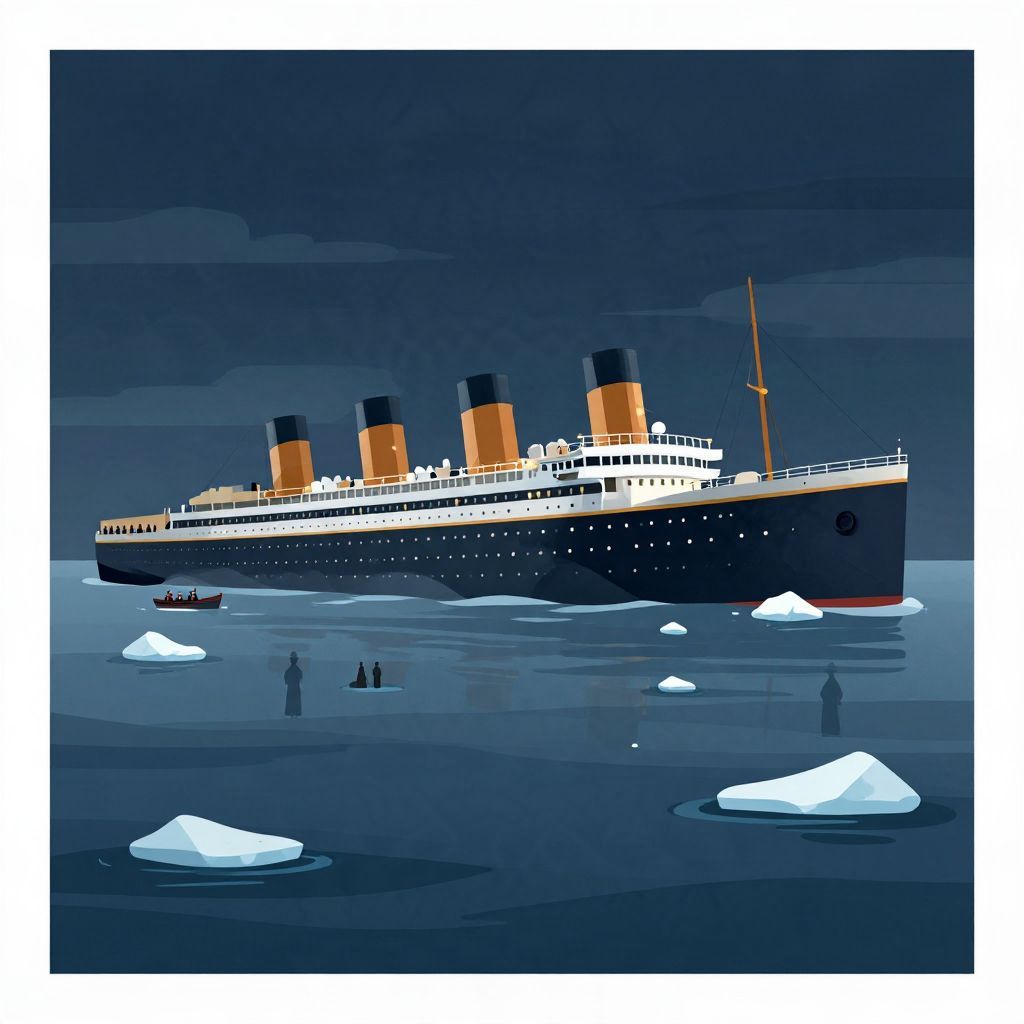
The water when the Titanic sank was brutally cold—cold enough to kill most people within minutes. On the night of 14–15 April 1912, the North Atlantic near the ship was generally estimated at about 28°F to 31°F (roughly -2°C to -1°C), close to the freezing point of seawater.
That temperature mattered as much as the collision itself. Even for strong swimmers, survival in such water was extremely unlikely without immediate rescue or proper protection, which helps explain the disaster’s devastating death toll.
How cold was the water when the Titanic sank?
The water around the Titanic was near freezing, usually estimated at about 28°F to 31°F (-2°C to -1°C). Because seawater freezes at a lower temperature than fresh water, the ocean could remain liquid even while being cold enough to cause rapid hypothermia and loss of consciousness.
Why the temperature was so dangerous
At those temperatures, the human body loses heat extremely fast. Sudden immersion can trigger gasping, panic, and an immediate shock response, followed by rapid exhaustion and loss of coordination. In practical terms, many people in the water that night would have had only a few minutes before they became unable to help themselves.
What happened in the water after the Titanic sank?
After the ship went down in the early hours of 15 April 1912, hundreds of passengers and crew were left in lifeboats or in the sea itself. Those in the water faced the combined effects of freezing temperatures, darkness, and the difficulty of rescue in a crowded disaster scene. The cold was a major reason so few people survived after entering the ocean.
Cold shock and hypothermia
The first danger was not just gradual chilling but cold shock. A sudden plunge into near-freezing water can cause involuntary inhalation, hyperventilation, and disorientation. If the person does not drown immediately, hypothermia follows as the body temperature drops. In the Titanic disaster, many victims likely succumbed to a combination of these effects.
How long could someone survive?
There is no exact survival time for every person, because age, clothing, body size, movement, and physical condition all mattered. Still, in water around freezing, survival without flotation or rescue was often measured in minutes rather than hours. Some people may have remained conscious longer, but functional survival was very short.
Why was the Atlantic so cold that night?
The Titanic struck the iceberg south of Newfoundland, in a region where the Labrador Current brings frigid Arctic water southward. That current helped create the icy conditions in the North Atlantic in April 1912. The presence of icebergs in the area was not unusual for the season, though it was still dangerous for a large liner traveling at speed.
Icebergs and seasonal risk
April was a risky month for North Atlantic shipping routes. Icebergs drifting south from Greenland could remain a threat well into spring. The ocean surface temperature around the Titanic’s route was cold enough to make survival in the water extremely difficult, even before the ship hit the iceberg.
How do historians and researchers know the water was so cold?
Researchers rely on a combination of survivor testimony, weather and ocean data, and later medical understanding of cold-water immersion. While exact measurements from the night itself are limited, the consensus is clear: the water was near freezing. That conclusion fits both the location and the known effects reported by survivors and rescuers.
What the evidence can and cannot prove
It is important to distinguish between well-supported estimates and precise numbers that cannot be verified to the degree of a modern laboratory reading. The commonly cited range is an informed historical estimate, not a single universally recorded measurement from the sinking itself. Even so, the broad picture is not in doubt: the water was lethally cold.
How did the cold water shape the outcome of the disaster?
The freezing ocean dramatically reduced the chances of survival for anyone who entered it. The Titanic carried too few lifeboats for everyone aboard, but even more lifeboats would not have changed the fact that many people were already in immediate danger once exposed to the water. Rescue capacity, not just ship design, became a fatal issue.
The role of lifeboats
Some lifeboats were launched partially filled, and many survivors were rescued from the boats rather than the sea. Those already in the water were far less likely to live long enough to be picked up. The cold therefore magnified every other failure of the night: limited lifeboat space, delayed evacuation, and the time it took to find and retrieve survivors.
How cold is “near freezing” in seawater terms?
Fresh water freezes at 32°F (0°C), but seawater contains salt, which lowers the freezing point. That is why the North Atlantic could be around 28°F to 31°F and still remain liquid. For a person immersed in it, however, the difference between freezing and “just above freezing” is not comforting—it is still extreme cold.
Why saltwater matters
Because seawater freezes at a lower temperature, ocean temperatures can dip below the freezing point of fresh water without turning solid. This makes cold-water disasters especially dangerous in polar and subpolar seas. The Titanic’s location placed it in exactly that kind of environment.
Why the Titanic disaster is remembered through the water temperature
The temperature of the water has become one of the most memorable facts about the sinking because it explains so much of the tragedy. The Titanic did not only sink; it sank into conditions that made rescue from the sea almost impossible. The cold turned a maritime accident into a mass-casualty disaster.
Lasting historical significance
After the sinking, investigations and reforms focused on lifeboats, wireless communication, and ice warnings. The disaster also deepened public understanding of cold-water survival and the limits of human endurance. In that sense, the water temperature is not a minor detail—it is central to why the Titanic story remains so haunting.
In short, the water when the Titanic sank was roughly 28°F to 31°F (-2°C to -1°C), cold enough to make survival in the open sea extraordinarily unlikely. If you want to explore more of the disaster, see what time the Titanic hit the iceberg and how the Titanic broke in half.