
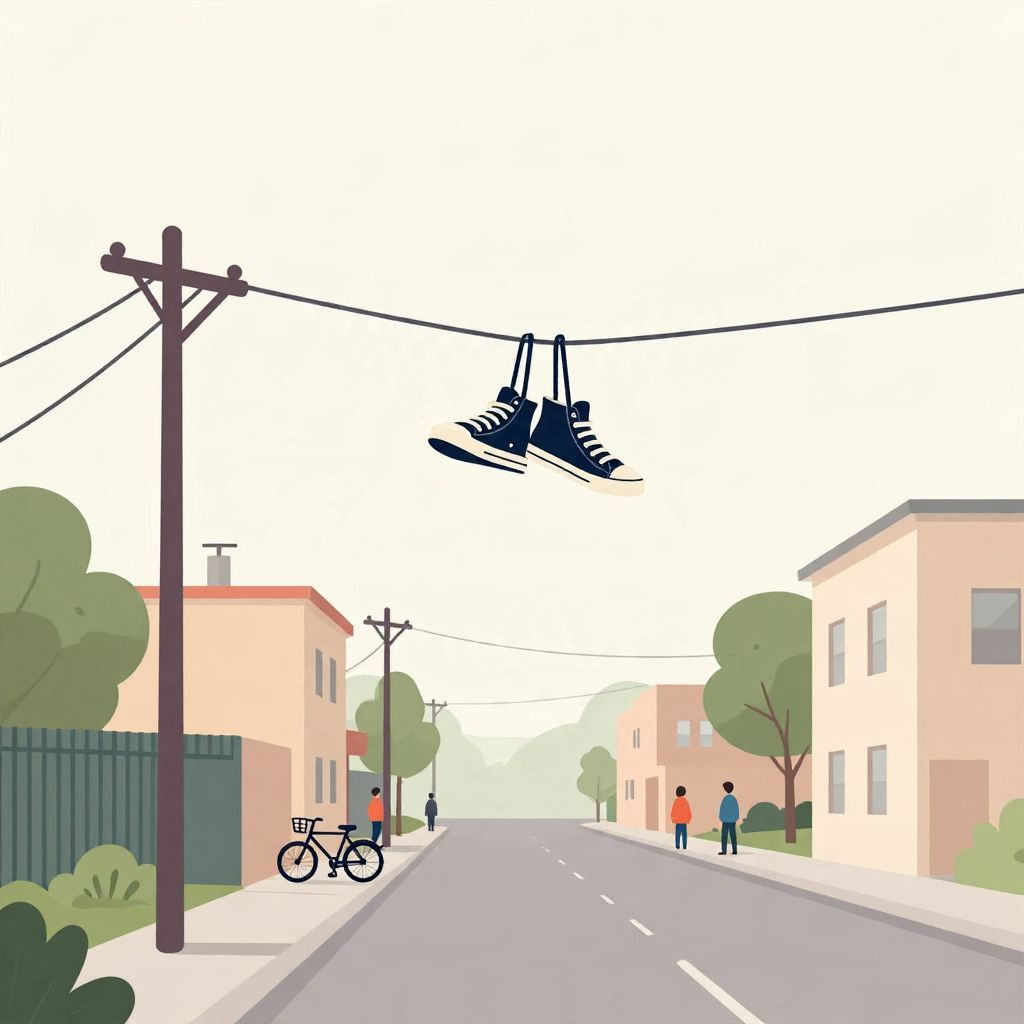
People often ask what shoes on a powerline mean because the sight can seem mysterious, symbolic, or even threatening. The short answer is that there is no single universal meaning. In many places, shoes tossed over power lines are best understood as a modern urban habit whose meaning changes by neighborhood, generation, and local rumor.
Some interpretations are practical, some are playful, and some are tied to folklore or crime myths. The history of the practice is less a single origin story than a collection of explanations that developed in different times and places.
What Does Shoes On A Powerline Mean?
Shoes on a powerline can mean several different things, depending on the context. Historically and culturally, people have linked them to celebration, graduation, gang territory, memorials, pranks, or simple boredom. In most cases, however, there is no confirmed universal code behind them, and the meaning is usually local rather than historical.
The Most Common Explanations
Because the practice is informal, people have attached many meanings to it. Some explanations are widely repeated, but not all are equally well supported. The same pair of shoes can be read very differently from one street to another.
1. A prank or rite of passage
One of the oldest and simplest explanations is that someone threw the shoes up there as a joke or challenge. For children and teenagers, tossing shoes onto wires can be a dare, a display of skill, or a small act of rebellion. In this sense, the shoes are not a coded message at all, but a visible mark of mischief.
2. A sign of celebration or transition
In some communities, shoes on a line have been associated with milestones such as graduation, leaving school, or finishing military service. This meaning is not universal and is often based on local tradition rather than formal custom. The shoes may symbolize moving on from one stage of life to another.
3. A rumored marker of crime or gang activity
Perhaps the most famous modern interpretation is that shoes on power lines mark gang territory or drug-selling locations. This idea is common in popular culture, but historians and urban researchers treat it cautiously. In some neighborhoods, people have believed this to be true, yet there is no reliable evidence that it functions as a consistent, organized system across cities or countries.
4. A memorial or tribute
Sometimes shoes are thrown up in memory of a person who has died, especially if the shoes belonged to them or were placed by friends. In these cases, the act can resemble a spontaneous memorial. Still, without local knowledge, it is impossible to know whether the shoes are intended as tribute or something else.
5. A sign of abandonment or neighborhood change
In some urban areas, people read shoes on wires as part of the visual language of decline, neglect, or changing streetscapes. That interpretation reflects how residents experience their environment more than any fixed historical meaning. The shoes become part of the landscape of a neighborhood rather than a message with one clear code.
Where Did the Practice Come From?
There is no single documented origin for shoes on power lines. The custom appears to have emerged in the 20th century, especially in urban settings where overhead utility wires were common. As cities expanded and telephone and electrical lines spread, the wires themselves became a visible place for objects to land and remain.
The practice likely grew from a mix of youthful play, urban improvisation, and the human tendency to assign meaning to unusual sights. Once shoes appeared on wires often enough, people began to create stories about them. Over time, those stories became part of local folklore.
Why shoes specifically?
Shoes are easy to throw, recognizable from a distance, and often symbolically loaded. They can represent the person who wore them, a stage of life, or the act of leaving something behind. Because shoes are such personal objects, seeing them suspended overhead naturally invites interpretation.
Why power lines?
Power lines and telephone wires are elevated, visible, and accessible from sidewalks, alleys, and schoolyards. They became an accidental public display space. The wires also make the shoes hard to retrieve, which helps the image last long enough to attract attention and stories.
Historical and Cultural Context
The meaning of shoes on a powerline belongs to modern street culture, not to ancient ritual or any single documented tradition. Its history is tied to the growth of cities, the spread of overhead utility infrastructure, and the rise of neighborhood folklore in the 20th century.
In the late 19th and early 20th centuries, many cities began filling with telephone and electrical wires. These wires changed the visual environment of streets and created new opportunities for informal expression. By the mid-20th century, urban youth culture in many places had developed its own symbols, dares, and graffiti-like habits. Shoes on wires fit into that broader world of public, unofficial expression.
As the practice became more visible, it also became more mythologized. People who did not know the local context often explained the shoes through fear, rumor, or moral judgment. That is one reason the same image can still trigger very different reactions today.
Gang Territory Myth: What the Evidence Says
The gang-territory explanation is one of the most persistent modern myths about shoes on power lines. It is repeated so often that many people assume it must be a proven code. In reality, the historical record is much less clear.
Law-enforcement folklore, neighborhood rumor, and media coverage have all helped spread the idea. But researchers and local observers have often found that shoes appear for many unrelated reasons. In other words, the presence of shoes alone is not reliable evidence of gang activity. Treating it as such can lead to mistaken assumptions about a community.
This is an important historical lesson: symbols in public space often acquire meanings after the fact. A practice that begins as a prank or casual act can later be reinterpreted through fear, crime stories, or social tension.
Folklore, Rumor, and Urban Legend
Shoes on a powerline are a good example of how urban legends work. People see something unusual, create an explanation, repeat it, and eventually the explanation can feel like fact. Over time, the story may become more important than the original act.
That process is common in modern history. As cities grew larger and more anonymous, residents relied more on rumor to explain unfamiliar sights. The shoes became a blank canvas for meaning. One neighborhood might see a joke; another might see a memorial; another might see danger.
Why the meaning changes
- Local context: The same image can mean different things in different neighborhoods.
- Timing: Shoes placed near a school, park, or memorial may be read differently than shoes in an alley.
- Community memory: Past incidents can shape how residents interpret later ones.
- Media influence: Movies, news reports, and online posts can spread one explanation widely.
How People Interpret It Today
Today, the meaning of shoes on power lines is still unsettled. In some places, people treat them as harmless street art or a prank. In others, they are seen as signs of a rough neighborhood. Online discussions often amplify the mystery, turning a local oddity into a national talking point.
Modern social media has also changed the story. A photo of shoes on a wire can circulate far beyond the place where it was taken, stripped of its local context. That can make the image seem more symbolic than it really is. Historically, this is a reminder that meaning is often produced by the audience as much as by the original act.
What It Does Not Mean
It is important not to overstate the symbolism. Shoes on a powerline do not have one official meaning, and they are not proof of any single social condition. They are not a universal gang code, and they are not an ancient ritual with a fixed origin. Most of the time, the best historical answer is simply that someone threw the shoes there and the community later assigned meaning to them.
Why This Small Urban Mystery Matters
The history of shoes on a powerline shows how everyday objects can become symbols. It also shows how urban life produces folklore. In crowded modern cities, people constantly interpret signs, from graffiti to abandoned furniture to shoes hanging overhead. Those interpretations reveal as much about the observer’s fears and expectations as they do about the object itself.
That is why this question matters historically. It is not only about shoes. It is about how communities create meaning, how rumors spread, and how ordinary streets become places of memory, anxiety, and storytelling.
So, what does shoes on a powerline mean? Usually, it means that there is no single fixed meaning at all. The practice is a modern urban custom shaped by prank, rumor, symbolism, and local history. If you want to understand it accurately, the most important clue is not the shoes themselves, but the neighborhood and the people who live there.