
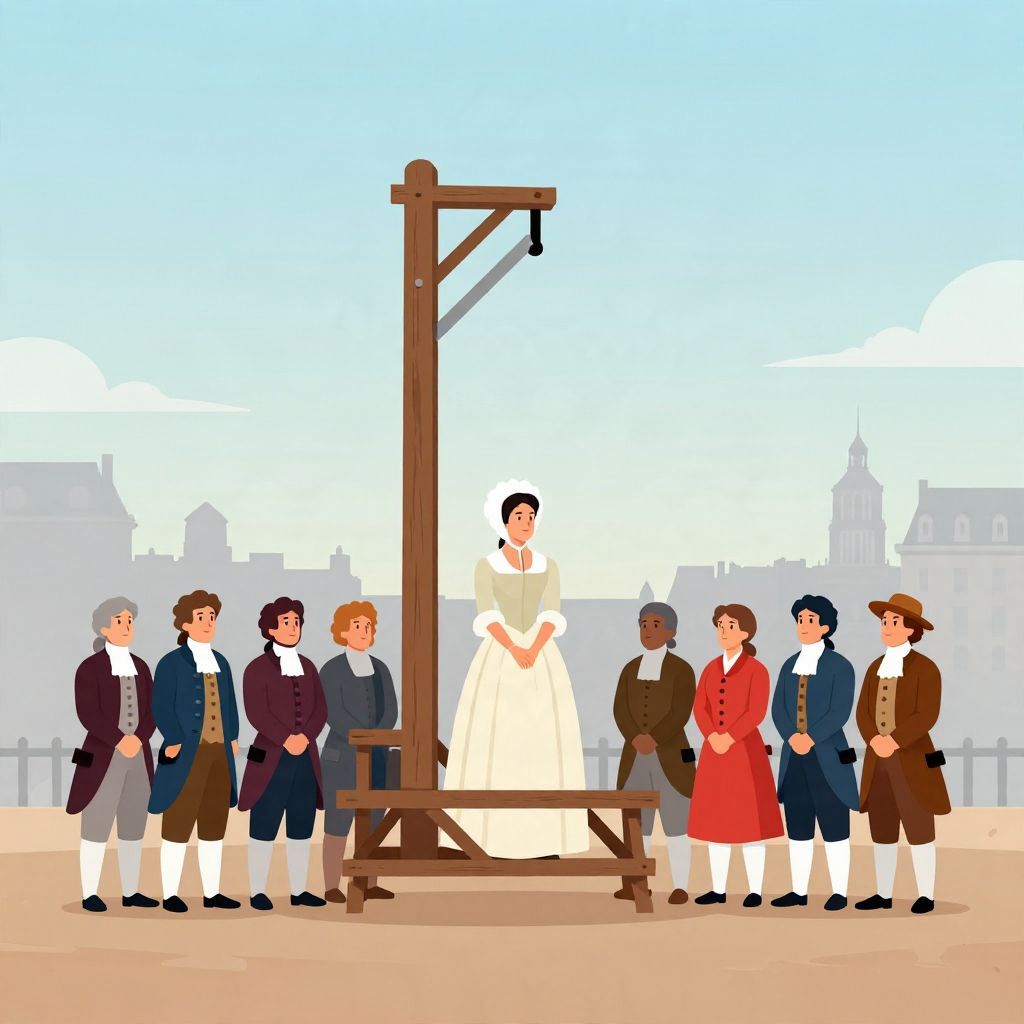
Marie Antoinette died during the French Revolution, executed by guillotine in Paris on 16 October 1793. She had been the queen of France as the wife of Louis XVI, but by the time of her death she was no longer a reigning monarch. Her execution was the result of revolutionary politics, war, and the collapse of trust in the French royal family.
Her death became one of the most famous moments of the Revolution because it symbolized the end of the old regime and the rise of a new, far more radical political order.
How did Marie Antoinette die?
Marie Antoinette was executed by guillotine in Paris on 16 October 1793, after being convicted by the Revolutionary Tribunal of treason and other political crimes. She was taken from prison, brought to the Place de la Révolution, and publicly beheaded. Her death was swift, but it followed months of imprisonment, trial, and political humiliation.
What led to her execution?
Marie Antoinette’s execution was not the result of one single event. It came from years of mounting anger over monarchy, privilege, debt, and the political crisis that engulfed France after 1789. As the Revolution grew more radical, the queen became a powerful symbol of everything many revolutionaries wanted to destroy.
From queen to political target
Born Archduchess Maria Antonia of Austria, Marie Antoinette married the future Louis XVI in 1770. As queen, she was often criticized for spending, court influence, and perceived foreign loyalties. Some of this criticism was exaggerated or unfair, but it mattered politically because public opinion had turned against the royal family long before the monarchy was abolished.
After the Revolution began in 1789, the royal family’s failed flight from France in 1791 deepened suspicion. Many revolutionaries believed the king and queen were secretly working against the nation. Whether or not every accusation was true, the monarchy’s actions made it easier for opponents to portray them as enemies of the Revolution.
War, fear, and radicalization
By 1792, France was at war with several European powers, including Austria. That context mattered enormously. Marie Antoinette was Austrian by birth, and revolutionary propagandists often treated her as a foreign threat. In a time of invasion fears and internal unrest, the queen’s identity made her especially vulnerable to attack.
The monarchy was abolished in September 1792, and Louis XVI was later executed in January 1793. After the king’s death, Marie Antoinette remained imprisoned. Her trial in October 1793 was part of the revolutionary government’s broader effort to eliminate perceived internal enemies during the period often associated with the Reign of Terror.
What happened during her trial?
Marie Antoinette was tried before the Revolutionary Tribunal in Paris. The proceedings were political as much as legal. She was accused of conspiring against France, undermining the state, and even of deeply personal moral crimes designed to discredit her. Some charges were based on politics and wartime fears; others were sensational allegations meant to inflame public opinion.
The main accusations
- Conspiring with foreign powers against France
- Supporting counterrevolutionary efforts
- Using royal influence to weaken the Revolution
- Being morally corrupt, according to hostile revolutionary rhetoric
One of the most notorious moments in the trial came when she was accused of incestuous behavior toward her son. This accusation was widely seen even then as a grotesque attempt to humiliate her. It reflected the revolutionary climate of the time, when political condemnation often mixed with personal attack and public theater.
Marie Antoinette defended herself with composure, but the verdict was never in serious doubt. She was found guilty and sentenced to death. In the revolutionary atmosphere of 1793, the trial served not only to punish her but also to demonstrate the government’s power over the former royal household.
How was Marie Antoinette executed?
On the morning of 16 October 1793, Marie Antoinette was brought from the Conciergerie prison to the scaffold in a simple white dress. She was executed by guillotine in the Place de la Révolution, the same public square where Louis XVI had died earlier that year. The guillotine was presented by revolutionaries as a more equal and “humane” method of execution than older forms of punishment.
The final journey
Unlike the dramatic portraits that later surrounded her death, the actual event was brief. She was escorted through Paris in an open cart, a humiliating public procession meant to display revolutionary justice. Contemporary accounts suggest she maintained her composure, though details vary depending on the source.
After her execution, her body was buried in a common grave. Like many victims of the Revolution, she was denied the ceremonial burial that would once have accompanied royal death. Her remains were later reinterred after the Bourbon Restoration, when the monarchy returned in 1814.
Why did the revolutionaries kill Marie Antoinette?
Revolutionary leaders did not execute Marie Antoinette simply because she had been queen. They killed her because she had become a political symbol. To many revolutionaries, she represented monarchy, privilege, foreign influence, and resistance to the new order. Her death was meant to protect the Revolution and warn its enemies.
Symbol over individual
In revolutionary politics, symbols mattered as much as institutions. Marie Antoinette was not only a person; she was a public image onto which fears and resentments were projected. Her Austrian birth, her court reputation, and the monarchy’s political failures all made her an easy target.
That does not mean all criticism of her was invented. The royal court did spend lavishly, and the monarchy did lose legitimacy. But the violence of her execution went far beyond criticism. It reflected a revolutionary government that had moved from reform to coercion, and from reformist politics to survival through terror.
The role of the Reign of Terror
Marie Antoinette’s death took place during the Reign of Terror, a period when the revolutionary government used mass arrests and executions to defend itself against perceived threats. In that climate, legal process and political judgment were closely intertwined. Her execution was both a punishment and a political message.
For many contemporaries, the queen’s death showed how far the Revolution had gone. For supporters of the revolutionary government, it was a necessary act against treason. For opponents, it became evidence of revolutionary cruelty. Historians continue to study both the political logic and the human cost of that moment.
What happened after her death?
Marie Antoinette’s execution did not end the Revolution, but it marked a turning point. The monarchy was already gone, and her death confirmed that no member of the royal family was beyond revolutionary justice. Yet the violence of 1793 also helped shape later memories of the Revolution as a time of extremism and bloodshed.
Historical significance
- It symbolized the collapse of the French monarchy
- It showed the radicalization of revolutionary justice
- It deepened the divide between revolutionary and royalist memory
- It helped turn Marie Antoinette into a lasting historical figure
In later centuries, Marie Antoinette became a figure of fascination, blame, sympathy, and myth. Some remembered her as a frivolous queen; others as a scapegoat destroyed by politics. Modern historians usually take a more balanced view, recognizing both her limitations as a political actor and the extent to which she was demonized by enemies of the monarchy.
Myths and misunderstandings about her death
Because Marie Antoinette’s death is so famous, it has attracted many legends. Some are romantic inventions, while others are distortions of the historical record. Separating fact from later storytelling helps explain what really happened.
Common misconceptions
- Myth: She was executed because of one single scandal.
Reality: Her death resulted from a long political crisis and revolutionary radicalization. - Myth: The trial was a normal criminal case.
Reality: It was a highly political proceeding shaped by wartime fears. - Myth: She was killed only for being unpopular.
Reality: She was executed because revolutionaries saw her as a threat to the Republic.
It is also important not to confuse later romantic images of Marie Antoinette with the historical woman. Much of what people “know” about her comes from propaganda, memoirs, or later retellings. The historical record shows a queen caught in a revolutionary crisis that she could not control and could not escape.
Why does Marie Antoinette’s death still matter?
Marie Antoinette’s death matters because it captures a central truth about revolutions: they do not only change governments, they change the meaning of power, justice, and public life. Her execution was not just the death of a queen. It was a declaration that the old social order had been overthrown, and that political legitimacy now belonged to the revolutionary state.
At the same time, her fate reminds us that revolutions can produce both liberation and brutality. Marie Antoinette was a symbol, but she was also a person who faced imprisonment, public humiliation, and death. Her story remains important because it shows how quickly political fear can turn human beings into enemies of the state.
In short, Marie Antoinette died by guillotine in Paris on 16 October 1793 after a revolutionary trial, and her execution became one of the defining events of the French Revolution. If you want to explore the political buildup behind it, see why Marie Antoinette was executed and why Marie Antoinette was killed.