
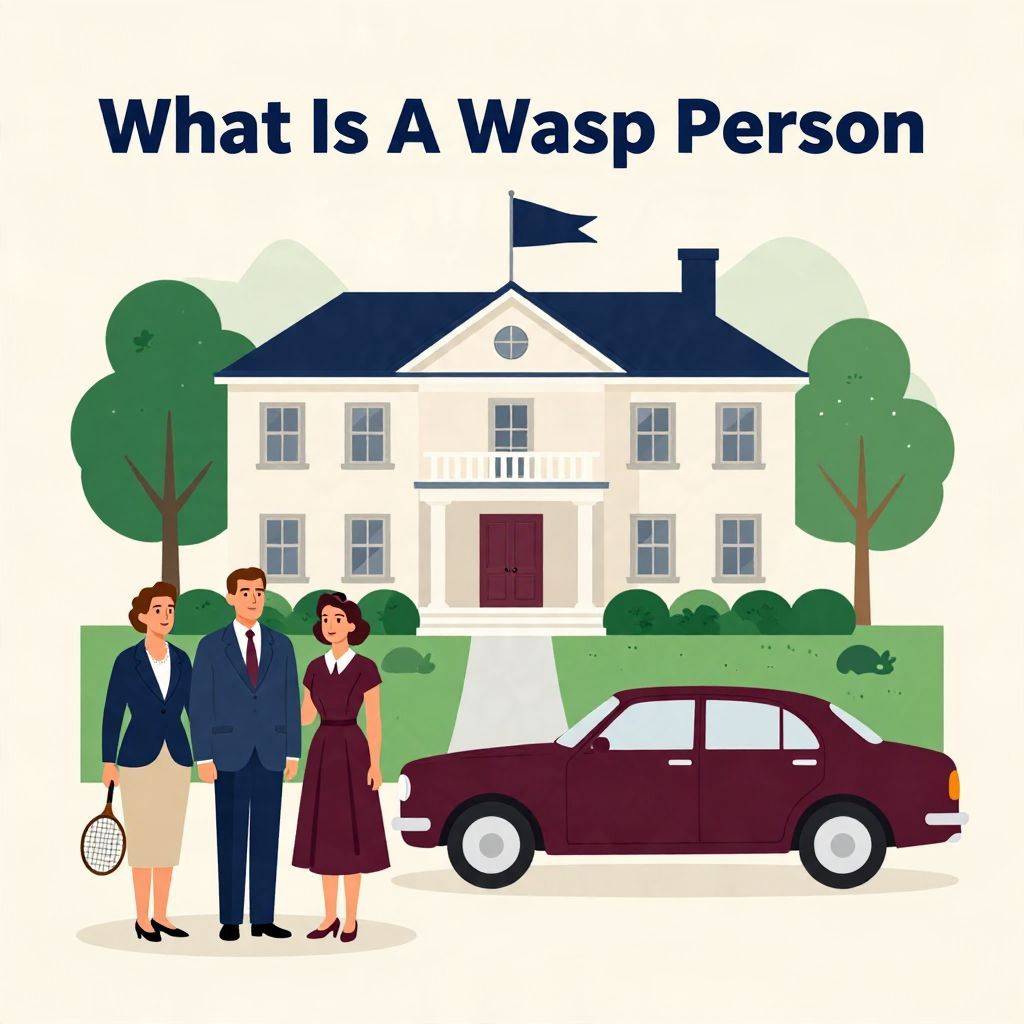
What is a WASP person? In American history, “WASP” usually means White Anglo-Saxon Protestant: a shorthand label for people, families, and social circles associated with white, English-descended, Protestant Americans, especially those long linked to political, educational, and economic power.
The term is not a formal ethnic category. It is a social and cultural label that became especially useful in the 20th century, when Americans used it to describe a powerful establishment class and, sometimes, to criticize its influence.
What is a WASP person?
A WASP person is generally understood as a white American of English or broader British ancestry who identifies with Protestant traditions. The phrase became popular in the mid-20th century as a way to describe a historically influential social group, especially in the Northeast and upper-middle and upper classes.
Where did the term WASP come from?
The acronym WASP emerged in the United States in the 20th century, though the social reality behind it was much older. It condensed three ideas—whiteness, English ancestry, and Protestantism—into a single label used to identify a dominant cultural group in American public life.
The older social background
From the colonial era onward, many of the most influential settlers in British North America were English Protestants. Their language, laws, religious institutions, and political habits shaped early colonial society. Over time, these families and their descendants often occupied positions of wealth and status, especially in the original English colonies and later in national institutions.
Why the label mattered later
By the 19th and early 20th centuries, the United States had become far more diverse through immigration from Ireland, Germany, Italy, Eastern Europe, and elsewhere. In that changing society, “WASP” came to identify not just ancestry or religion but a broader establishment culture that many people saw as setting the norms of American respectability and power.
What did WASP mean historically?
Historically, WASP referred less to a strict genealogy than to a social identity. It described people who were often assumed to belong to the mainstream of American leadership: old family names, Protestant churches, elite schools, private clubs, and professional networks. The term also carried a critical edge, because it implied exclusion as well as privilege.
Not every white Protestant was a WASP
It is important not to use the term too broadly. Many white Protestants in the United States were poor, rural, immigrant, or outside elite circles. Likewise, some people with English ancestry did not fit the social profile associated with WASPs. The term usually pointed to status, culture, and institutional influence, not simply ancestry.
Not a fixed ethnic identity
Unlike an ethnicity in the strict sense, WASP identity was fluid and socially constructed. It depended on who was doing the labeling and in what context. In some settings it was neutral shorthand; in others it was used satirically or critically to describe a perceived establishment class.
How did WASP culture develop in America?
WASP culture developed through the long dominance of English Protestant settlers in colonial America and the early republic. Their traditions shaped local government, education, moral codes, and public life. As the United States expanded, these patterns became associated with social leadership, especially in older Atlantic coastal cities.
Colonial foundations
In New England, Puritan communities emphasized literacy, church discipline, and community order. In the South, Anglican elites developed plantation societies with strong class hierarchies. Though these regions differed, both helped establish the political and cultural influence of English Protestant settlers.
Republican leadership and elite institutions
After independence, many leading political families came from Protestant Anglo-American backgrounds. In the 19th century, elite colleges, prep schools, inherited wealth, and exclusive clubs reinforced these networks. The result was not a single unified bloc, but a recognizable upper-class culture that outsiders increasingly noticed.
Immigration and the rise of “old stock” identity
As new immigrant communities grew, some native-born Protestants began to think of themselves as “old stock” Americans. This was not merely a matter of ancestry; it was also a response to social change, urbanization, and competition over jobs, politics, and cultural authority. The WASP idea later captured that older establishment identity.
What are the key traits associated with WASPs?
Commonly associated traits include English or British ancestry, Protestant church affiliation, upper or upper-middle-class status, and ties to established institutions. In popular culture, WASPs were often linked with restraint, reserve, education, and social exclusivity, though these traits were stereotypes as much as descriptions.
- Ancestry: usually English, sometimes broader British or Northern European in practice
- Religion: Protestant denominations such as Episcopal, Presbyterian, Congregationalist, Methodist, or Lutheran in some usages
- Social position: often affluent or professionally influential
- Institutions: elite schools, universities, clubs, law firms, banks, and political networks
- Culture: manners, restraint, and a preference for established social codes
Religion was central, but not always strictly observed
Protestantism mattered because it shaped moral language, family life, and social networks. Yet many people labeled WASP were not especially devout. In practice, the term often referred to cultural Protestantism as much as religious belief.
How was the term used in modern America?
By the mid-20th century, “WASP” was widely used in journalism, politics, and social commentary. It could describe a real social class, but it also became a shorthand for privilege, conformity, and exclusion. The term gained force during debates over immigration, civil rights, and access to elite institutions.
A label of power and criticism
For some, being called WASP implied prestige and traditional respectability. For others, it pointed to a narrow establishment that had long dominated universities, corporations, and politics. The word therefore carried both descriptive and critical meanings, depending on the speaker.
Changing meanings after World War II
After World War II, American society became more open in some ways and more self-conscious about old hierarchies in others. Jewish Americans, Catholics, African Americans, and later other groups challenged older patterns of exclusion. As these changes unfolded, WASP became less a universal norm and more one identity among many.
Was WASP ever an official category?
No. WASP was never an official census category, legal status, or government classification. It is a social term created by observers to describe a pattern of ancestry, religion, and class. Because it is informal, its meaning can shift depending on context and historical period.
Why historians treat it carefully
Historians use the term cautiously because it can oversimplify. Not all white Protestants had equal power, and not all powerful Americans were WASPs. Wealth, region, gender, race, and family background all mattered. The term is useful only when it helps explain a broader social pattern rather than replace historical complexity.
Common misconceptions about WASP identity
Several misunderstandings surround the term. One is that it refers to all white Americans of English descent. Another is that it describes a single unified group with identical beliefs. In reality, WASP identity was broad, internally divided, and shaped by changing class and regional differences.
Misconception 1: It means simply “white Protestant”
That definition is too broad. Many white Protestants were not part of the elite or establishment culture associated with the term. The “A” in Anglo-Saxon also reflects an older, sometimes idealized idea of English heritage rather than a precise ethnic measurement.
Misconception 2: It describes a timeless American majority
WASP influence was historically significant, but it was never the whole country. The United States has always included Native peoples, enslaved Africans and their descendants, immigrants, Catholics, Jews, and many other communities. The WASP label helps explain one powerful strand of American history, not the entire national story.
Misconception 3: It is only about ancestry
In practice, the term often pointed to class and culture. A family’s schooling, neighborhood, church, accent, and social connections could matter as much as bloodline. That is why the label is best understood as a social category, not a simple ethnic fact.
Why does the term still matter today?
The phrase “WASP” still appears because it captures a real historical pattern: the long dominance of white, English-descended Protestant elites in many parts of American life. Even as their monopoly weakened, their influence shaped institutions, traditions, and ideas about who counted as “mainstream.”
Its legacy in American institutions
Elite universities, old financial firms, private clubs, and certain political traditions were once heavily shaped by this group. Many of those institutions have diversified, but their historical roots remain part of American social history. Studying WASPs helps explain how power was organized and normalized.
Its limits as a modern label
Today, the term can sound dated or overly broad. Many Americans who might once have been described as WASP no longer fit the old social pattern, and the country’s diversity has transformed the meaning of cultural belonging. Still, the label remains useful for understanding older class structures and social hierarchies.
What should you remember about a WASP person?
A WASP person is best understood as someone associated with the historically influential White Anglo-Saxon Protestant establishment in the United States. The term describes a social world shaped by English Protestant heritage, class privilege, and institutional power, not a rigid biological or legal identity.
In short, WASP is a historically loaded label for a group that helped define American elite culture for generations. To understand it fully, it helps to see both its roots in colonial English Protestant society and its later role in debates over class, identity, and power. For related context, you may also want to read about nationalism in history and American imperialism.