
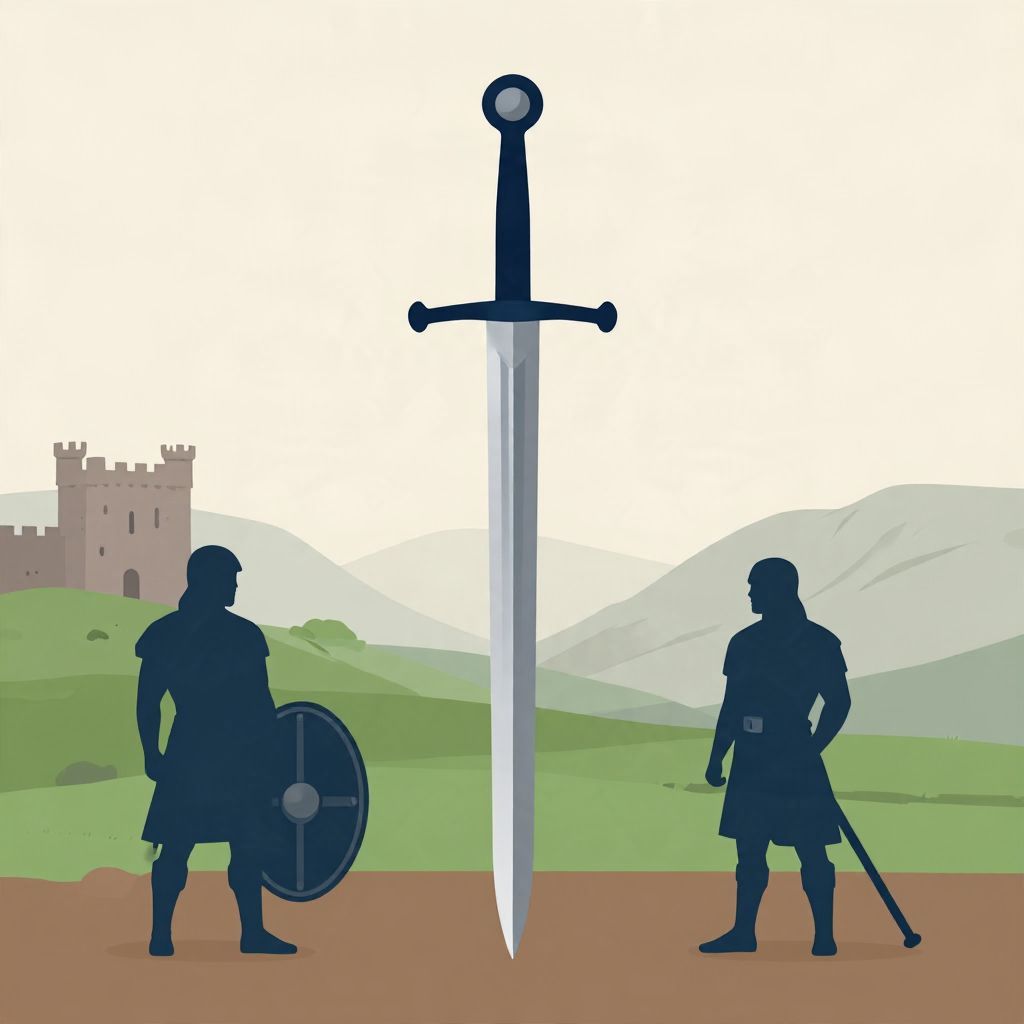
What is a claymore? The word most often refers to a large Scottish sword, usually associated with Highland warriors from the late medieval and early modern periods. In popular culture, “claymore” can also mean a Scottish two-handed sword, though historians note that the term has been used in more than one way over time.
Because of that, the answer depends partly on context: a claymore may mean a basket-hilted broadsword or the earlier two-handed Highland sword. Both are tied to Scotland’s martial history and to the changing ways Scottish fighters met war, clan conflict, and state power.
What Is a Claymore?
A claymore is a traditional Scottish sword, best known as a large battlefield weapon from the late Middle Ages and early modern era. In strict historical usage, the term can refer either to the two-handed sword used in the 15th to 17th centuries or, more broadly in later English usage, to the basket-hilted broadsword carried by Highland soldiers. The word itself comes from Scottish Gaelic and means “great sword.”
The two main meanings of “claymore”
The two-handed claymore
The claymore most closely associated with Highland warriors was a long, two-handed sword used roughly from the 1400s into the 1600s. It had a long grip, a straight double-edged blade, and a crossguard with sloping arms that often ended in quatrefoil or quatrefoil-like shapes. This weapon was designed for reach, power, and cutting ability in close combat.
The basket-hilted sword
By the 17th and 18th centuries, many Scottish fighters used basket-hilted broadswords. These are sometimes called claymores in English-language sources, especially in later popular writing. They were shorter than the two-handed version and were paired with a protective metal basket around the hand. Strictly speaking, many historians prefer to reserve “claymore” for the earlier two-handed sword, but common usage has blurred the distinction.
Where did the claymore come from?
The claymore emerged in the context of late medieval Scotland, where warfare was shaped by clan rivalries, border conflict, and shifting alliances with England and continental Europe. Scottish swordsmen did not develop in isolation; their weapons reflected broader European trends in sword design, especially the move toward longer blades for mounted and infantry combat. The claymore was part of a wider family of greatswords used across Europe.
Gaelic origin of the name
The term is derived from Scottish Gaelic claidheamh mòr, meaning “great sword.” This name describes the weapon’s impressive size rather than a single exact model. That linguistic point matters, because historical names were often flexible. A weapon could be called a “great sword” in one period and later be narrowed in meaning by collectors, antiquarians, and museum labels.
When was the claymore used?
The two-handed claymore is generally associated with the 15th to 17th centuries, especially in Highland Scotland. It appears in a period when infantry tactics were changing and when swords remained important symbols of status as well as practical weapons. The basket-hilted broadsword became more prominent later, especially in the 17th and 18th centuries, when firearms increasingly dominated warfare but swords still mattered in close fighting.
A simple chronology
- Late 1400s: large two-handed swords become more visible in Scottish and wider European warfare.
- 1500s: the claymore is strongly associated with Highland fighters and clan warfare.
- 1600s: basket-hilted swords spread, while the two-handed form gradually declines.
- 1700s: the broadsword remains a symbol of Highland martial identity, even as military technology changes.
What did a claymore look like?
The classic two-handed claymore was a very large sword, often around 4 feet long or more, though surviving examples vary. It usually had a long grip for both hands, a straight blade, and a simple guard with forward-sloping arms. Unlike later cavalry sabers or curved swords, it was built for powerful cuts and controlled thrusts rather than sweeping mounted slashes.
Key physical features
- Blade: long, straight, and double-edged
- Grip: extended to allow two-handed use
- Crossguard: often angled downward toward the blade
- Purpose: reach, force, and battlefield intimidation
The basket-hilted version looks different. Its defining feature is the protective metal basket around the hilt, which shields the hand from cuts. This later sword is usually shorter and more practical for the close, fast fighting of the early modern period.
How was the claymore used in battle?
The claymore was a weapon of reach and momentum. In skilled hands, it could deliver heavy cuts and keep an opponent at distance. The two-handed version was especially useful for infantry fighting, where a warrior needed both leverage and room to swing. It was not a magical weapon, and it was not used in exactly the same way in every battle; its effectiveness depended on training, terrain, armor, and the opponent’s weapons.
Against armor and pikes
In the late medieval period, swords were often used alongside spears, axes, bows, and polearms. A claymore was not designed to defeat heavy plate armor by brute force alone, but it could still be dangerous in the chaos of battle, especially against less armored opponents. In later centuries, as pikes and firearms became more common, swords became secondary weapons, though still important in melee combat and personal defense.
Why is the claymore so closely linked to Highland Scotland?
The claymore became a powerful symbol of Highland identity because it fit the image of the clan warrior: mobile, fierce, and independent. Highland society had its own political and military traditions, and swords played a visible role in elite culture. Over time, writers, artists, and later national romanticism turned the claymore into an emblem of Scotland itself, even though many Scots outside the Highlands also used swords of similar types.
From weapon to symbol
By the 18th and 19th centuries, the claymore was no longer just a practical weapon. It became part of a larger story about Scottish heritage, especially after the Jacobite uprisings and the cultural transformation of the Highlands. Romantic literature and art helped fix the claymore in the public imagination as the sword of the proud Highlander.
Was the claymore a unique Scottish invention?
Not entirely. The claymore was distinctly associated with Scotland, but it belonged to a broader European world of great swords and long blades. Similar weapons existed in other regions, and swordmaking techniques moved across borders through trade, war, and craftsmanship. What made the claymore special was not that it appeared from nowhere, but that Scotland adapted the greatsword tradition to its own military and cultural setting.
Claymore in popular culture
Today, the claymore appears in films, games, museums, reenactment groups, and tourist imagery. Popular culture often exaggerates its size or uses the term loosely for any large Scottish sword. This has helped keep the weapon famous, but it has also created confusion. A museum label, a historical reenactor, and a fantasy novel may all use “claymore” differently, so context matters.
Common misconceptions
- It was not always the same sword type in every period.
- It was not used only by Highlanders, though they are strongly associated with it.
- It was not a single standardized model with one fixed shape.
- It was a real battlefield weapon, not just a ceremonial object.
Why does the claymore matter historically?
The claymore matters because it reveals how weapons reflect social change. It shows the evolution of warfare from medieval hand-to-hand combat toward the firearm age. It also illustrates how a weapon can become a cultural symbol long after its military usefulness fades. In Scotland’s case, the claymore is both a practical artifact of war and a lasting emblem of identity, memory, and historical imagination.
In short, a claymore is a great Scottish sword, most accurately the large two-handed blade of the late medieval and early modern Highlands, though the term later expanded to include basket-hilted broadswords. Its history blends real battlefield use with later myth and national symbolism. If you want more on related topics, you can also explore what a scimitar is or read about what a kilt is.