
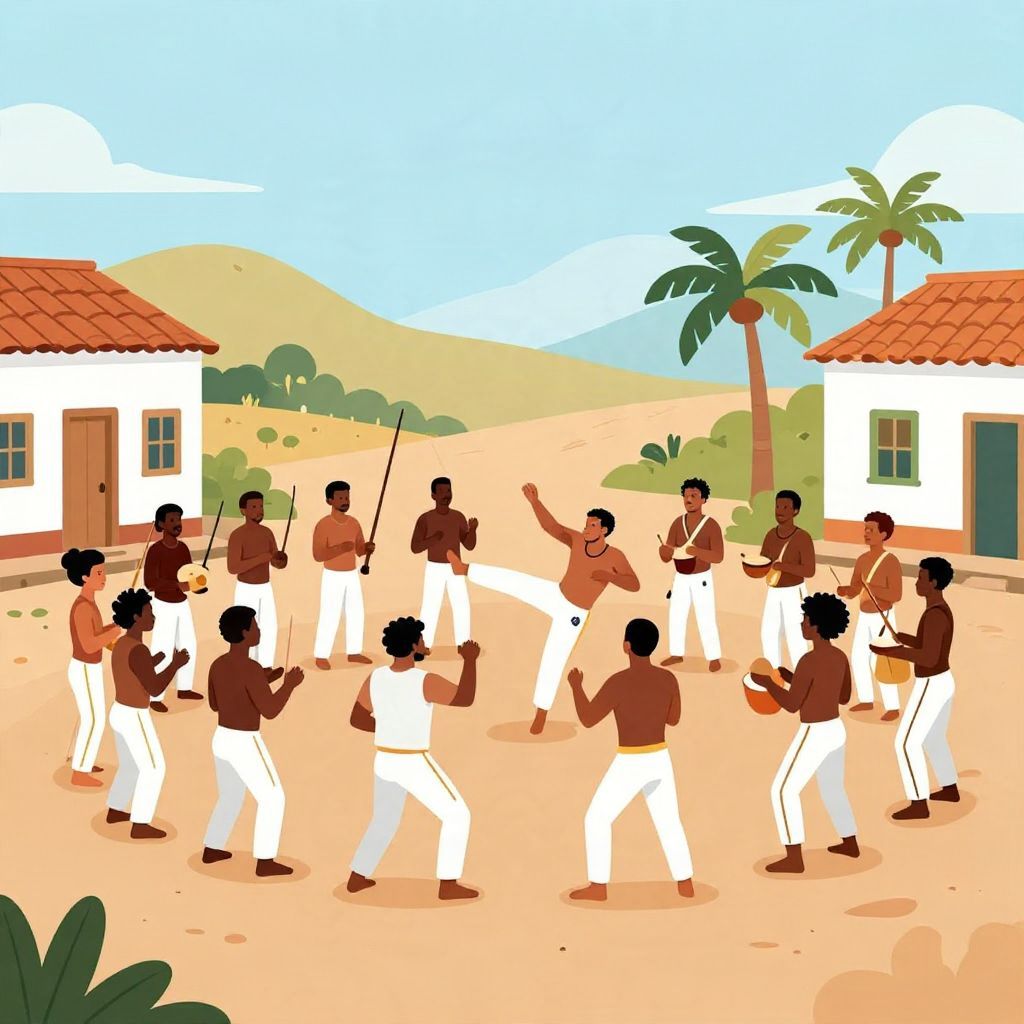
What is capoeira? It is a Brazilian martial art, dance, and game that combines fighting techniques with music, rhythm, acrobatics, and ritualized movement. Today it is practiced worldwide, but its roots lie in the history of slavery, resistance, and Afro-Brazilian culture.
Capoeira developed in Brazil during the colonial era, especially among Africans and their descendants who were enslaved there. Its exact origins are debated, but historians generally agree that it emerged from a mix of African fighting traditions, Brazilian social conditions, and the need for self-defense under slavery.
What Is Capoeira?
Capoeira is an Afro-Brazilian practice that blends combat, performance, and music. Players face each other inside a circle called a roda, using kicks, sweeps, evasion, and acrobatic movements to “play” rather than simply strike. It is both a martial art and a cultural expression shaped by oppression, creativity, and community.
Where Did Capoeira Come From?
Capoeira emerged in colonial Brazil, likely between the 17th and 19th centuries, among enslaved Africans and their descendants. Because enslaved people were often prohibited from carrying weapons or training openly, capoeira’s movements may have developed as a disguised form of self-defense and social bonding. Scholars also note that it was not created from one single source.
African roots and Brazilian development
The strongest historical interpretation is that capoeira grew from multiple African traditions brought to Brazil through the Atlantic slave trade, especially from Central and West Africa. These influences then changed in Brazil, where Africans from different regions were forced together and adapted their practices to new conditions. In this sense, capoeira is both African-derived and distinctly Brazilian.
Popular stories sometimes claim capoeira came from a single African fighting style or from one specific ethnic group. That is too simple. The historical evidence points instead to cultural blending over time, not a single inventor or exact birthplace.
Why secrecy mattered
Under slavery, open resistance could be punished severely. Capoeira may have offered a way to train for defense while appearing to be dance or play. Its music, rhythm, and circular format could help conceal its martial purpose. Even after emancipation, capoeira remained associated with poor urban communities, street life, and resistance to authority.
How Did Capoeira Develop Over Time?
Capoeira changed significantly from the colonial period to the modern era. It moved from enslaved communities to free Black and mixed-race urban groups, then became criminalized by the state, and finally was reimagined as a national cultural symbol. Its history is therefore not a straight line but a series of transformations.
Colonial and early national Brazil
By the late colonial and early imperial periods, capoeira was visible in cities such as Rio de Janeiro, Salvador, and Recife. Historical records from the 19th century show authorities treating capoeira practitioners as a public order problem. Groups of capoeiras were sometimes linked to street violence, political factionalism, and neighborhood defense, though not all practitioners were criminals.
In this period, capoeira was not yet the polished, standardized art many people know today. It was often rougher, more local, and more closely tied to urban survival. Its social meaning depended on who was practicing it and in what setting.
Criminalization in the 19th and early 20th centuries
After slavery ended in Brazil in 1888, capoeira did not immediately gain acceptance. In fact, the new republic criminalized it in the Penal Code of 1890. Practitioners could be arrested, punished, or deported. This reflected elite fears of Black mobilization, disorder, and popular culture outside state control.
Despite repression, capoeira survived in informal spaces. Teachers, musicians, and community leaders kept the tradition alive, often adapting it to avoid police attention. This survival was crucial: without those informal networks, capoeira might have disappeared or been absorbed into other forms.
Recognition and modernization
In the 20th century, capoeira gained new legitimacy. Important masters helped systematize teaching methods and public presentation. Two especially influential figures were Mestre Bimba, who developed Capoeira Regional in the 1930s, and Mestre Pastinha, who championed Capoeira Angola, emphasizing older traditions, strategy, and ritual.
Under these masters, capoeira became more organized, with clearer training methods, formal schools, and public demonstrations. The Brazilian state gradually shifted from repression to cultural promotion, and capoeira came to be seen as part of national heritage rather than a threat.
How Is Capoeira Practiced?
Capoeira is usually practiced in a roda, a circle formed by participants and musicians. Two players enter the center and exchange movements in a controlled, responsive dialogue. The goal is not necessarily to injure the opponent but to demonstrate skill, timing, creativity, and awareness.
The role of music
Music is central to capoeira. Instruments commonly include the berimbau, a single-string musical bow that leads the rhythm, along with drums, tambourines, and handclapping. Songs can guide the pace of the game, preserve memory, and connect players to capoeira’s history. In many traditions, music is not an accessory; it is part of the art itself.
Movement and strategy
Capoeira uses low stances, spinning kicks, evasions, feints, sweeps, and acrobatic transitions. The body is constantly in motion, often close to the ground. Because attacks are often disguised as dance-like movement, capoeira rewards deception, timing, and improvisation. It is as much about reading an opponent as about physical strength.
There are different styles and schools, but most share a common emphasis on rhythm, responsiveness, and ritual. That combination makes capoeira unusual among martial arts and explains why outsiders often struggle to classify it neatly.
What Makes Capoeira Historically Important?
Capoeira matters because it reveals how oppressed communities can preserve identity and agency under extreme pressure. It is not only a fighting method but also a historical record of African diaspora life in Brazil. Its survival shows how culture can function as resistance, memory, and adaptation at the same time.
Resistance and survival
For enslaved and marginalized people, capoeira could offer practical defense, physical training, and social cohesion. Even when it was criminalized, it remained a way to build community and transmit knowledge. Its history therefore belongs not just to martial arts but to the broader history of slavery and emancipation in the Americas.
Afro-Brazilian identity
Capoeira is also a major expression of Afro-Brazilian culture. Alongside music, religion, language, and cuisine, it helped shape a cultural world that survived despite violence and exclusion. In the 20th and 21st centuries, capoeira became a source of pride for many Brazilians and a global symbol of Brazilian cultural creativity.
Common Misconceptions About Capoeira
Because capoeira looks like dance and fight at the same time, it is often misunderstood. Clearing up a few common misconceptions helps explain its history more accurately.
- It was not invented by one person. Capoeira developed over time through many communities.
- It is not “just dance.” Dance elements are real, but so are combat techniques and strategic movement.
- It is not purely African or purely Brazilian. It is an Afro-Brazilian creation shaped by both African heritage and Brazilian colonial conditions.
- It was not always legal or celebrated. For much of its history, capoeira was stigmatized and punished.
Capoeira Today
Today capoeira is practiced around the world in schools, cultural centers, and community groups. It is taught as a martial art, a fitness practice, a musical tradition, and a heritage art. In Brazil, it has become a symbol of national culture, while also remaining a living reminder of slavery, resistance, and Black creativity.
Modern capoeira includes both tradition and change. Some groups emphasize historical forms and ritual, while others focus on sport, performance, or education. This flexibility has helped capoeira spread globally without losing its connection to its origins.
Key Facts About Capoeira
- Origin: Colonial Brazil, with roots in African diaspora communities.
- Historical context: Developed under slavery and racial oppression.
- Main elements: Movement, music, song, ritual, and strategy.
- Important styles: Capoeira Angola and Capoeira Regional.
- Modern status: Recognized internationally as a cultural practice and heritage tradition.
So, what is capoeira? Historically, it is an Afro-Brazilian form of embodied resistance that became a martial art, musical tradition, and cultural performance. Its story runs from slavery and criminalization to recognition and global spread, making it one of the most distinctive cultural creations in the history of the Atlantic world.