
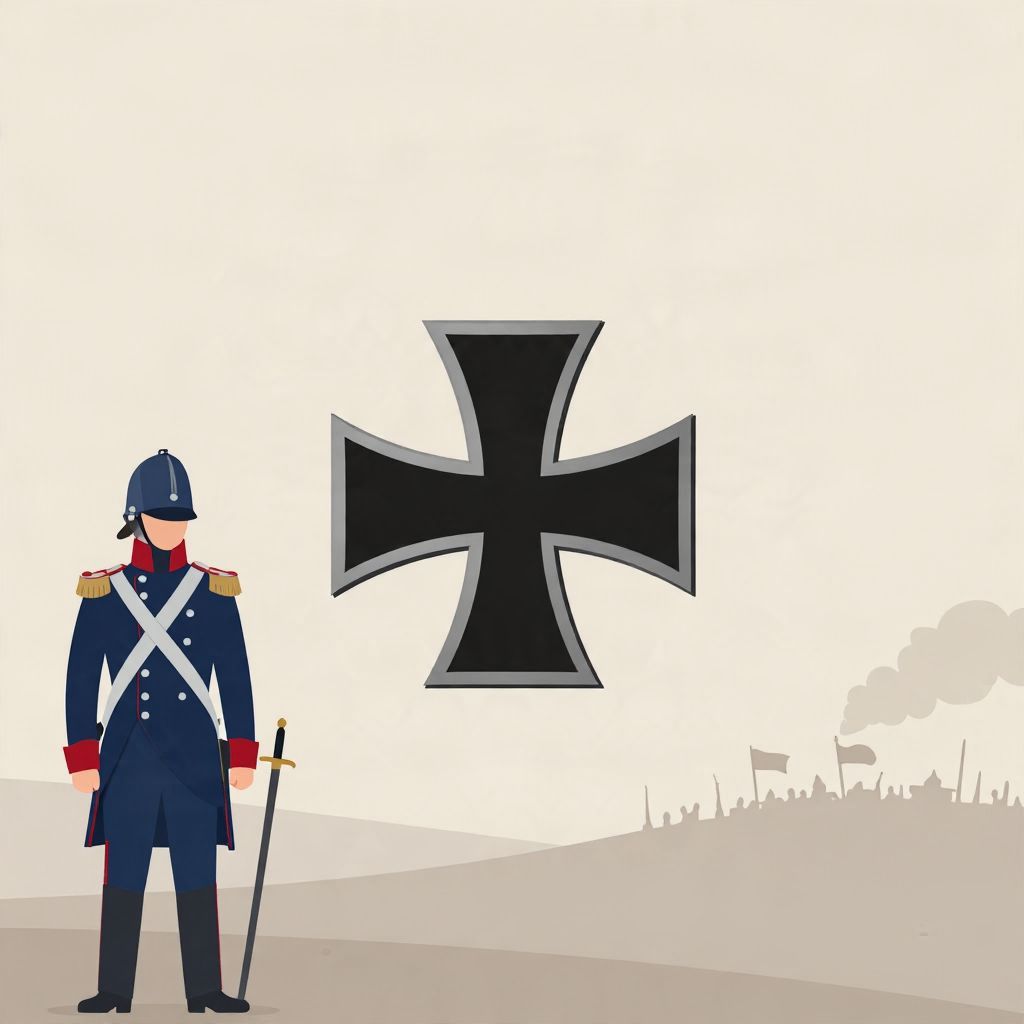
The Iron Cross is one of the most recognizable military symbols in modern European history. Most people know it as a German decoration, but its meaning has changed over time, and it is often misunderstood because of its later association with Prussian militarism and Nazi imagery.
In historical terms, the Iron Cross began as a Prussian military award in the early 19th century. It was created to honor bravery and service in wartime, then became a broader symbol of German military tradition, with a complicated legacy that still shapes how it is seen today.
What Is an Iron Cross?
The Iron Cross was originally a Prussian military decoration established in 1813 by King Frederick William III during the Napoleonic Wars. It was later revived by German states and the German Empire, and it became a symbol of military valor, German nationalism, and, in the 20th century, controversial wartime imagery.
Origins of the Iron Cross
The Iron Cross was introduced in a moment of crisis. In 1813, Prussia was fighting against Napoleon’s forces after years of defeat and occupation. Frederick William III wanted a decoration that could recognize courage in war without the aristocratic exclusiveness of older orders. The result was a medal intended to be awarded for merit rather than noble birth.
Why “Iron”?
The name came from the material and the symbolism. Iron suggested strength, austerity, and sacrifice. The design was also deliberately simple: a black cross with a silver or white border, made to stand out visually while avoiding the luxury associated with gold or jeweled decorations. The use of iron reflected wartime seriousness more than wealth or prestige.
Who designed it?
The Iron Cross is commonly associated with the architect Karl Friedrich Schinkel, though the exact degree of his role is sometimes discussed in historical accounts. What is clear is that the design drew on older cross forms used in European heraldry and on the black cross of the Teutonic Order, which helped connect the award to a longer Germanic visual tradition.
How the Iron Cross Worked as a Military Decoration
The original Iron Cross was not just a single medal. It was part of a system of wartime distinction. It could be awarded in different classes, with higher levels reserved for more exceptional service. This made it a practical military honor that could be used to reward both officers and ordinary soldiers.
Classes and ranks
- Second Class — often the first level awarded for notable bravery or service.
- First Class — a higher grade worn on the uniform.
- Grand Cross — a very high honor, usually reserved for senior commanders.
The structure mattered because it allowed the state to recognize military achievement across ranks. That was part of the award’s appeal in the 19th century: it fit the new idea that wartime merit could be publicly honored, even in a society still shaped by hierarchy.
The Iron Cross in the 19th Century
After its creation in 1813, the Iron Cross became tied to Prussian victories and patriotic memory. It was revived in later wars, including the Franco-Prussian War of 1870–1871, when German unification was achieved under Prussian leadership. By then, the decoration had become more than a military award; it was a symbol of Prussian and then German state power.
From Prussia to the German Empire
When Germany unified in 1871, Prussia dominated the new empire politically and militarily. The Iron Cross remained associated with Prussian military tradition, but it increasingly functioned as a German national symbol as well. Its meaning grew from a battlefield honor into a sign of state authority and military success.
The Iron Cross and World War I
The Iron Cross was revived again in 1914 at the start of World War I. Millions of soldiers served in the German army, and the decoration became widely recognized across Europe. It was awarded for bravery, leadership, and distinguished military service, and it helped reinforce the idea of sacrifice for the nation during total war.
Why it mattered in World War I
In World War I, the Iron Cross became part of mass warfare culture. It was no longer a rare symbol seen only among elites. Soldiers from many backgrounds could receive it, which gave it broad visibility. At the same time, its image became linked to German militarism in the eyes of enemy states and later historians.
The Iron Cross and Nazi Germany
The Iron Cross was revived once more in 1939 by Adolf Hitler. This is the period that most strongly shaped its modern reputation. The Nazi regime used many older German symbols to present itself as the heir to past military glory, and the Iron Cross was one of the most important of these symbols.
How the Nazis changed its meaning
The Iron Cross under Nazi rule was still a military decoration, but it was now embedded in a dictatorship that pursued aggressive war and genocide. The award itself predated Nazism by more than a century, yet its use by the regime permanently affected how it is viewed. Because of this association, the Iron Cross is often mistaken for a Nazi symbol, even though its origins are much older.
Important distinction
It is historically important to separate the Iron Cross from the swastika and other explicitly Nazi emblems. The Iron Cross was not created by the Nazis, but the regime did use and adapt it. That means the symbol has a layered history: Prussian in origin, German in national use, and heavily burdened by its association with Nazi military power.
Is the Iron Cross Still Used Today?
The original wartime Iron Cross was discontinued after World War II, and Germany’s relationship with military symbols changed dramatically after 1945. In the postwar period, the Federal Republic of Germany developed new forms of military decoration that avoided Nazi associations. The Iron Cross itself survives mainly in historical memory, design, and popular culture.
Modern military insignia
Germany’s modern armed forces, the Bundeswehr, use a stylized cross based on the old Iron Cross shape as a national emblem on vehicles and aircraft. This version is not the same as the wartime medal, but it shows how the basic form has remained part of German visual identity. The symbol’s use today is therefore official in some contexts, but always separated from Nazi ideology.
Common Misunderstandings About the Iron Cross
Because the Iron Cross appears in films, games, fashion, and military imagery, it is often misunderstood. Some people assume it is simply a Nazi emblem, while others treat it as a generic sign of toughness or rebellion. Historically, both views are incomplete.
What it is not
- It is not originally a Nazi symbol.
- It is not identical to the swastika or other party insignia.
- It is not just a decorative cross without political meaning.
Its history includes bravery, nationalism, militarism, and propaganda. That combination explains why the symbol remains controversial and why its meaning depends heavily on context.
Why the Iron Cross Still Matters Historically
The Iron Cross is important because it shows how a military decoration can become a long-lasting political and cultural symbol. It reflects the rise of modern nationalism, the transformation of warfare, and the power of visual emblems in shaping public memory. Few symbols carry such a long and difficult history in such a compact form.
Its lasting legacy
For historians, the Iron Cross is useful because it connects several eras at once: the anti-Napoleonic struggle, Prussian state-building, German unification, World War I, and Nazi appropriation in World War II. Its story is not just about a medal. It is about how states use symbols to reward loyalty, project power, and build identity.
So, what is an Iron Cross? It is a Prussian military decoration created in 1813 that later became one of the best-known symbols of German military history. Its meaning changed over time, and its association with Nazi Germany makes it especially controversial today. For more on how symbols gain new meanings across history, see broader historical themes and cultural divergence in history.