
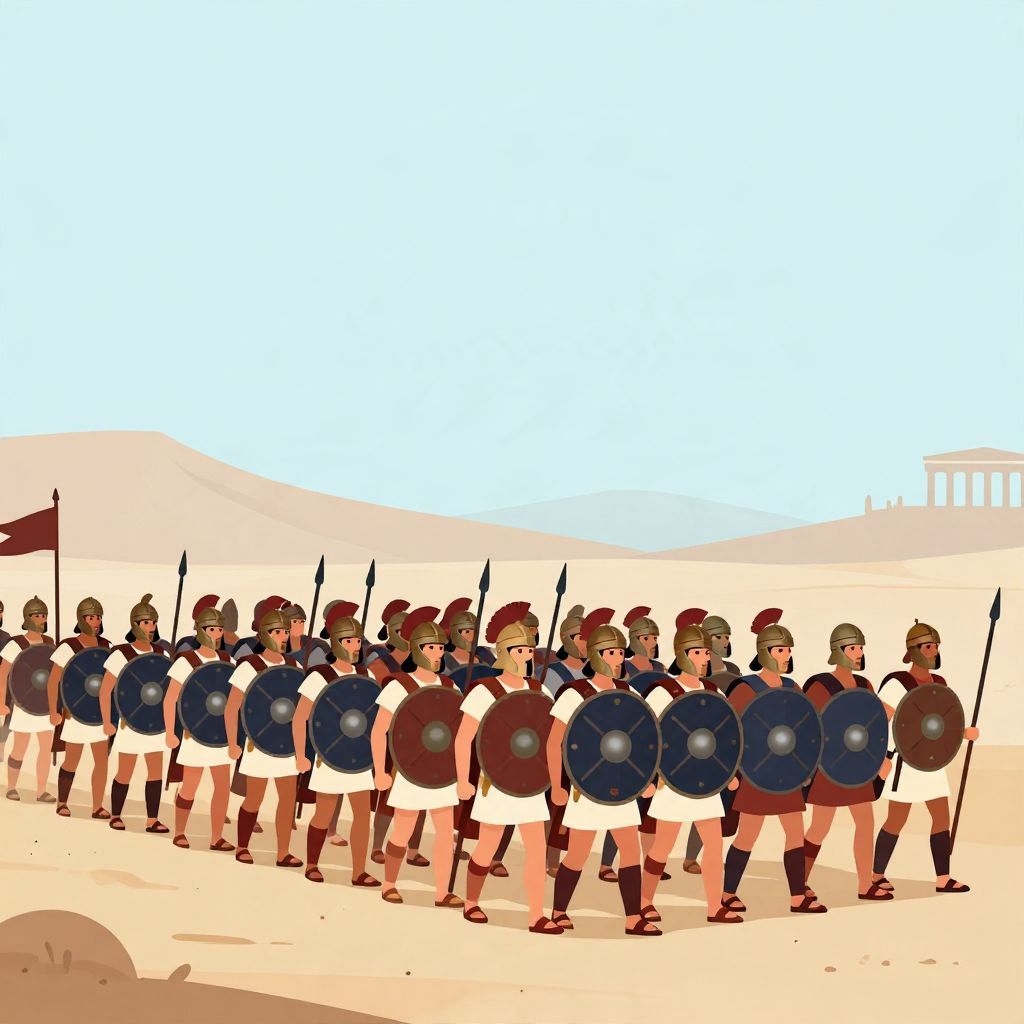
What is a phalanx? In ancient history, it was a tightly packed infantry formation designed to fight as a single mass rather than as individual soldiers. Most famously associated with Greek city-states, the phalanx helped armies project power, hold ground, and break enemy lines.
Its importance goes beyond battlefield tactics. The phalanx shaped military organization, citizenship, and the rise of professional armies in the ancient Mediterranean and Near East. It also changed over time, from early Greek hoplite ranks to the larger, more complex Macedonian version used by Philip II and Alexander the Great.
What Is a Phalanx?
A phalanx was a close-order infantry formation in which soldiers stood shoulder to shoulder in deep ranks, usually carrying shields and long spears. The formation relied on discipline, cohesion, and collective movement. Rather than individual combat skill, its strength came from presenting a solid wall of men and weapons that was difficult to penetrate.
Origins of the Phalanx
Early Greek development
The classic Greek phalanx emerged during the Archaic period, roughly the 8th to 7th centuries BCE, though its exact origins are debated. It is usually linked to the rise of the hoplite, a heavily armed citizen-soldier who could afford armor, a round shield, a spear, and other equipment. As Greek poleis grew, warfare became more organized and more dependent on citizen participation.
Why it developed
The phalanx suited a world of relatively small states, where battles were often fought on open ground between neighboring communities. It rewarded discipline and mutual protection. Each soldier’s shield protected not only himself but also part of the man beside him, encouraging cooperation and social cohesion. In that sense, the formation reflected the political culture of many Greek city-states, where citizenship and military service were closely connected.
How a Phalanx Worked
In its simplest form, the phalanx was a line of infantry arranged in several ranks. Soldiers stood close together, with shields overlapping or nearly overlapping, and spears thrust forward from the front ranks. The men in the rear ranks helped maintain pressure, replace the fallen, and keep the formation steady. Success depended on staying aligned and advancing without breaking formation.
Key features of the formation
- Depth: Usually several ranks deep, sometimes much deeper in later versions.
- Shields: Large shields helped protect the soldier and the unit as a whole.
- Spears: Long thrusting spears were the main offensive weapon.
- Discipline: Training and cohesion mattered more than individual heroics.
- Terrain: Flat or gently sloping ground favored the formation.
The phalanx was powerful, but not flexible. It worked best in frontal combat and could be vulnerable on rough ground, to flank attacks, or if its order was disrupted. Once the line broke, its strength declined quickly.
The Greek Hoplite Phalanx
The best-known phalanx is the Greek hoplite phalanx, used by city-states such as Sparta, Athens, Corinth, and Thebes. Hoplites were usually citizen-soldiers who equipped themselves. Their armor varied over time and by wealth, but common elements included a helmet, breast protection, greaves, a large round shield, and a spear. A short sword was a backup weapon.
Battle and social meaning
For many Greeks, the phalanx was more than a military tactic. It symbolized the unity of the polis. The line of soldiers fighting side by side mirrored the idea of citizens sharing responsibility for the city’s defense. This does not mean every Greek state was equal or democratic, but the formation did reinforce a social ideal of collective duty.
Famous examples
Greek phalanxes played major roles in battles such as Marathon in 490 BCE, where Athenian and Plataean hoplites helped defeat a Persian force, and Plataea in 479 BCE, where Greek allies again used heavy infantry effectively. These victories became central to Greek memory, though they were part of much larger wars involving naval power, logistics, and alliances as well as infantry combat.
The Macedonian Phalanx
The phalanx changed significantly under Philip II of Macedon in the 4th century BCE. He reorganized infantry around the sarissa, an extremely long pike, making the formation denser and more dangerous at range. This Macedonian phalanx was not simply a larger Greek hoplite line; it was a different battlefield system.
What made it different
- The sarissa was much longer than the traditional Greek spear.
- Soldiers needed both hands to wield it, so shields were smaller and carried differently.
- The formation was deeper and more specialized.
- It worked alongside cavalry, skirmishers, and other troops in a combined-arms system.
Alexander the Great inherited this military structure and used it in his conquests across the Persian Empire. The Macedonian phalanx could pin enemies in place while cavalry struck at vulnerable points. Its success depended on coordination, not just brute force. In this sense, it was part of a broader military revolution in the eastern Mediterranean.
Phalanx in Other Ancient Armies
The word “phalanx” is often used for Greek and Macedonian formations, but similar dense infantry systems appeared elsewhere in antiquity. Ancient Near Eastern armies used massed infantry, and later Hellenistic kingdoms adapted the Macedonian model. The Roman army, however, eventually proved more flexible than the phalanx, especially in broken terrain and against enemies who used looser formations.
Rome and the decline of the phalanx
Early Rome may have used a phalanx-like formation, but by the middle Republic it had shifted to the manipular legion, which was more adaptable. Roman military success owed much to this flexibility. Against the Macedonian phalanx, Roman troops could exploit gaps, uneven ground, and the formation’s limited maneuverability. The battles of Cynoscephalae in 197 BCE and Pydna in 168 BCE are often cited as examples of Roman advantages over phalanx warfare.
Strengths and Weaknesses of the Phalanx
Why it was effective
The phalanx was effective because it concentrated force. A disciplined line of heavy infantry could push back less organized troops, hold a defensive position, and create a psychological barrier. The sight of a bristling wall of spears was intimidating, and the physical pressure of a compact advance could overwhelm opponents.
Its limitations
At the same time, the phalanx had clear weaknesses. It was hard to turn quickly, difficult to use in rough terrain, and vulnerable if attacked from the side or rear. It also required training and morale. If soldiers panicked or the line became uneven, the formation could collapse. Because of these limits, successful armies often paired the phalanx with cavalry, archers, or light infantry.
Phalanx and Ancient Warfare
The phalanx changed the way ancient armies fought. It encouraged set-piece battles on chosen ground, increased the importance of training and equipment, and helped professionalize warfare. In Greek history, it was tied to the rise of citizen militias. In Macedonian and Hellenistic warfare, it became part of larger, more centralized kingdoms that could support standing armies and specialized troops.
Broader historical impact
The phalanx also influenced political culture. In many Greek states, military service and civic identity were linked. In Macedon, royal power and military innovation worked together to produce expansion. Over time, however, the rise of more flexible military systems reduced the battlefield dominance of the phalanx. It did not disappear overnight, but it gradually lost its edge against armies that could maneuver more easily.
Common Misconceptions
One common misunderstanding is that all phalanxes were identical. In reality, the formation changed over centuries and across regions. Another misconception is that the phalanx was unstoppable. It was formidable in the right conditions, but it was not invincible. Its historical reputation comes partly from Greek literary tradition, which often celebrated disciplined infantry as a defining feature of civilization.
It is also important not to imagine the phalanx as a rigid machine. Ancient armies were made up of human beings, and battle outcomes depended on leadership, terrain, morale, timing, and luck. The phalanx was a system, not a guarantee.
Why the Phalanx Still Matters
The phalanx remains important because it shows how military organization reflects society. It was not just a way to fight; it was a way to structure collective action. From the citizen hoplites of Greece to the pike formations of Macedon, the phalanx reveals how ancient states balanced discipline, technology, and political identity.
In short, a phalanx was a dense infantry formation that helped shape ancient warfare for centuries. It began as a Greek citizen-soldier tactic, evolved under Macedonian kings, and eventually gave way to more flexible military systems. For readers interested in how armies and societies changed over time, related topics such as what a feudal system was can help show how military organization shaped political life in other eras.