
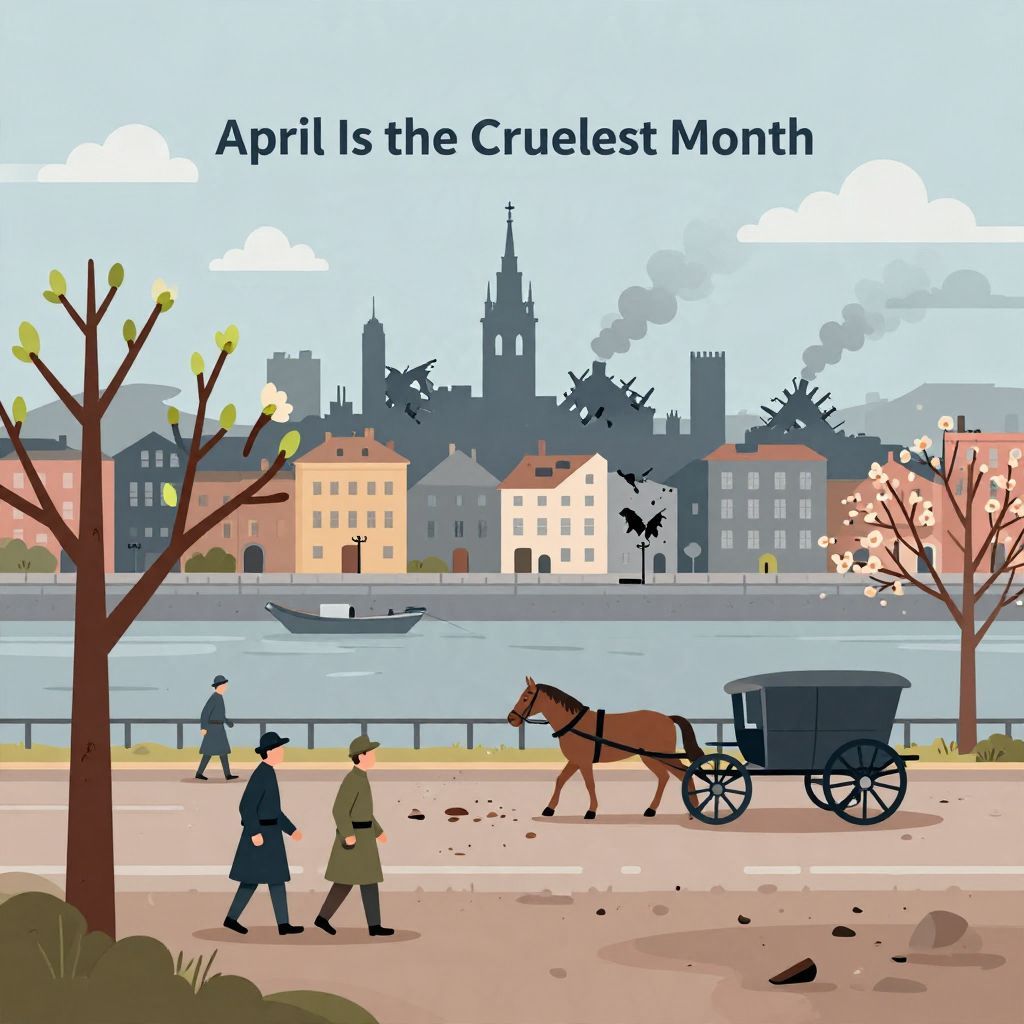
“April is the cruellest month” is one of the most famous opening lines in modern literature, but it is not a historical fact in the usual sense. The phrase comes from T. S. Eliot’s 1922 poem The Waste Land, where April is presented as emotionally painful because it forces life, memory, and desire back into motion.
To understand why the line became so influential, it helps to place it in its literary and historical context: post-World War I disillusionment, urban modernity, and a new style of poetry that questioned older ideas of renewal, spring, and hope.
What does “April is the cruellest month” mean?
The line means that spring can feel painful because it revives longing, memory, and growth after winter’s numbness. In The Waste Land, Eliot reverses the traditional idea that spring is joyful. For him, April is “cruel” because it stirs life in a spiritually exhausted world.
Where does the phrase come from?
The line appears at the start of T. S. Eliot’s The Waste Land, first published in 1922. Eliot wrote the poem in the aftermath of the First World War, and its fragmented style reflected a broader sense of cultural breakdown in Europe and beyond. The phrase is literary, not a proverb from earlier history.
The poem’s opening
Eliot begins by rejecting the conventional association of April with renewal. Instead of celebrating spring, he presents it as a force that disturbs winter’s “forgetful snow.” That image matters: winter is not simply cold, but a season of emotional shelter, while spring brings unwanted consciousness.
Why the line stood out
The opening was striking because it directly challenged a familiar seasonal expectation. In much Western literature, spring symbolizes rebirth, fertility, and hope. Eliot’s reversal made the line memorable, and it quickly became one of the best-known phrases in twentieth-century poetry.
Why is April called “cruel” in the poem?
April is “cruel” because it awakens desire and memory in people who may prefer emotional numbness. Eliot writes from a world shaped by war, social dislocation, and spiritual uncertainty. In that setting, the return of life is not comforting; it is unsettling, because it reminds people of what has been lost.
Winter versus spring
Eliot contrasts two states:
- Winter, which covers the earth in snow and keeps feeling dormant.
- Spring, which “breeds” lilacs and stirs the roots of life.
The cruelty lies in the fact that spring does not heal suffering automatically. It exposes it. Growth returns, but so does pain.
A modernist view of history
The poem belongs to modernism, a literary movement that responded to the upheavals of the early twentieth century. Modernist writers often used broken structure, allusion, and irony to show that older certainties had weakened. Eliot’s April is cruel because the old promise of seasonal renewal no longer feels trustworthy.
How did World War I shape the meaning of the line?
The First World War, fought from 1914 to 1918, profoundly shaped the mood of The Waste Land. Europe had suffered mass death, trauma, and political instability. In that context, a simple celebration of spring could seem naïve. Eliot’s line captures a civilization that feels spiritually exhausted after catastrophe.
Postwar disillusionment
Many writers and artists after the war questioned progress, faith, and inherited cultural values. The war had shown that industrial modernity could produce destruction on a vast scale. Eliot’s poem does not describe battles directly, but its emotional landscape reflects the age of shattered confidence that followed them.
Not a literal historical claim
It is important to distinguish the poem’s symbolism from historical evidence. Eliot was not saying that April is objectively the worst month in history. He was using April as a literary device to express a mood of unease. The line is powerful because it turns a common seasonal idea into a statement about suffering and consciousness.
Why did the line become so famous?
The phrase became famous because it is brief, surprising, and emotionally resonant. It also works on several levels at once: as poetry, as cultural criticism, and as a memorable reversal of expectation. Readers often quote it even when they have not read the full poem, which helped it enter popular culture.
A line that travels beyond its original context
Over time, the opening line came to be used in journalism, essays, and everyday speech to suggest that a difficult season, event, or memory can feel worse precisely because it revives life. Its endurance shows how a literary image can escape its original setting and become part of common language.
Why the wording matters
Eliot wrote “cruellest” in British spelling, which is often preserved when the line is quoted. The wording has a formal, almost archaic quality that suits the poem’s dense style. That tone helped the line sound timeless, even though it was written in a very specific historical moment.
Was April really seen as a cruel month before Eliot?
Not in any widespread historical sense. In European and North American traditions, April was usually associated with spring, planting, rain, and renewal. Eliot’s originality lies in his reversal of that expectation. He did not inherit a common saying; he transformed a familiar seasonal symbol into something unsettling.
Older seasonal traditions
For centuries, spring festivals and agricultural calendars had treated April as a time of return and growth. In many societies, the season marked the resumption of fieldwork and the visible revival of nature. Eliot’s poem stands out because it rejects that celebratory pattern.
Literary precedent
While poets before Eliot had linked spring with longing or sadness, the exact formulation “April is the cruellest month” is his own. The line’s fame can sometimes make it seem like an old proverb, but it is a modern literary invention from the early twentieth century.
How should readers interpret the line today?
Today, the phrase is often used in two ways: literally, to joke about difficult weather or busy seasonal transitions, and figuratively, to describe emotional discomfort that comes with change. Historically, though, its deeper meaning remains tied to the aftermath of war and the modernist sense that renewal can be painful as well as hopeful.
Common misunderstandings
- It does not mean April is historically the most dangerous month.
- It does not refer to a specific event in April.
- It does express a literary idea about awakening after numbness.
Why it still resonates
The line endures because many people recognize the feeling behind it. Change can be hard, even when it is good. Spring may bring energy, but it can also bring pressure, memory, and the return of unresolved emotions. Eliot captured that paradox with unusual force.
The historical significance of the phrase
“April is the cruellest month” matters historically because it reflects a turning point in twentieth-century culture. It shows how literature responded to war, disillusionment, and the collapse of old certainties. The line is not a historical event, but it is a historical artifact: a small phrase that reveals the emotional climate of its age.
What it tells us about the 1920s
The early 1920s were marked by recovery, instability, and experimentation. Artists and writers were searching for new forms that could express a fractured world. Eliot’s poem became one of the defining works of that search, and its opening line became a shorthand for modern unease.
Its lasting cultural power
Few literary lines have moved so easily from poetry into public speech. That longevity is part of its historical importance. It reminds us that history is not only made by wars, governments, and treaties, but also by phrases that shape how people imagine experience.
So, “April is the cruellest month” is best understood as a modernist literary statement born from the trauma and uncertainty of the post-World War I era. It is famous not because April was uniquely harsh in history, but because Eliot turned spring itself into a symbol of painful awakening. For more context on the era surrounding Eliot’s world, see what happened in 1926 and what happened in 1965.