
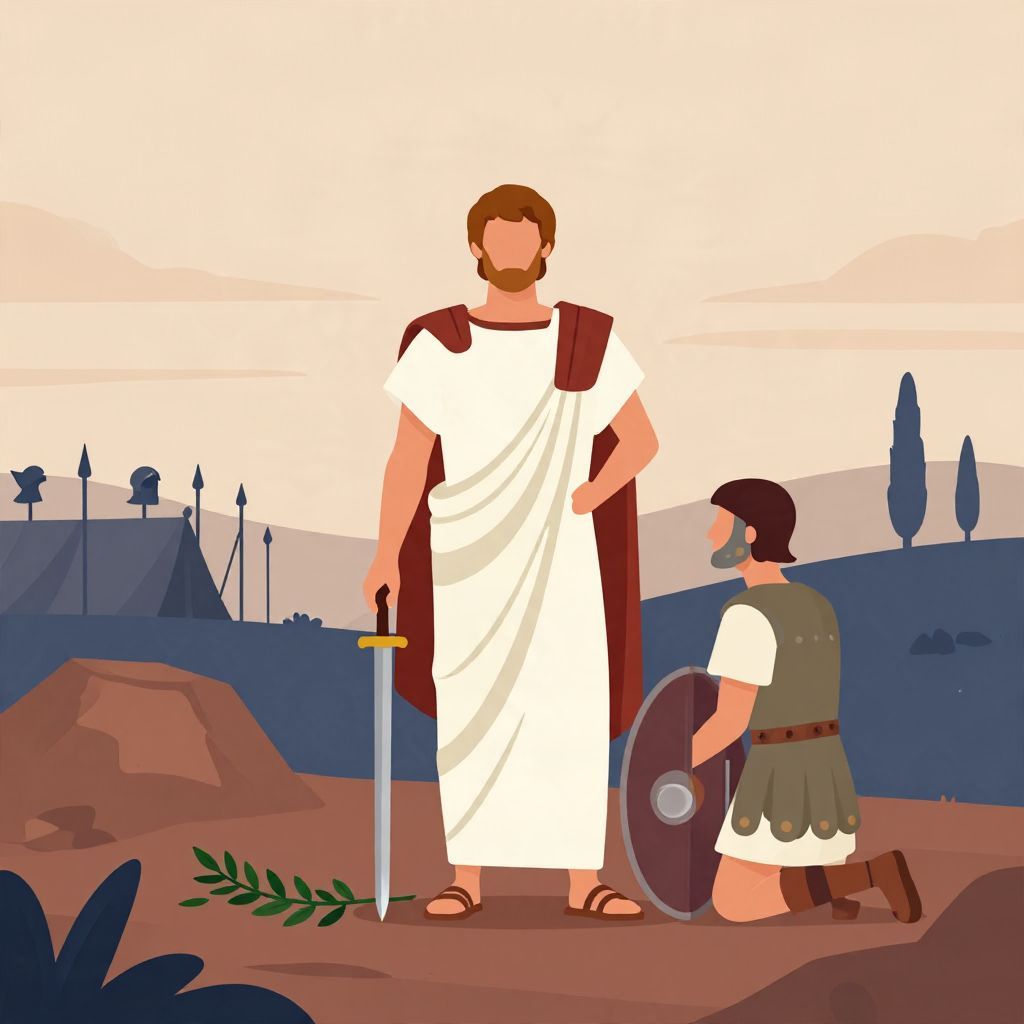
How did Brutus die? The short answer is that Marcus Junius Brutus, one of Julius Caesar’s assassins, died by suicide in 42 BCE after his forces were defeated by the armies of Mark Antony and Octavian at the Battle of Philippi. Ancient writers disagree on some details, but the broad outline is clear: Brutus saw defeat as inevitable and chose death rather than capture.
His end mattered because it marked the collapse of the last major republican resistance to Caesar’s heirs. Brutus became a symbol of political idealism, betrayal, and the tragic limits of resisting a rising autocracy in the late Roman Republic.
How did Brutus die?
Brutus died by suicide after the Battle of Philippi in October 42 BCE. According to ancient accounts, once his army was broken and his cause lost, he either fell on his sword himself or asked a trusted companion to help him die. The exact method is not certain, but historians agree that he chose death rather than surrender to his enemies.
Who was Brutus, and why was he fighting?
Marcus Junius Brutus was a Roman senator and one of the leading conspirators in the assassination of Julius Caesar on the Ides of March in 44 BCE. He and other senators claimed they were defending the Roman Republic against tyranny. Brutus was also tied by family memory and political identity to the old republican tradition, which made him a powerful symbol for anti-monarchical resistance.
Brutus after Caesar’s assassination
Caesar’s murder did not restore the Republic in the way the conspirators hoped. Instead, it triggered a new round of civil war. Brutus and his ally Cassius left Italy and gathered support in the eastern provinces of the Roman world, where they raised armies and collected resources. Their opponents, especially Mark Antony and Octavian, presented themselves as avengers of Caesar and as defenders of order.
What happened at Philippi?
The Battle of Philippi, fought in two engagements in autumn 42 BCE in Macedonia, was the decisive clash between the forces of Brutus and Cassius and the armies of Antony and Octavian. Cassius died after the first battle, apparently believing his side had been defeated. Brutus continued the struggle for a short time, but his army was eventually overwhelmed in the second battle.
The collapse of Brutus’s cause
Brutus’s defeat was not just military; it was political and psychological. His coalition depended on keeping together a diverse group of senators, commanders, and provincial supporters. Once Cassius was dead and the army was broken, Brutus lost the practical means to continue. In Roman elite culture, surrender could mean humiliation, execution, or public display by the victors. Suicide was sometimes viewed by aristocrats as a final act of control and dignity.
Did Brutus kill himself, or was he killed?
Ancient sources generally say Brutus died by suicide, though they vary in the precise details. Some accounts describe him throwing himself on his sword; others suggest he was helped by a companion after the battle. Because these reports were written by authors with different political sympathies and after the fact, historians treat the exact scene cautiously. What is not in doubt is that Brutus did not die in battle as a combat casualty; he died after defeat, by his own hand or with assistance.
Why the details differ
Roman historians often shaped dramatic deaths to fit moral lessons. A noble suicide could signal courage, dignity, or tragic failure. For Brutus, writers had reason to emphasize both his resolve and the collapse of his republican cause. That means the story comes to us through a literary and political filter, not a modern eyewitness record we can verify in every detail.
Why did Brutus choose death?
Several factors likely influenced Brutus’s decision. First, he had lost the battle and probably knew that capture would end badly. Second, he had built his identity around Roman virtue, honor, and service to the Republic. Third, he may have believed that his death would spare him the shame of public defeat and the possibility of being paraded by his enemies in a triumph.
Roman ideas about honor and suicide
In elite Roman culture, suicide was not automatically seen as immoral. Philosophical traditions, especially Stoicism, sometimes treated a rational death as preferable to dishonor or tyranny. That does not mean Romans approved of all suicides, but it helps explain why Brutus’s end was remembered as politically meaningful rather than merely tragic.
What do the ancient sources say?
Our main accounts of Brutus’s death come from later ancient writers such as Plutarch and Appian, with supporting references in other Roman historical traditions. These authors wrote decades or even centuries after the events, drawing on earlier material that is now lost. Their narratives agree on the central fact of suicide, but they differ in tone, detail, and emphasis.
How historians read these sources
Modern historians compare the surviving accounts to reconstruct the most likely sequence of events. They are careful not to turn later literary drama into certainty. For example, a famous story about Brutus’s death scene may be memorable, but if it appears only in one tradition and serves a clear moral purpose, it must be treated as probable narrative shaping rather than unquestionable fact.
What happened after Brutus died?
Brutus’s death effectively ended the republican military challenge to the Second Triumvirate. His defeat allowed Antony and Octavian to divide power more securely, though their partnership later collapsed into another civil war. In the longer run, Octavian’s victory over Antony would lead to the rise of the Roman Empire under Augustus.
Why his death mattered politically
Brutus became one of the most famous losers in Roman history because he stood at the point where the Republic could still be imagined as recoverable. After Philippi, that possibility faded sharply. The old senatorial order remained, but it no longer controlled the future. Brutus’s death symbolized the failure of the aristocratic resistance to Caesar’s successors.
How should we understand Brutus today?
Brutus is often remembered in two conflicting ways: as a traitor who murdered Caesar, and as a principled republican who tried to stop dictatorship. The historical reality is more complicated. He was an elite Roman politician acting within a violent civil war, not a modern democrat in the contemporary sense. His motives mixed ideology, family memory, ambition, and fear of Caesar’s growing power.
Myth, memory, and reputation
Later generations turned Brutus into a symbol. Some admired him as a defender of liberty; others condemned him as an assassin. Shakespeare’s famous dramatization helped make “Brutus” shorthand for political betrayal in the English-speaking world. But the historical Brutus was also a product of the late Republic’s unstable politics, where violence had become a normal instrument of power.
Timeline of Brutus’s final years
- 44 BCE — Brutus joins the conspiracy to assassinate Julius Caesar.
- March 15, 44 BCE — Caesar is killed in the Senate house.
- 44–43 BCE — Civil conflict grows between Caesar’s supporters and the assassins.
- 42 BCE — Brutus and Cassius gather forces in the eastern provinces.
- October 42 BCE — The Battle of Philippi is fought in two engagements.
- After the second battle — Brutus dies by suicide after defeat.
Why does Brutus’s death still matter?
Brutus’s death matters because it captures a turning point in Roman history: the end of the Republic’s last serious armed defense and the beginning of a new political order. It also shows how ancient politics blended idealism and violence. Brutus died not as a private individual alone, but as a public figure whose death was understood as part of a larger struggle over power, legitimacy, and memory.
In the end, the answer to how did Brutus die is clear in broad terms: he died by suicide after defeat at Philippi in 42 BCE. The uncertainty lies in the exact manner, not in the historical significance. His death sealed the failure of the anti-Caesar cause and helped open the way for the Roman Empire.