
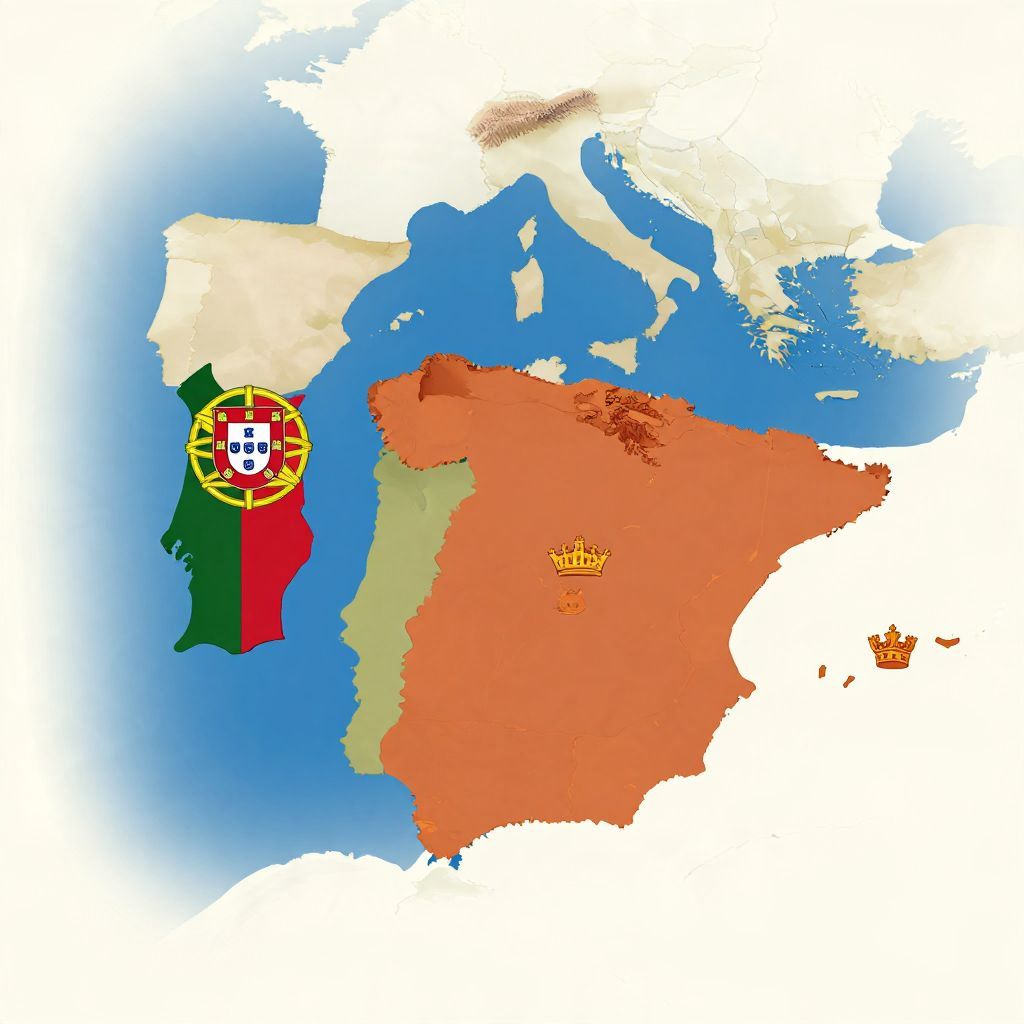
Is Portugal in Spain? No. Portugal is an independent country on the Iberian Peninsula, sharing a border with Spain but not belonging to it. The two countries are neighbors with long, intertwined histories, yet they have separate governments, national identities, and international standing.
The confusion is understandable because Portugal and Spain sit side by side, speak closely related Romance languages, and were once linked by dynastic unions and imperial rivalries. But historically and politically, Portugal has remained a distinct kingdom and later a sovereign state for most of its existence.
Is Portugal in Spain?
No. Portugal is not in Spain; it is a separate nation-state on the western edge of the Iberian Peninsula. It has its own capital, Lisbon, its own government, and its own history of independence. Although the two countries are neighbors and share deep cultural ties, Portugal has never been simply a region of Spain in the modern political sense.
Why people confuse Portugal with Spain
The confusion usually comes from geography and history. Portugal and Spain occupy the same peninsula in southwestern Europe, and their border is one of the oldest in Europe. Because the countries are so close, many people assume Portugal is part of Spain, but the border marks a real political division that has existed for centuries.
Shared peninsula, separate states
The Iberian Peninsula includes both Spain and Portugal, along with the tiny territory of Andorra and the British territory of Gibraltar. Geography alone does not determine political identity. Many regions in Europe share language families, trade networks, and dynastic ties without becoming one country, and Portugal is a clear example of that pattern.
Language and culture are related, not identical
Portuguese and Spanish are both Romance languages that developed from Latin after the fall of the Roman Empire. They are similar enough that speakers may recognize some words in each other’s language, but they are distinct languages with different histories, pronunciations, and literary traditions. Cultural overlap does not erase national separation.
How Portugal became a separate kingdom
Portugal’s independence emerged during the Middle Ages, not in modern times. The area was originally part of larger political units under Roman, Visigothic, and later Muslim rule. In the 11th and 12th centuries, Christian rulers in the north of the peninsula expanded southward during the process often called the Reconquista, and Portugal gradually became a kingdom of its own.
From county to kingdom
Portugal began as the County of Portugal, a frontier territory under the influence of the Kingdom of León. The decisive figure in its rise was Afonso Henriques, who broke away from Leonese control and became the first king of Portugal. By the mid-12th century, Portugal had established itself as an independent monarchy, and its borders became increasingly fixed over time.
Early recognition of independence
Medieval independence was not always neat by modern standards. Recognition came through a mix of military success, diplomacy, and papal approval. By the late 12th century, Portugal was widely treated as a separate kingdom in European politics. That long medieval statehood is one of the main reasons Portugal is not considered part of Spain today.
The Iberian Union: when Portugal and Spain were ruled together
There was one important period that fuels the misconception: the Iberian Union. From 1580 to 1640, Portugal and Spain were ruled by the same monarch after a dynastic crisis in Portugal. This did not erase Portugal as a country, but it did place it under the same royal house as Spain for about 60 years.
Why the union happened
The Portuguese royal line ended without a clear adult heir after the death of King Sebastian in 1578 and the later death of Cardinal-King Henry in 1580. Philip II of Spain claimed the Portuguese throne and eventually gained control. Portugal retained its laws, institutions, and colonial empire in theory, but many Portuguese later saw the union as a loss of autonomy.
Why it ended
Portuguese dissatisfaction grew because the union often served Spanish strategic interests first. In 1640, Portugal revolted and restored its independence under the House of Braganza. This Restoration War confirmed that Portugal was not merely a Spanish province waiting to be absorbed; it was a kingdom defending its sovereignty.
Portugal and Spain after independence
After 1640, Portugal and Spain remained separate states, even though they sometimes fought wars, negotiated alliances, and competed overseas. Their histories were connected by diplomacy and conflict, but each preserved its own monarchy, administration, and later republican institutions. Modern Portugal developed as an independent nation with its own colonial, political, and cultural trajectory.
Different imperial paths
Both countries built global empires, but they did so in different ways and on different timelines. Portugal was an early leader in Atlantic exploration, establishing routes to Africa, Asia, and Brazil in the 15th and 16th centuries. Spain, meanwhile, created a vast empire in the Americas after Christopher Columbus’s voyages. Their empires overlapped in time, but they were never the same empire.
Modern borders and diplomacy
The modern border between Portugal and Spain is one of Europe’s oldest continuous frontiers. Despite occasional tensions in earlier centuries, the two countries now cooperate closely within European and international institutions. Today, Portugal is a sovereign member of the European Union, the United Nations, and other global organizations as its own state.
What the historical evidence shows
The evidence is clear: Portugal is not in Spain. It is a separate country with a distinct medieval origin, a long tradition of sovereignty, and a national history shaped by both cooperation and rivalry with Spain. The main exception was the Iberian Union, when the two crowns were joined under one monarch, but even then Portugal remained legally and culturally distinct.
Key points in the historical timeline
- 11th–12th centuries: Portugal emerges from frontier counties on the Iberian Peninsula.
- Mid-12th century: Afonso Henriques establishes Portugal as an independent kingdom.
- 1580–1640: Portugal and Spain share a monarch during the Iberian Union.
- 1640: Portugal restores its independence.
- Modern era: Portugal remains a separate sovereign nation bordering Spain.
Why this distinction matters
Understanding that Portugal is not part of Spain is more than a geography lesson. It helps explain the political development of the Iberian Peninsula, the rise of two different empires, and the persistence of separate national identities despite close contact. It also shows how dynastic unions can temporarily join crowns without erasing nations.
So, the short answer is no: Portugal is not in Spain. It is Spain’s neighbor, not its region. For more on related Iberian history, you may also be interested in why Mexicans speak Spanish and what Spaniards look like.