
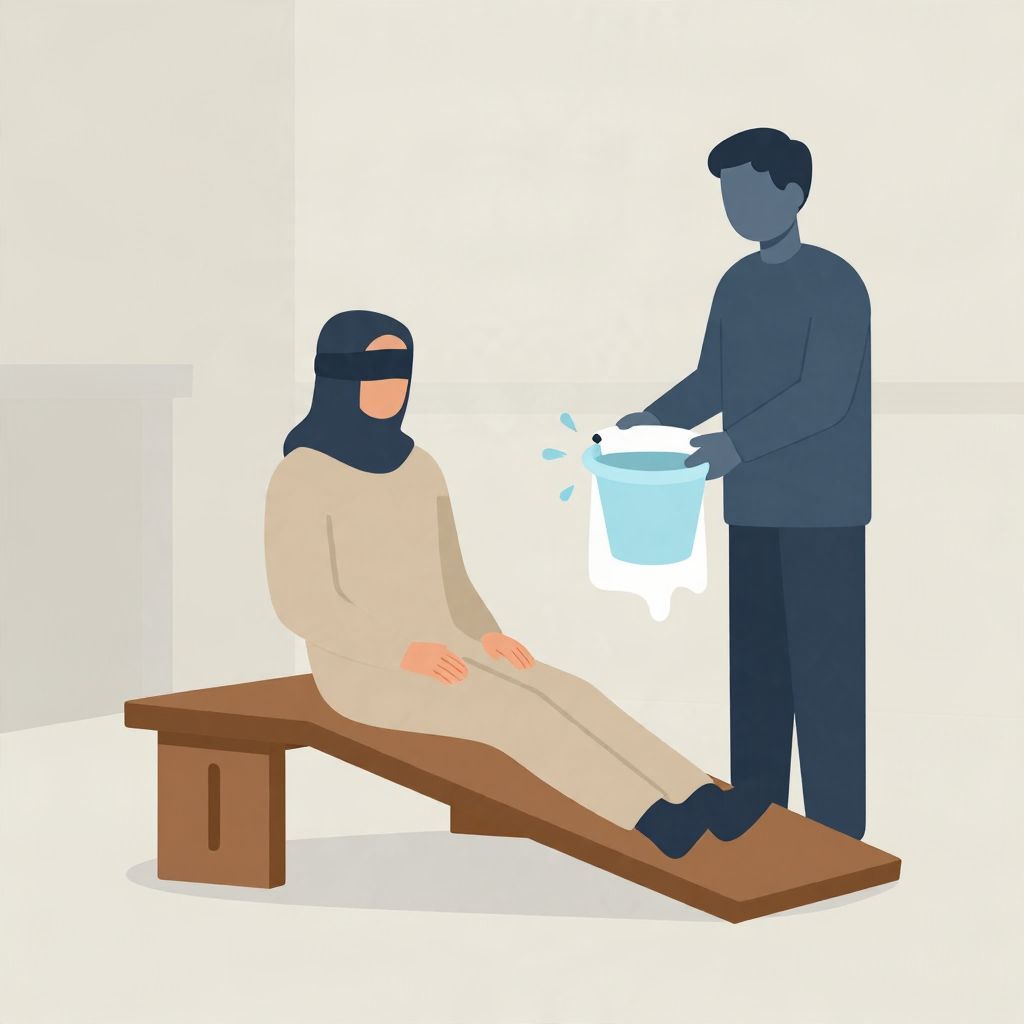
How does waterboarding work? Historically, it is a coercive interrogation method designed to create the sensation of drowning. By restricting breathing and triggering panic, it can force a person into intense distress very quickly. Because of its physical and psychological effects, waterboarding has long been debated as a form of torture rather than a legitimate questioning technique.
Its history stretches across centuries, though the modern term is associated most strongly with twentieth- and twenty-first-century state violence, war, and counterterrorism. Understanding how it works means looking at both the mechanics of the technique and the changing moral and legal arguments around it.
How Does Waterboarding Work?
Waterboarding works by immobilizing a person, placing cloth or another barrier over the face, and pouring water in a way that blocks normal breathing. The body reacts as if it is drowning: panic rises, breathing becomes difficult or impossible, and the person may experience choking, fear, and loss of control. The effect is psychological and physical, not merely symbolic.
The basic mechanism
In its simplest form, the technique limits airflow while water is applied to the nose and mouth area. Even when the amount of water is controlled, the body can interpret the situation as drowning. That sensation can trigger a powerful stress response, including gasping, helplessness, and an overwhelming urge to escape.
Why it is so effective as coercion
The method does not depend on lasting injury alone. Its power lies in terror: the person believes death may be imminent. Historically, interrogators who used it did so because fear of drowning can break resistance quickly. For that reason, many governments and human rights organizations classify it as torture.
What Is the Historical Origin of Waterboarding?
The exact origin of waterboarding is difficult to pin down, because similar drowning-based coercive methods appeared in different times and places. The modern name is relatively recent, but the underlying idea—using water to simulate drowning as punishment or interrogation—has older precedents in military and judicial violence.
Early and premodern precedents
Historical records from various societies describe forms of forced immersion, controlled drowning, or water-based punishment. These practices were not always identical to modern waterboarding, but they shared the same logic: using the fear of suffocation to compel obedience or extract information. Because terminology varied, historians are careful not to collapse all such practices into one exact technique.
From punishment to interrogation
In many premodern states, torture was often tied to legal systems that accepted confession as evidence. Water-based coercion fit into broader traditions of judicial torture, where pain and fear were used to force testimony. Over time, as legal standards changed in many countries, such methods became increasingly condemned, though not eliminated.
How Did Waterboarding Enter Modern History?
Waterboarding became especially visible in the twentieth century, when it was associated with colonial rule, military occupation, political repression, and wartime interrogation. Its modern history is less about a single origin point than about repeated reuse by states and armed groups seeking rapid cooperation from captives.
Colonial and wartime uses
In the late nineteenth and early twentieth centuries, reports of water-based coercion appeared in colonial settings and during military conflicts. Different countries used different names for similar actions, which sometimes obscured the technique in official records. The practice was often denied publicly even when survivors described it in detail.
The twentieth-century legal debate
After the Second World War, international human rights norms increasingly rejected torture. Yet waterboarding did not disappear. It re-emerged in later conflicts and internal security campaigns, especially where governments believed exceptional threats justified extraordinary methods. This tension between security and legality became central to the modern debate.
Why Is Waterboarding Considered Torture?
Waterboarding is widely considered torture because it deliberately inflicts extreme fear and physical suffering to break a person’s will. The key issue is intent: the technique is designed to make someone believe they are drowning. That is why many courts, governments, and medical professionals view it as incompatible with humane treatment.
Legal and moral standards
International law generally prohibits torture and cruel, inhuman, or degrading treatment. Waterboarding has been discussed in that context for decades, especially in relation to wartime detention and counterterrorism. Although governments have sometimes tried to redefine or rename it, the underlying method has been widely recognized as abusive.
Medical concerns
Medical experts have long warned that the technique can cause severe stress, panic, and physical harm. The body’s response to suffocation can be intense and unpredictable. Even when a person survives without obvious injury, the experience may produce lasting psychological trauma, including anxiety, nightmares, and post-traumatic stress.
How Has Waterboarding Been Used in Recent History?
Waterboarding became a major public controversy in the early twenty-first century, especially after the attacks of September 11, 2001. In the context of the “war on terror,” some officials argued that harsh interrogation was necessary to prevent attacks. Critics countered that the practice was torture, illegal, and unreliable.
Post-9/11 detention and interrogation
Public discussion intensified when reports emerged that detainees held by the United States had been subjected to waterboarding and related “enhanced interrogation techniques.” The issue sparked legal, political, and ethical disputes over whether security emergencies could justify methods long associated with torture. The controversy also revived older historical questions about state power and accountability.
Global reactions
Other countries and international bodies condemned the practice, emphasizing that banning torture is a core principle of modern law. The debate was not only about one technique, but about whether democracies could preserve legitimacy while using methods that simulate drowning. That question remains part of the historical legacy of the early twenty-first century.
Does Waterboarding Produce Reliable Information?
Historians and scholars of interrogation generally treat claims of reliability with caution. Fear may produce quick answers, but it can also produce false confessions, confusion, or whatever the interrogator wants to hear. That is one reason many experts argue that waterboarding is not only inhumane but also strategically flawed.
Pressure versus truth
Under extreme distress, a person may stop resisting and say almost anything to end the experience. Historically, this has made torture a poor method for gathering dependable intelligence. The apparent speed of results can be misleading, because information obtained under terror often requires careful verification and may be inaccurate.
The historical cost of coercion
States that rely on torture often face long-term consequences: damaged legitimacy, public scandal, legal challenges, and harm to victims. In the modern era, these costs have been central to debates over waterboarding. Even where officials have defended it as exceptional, critics have argued that normalizing such methods corrodes the rule of law.
How Has the Meaning of Waterboarding Changed Over Time?
The meaning of waterboarding has shifted from a hidden coercive practice to a widely recognized symbol of torture. In earlier periods, similar methods may have been described under different local terms or treated as ordinary instruments of power. Today, the word itself often evokes debates about human rights, legality, and abuse by the state.
From obscurity to public controversy
As global media, human rights law, and survivor testimony expanded public awareness, waterboarding became less a secret tool and more a political flashpoint. Its history illustrates how practices once normalized by authority can later become unacceptable when legal and moral standards change.
A symbol in modern memory
For many people, waterboarding now stands for the broader history of torture in modern warfare and detention. It is remembered not only for what it does physically, but for what it represents: the use of fear, domination, and state power against a helpless captive.
What Should We Remember About Waterboarding?
Waterboarding works by simulating drowning, causing intense panic and physical distress. Historically, it has appeared in different forms across time, but its modern significance lies in the way states and institutions have justified or condemned it. The technique’s history shows how coercion, law, and morality have collided in moments of crisis.
In the end, waterboarding is not just a historical curiosity or a technical method. It is a reminder that the struggle over torture has shaped modern political history, and that the standards societies choose in war and interrogation reveal much about their values. For related historical context, you may also want to explore articles on the history of torture and the post-9/11 war on terror.