
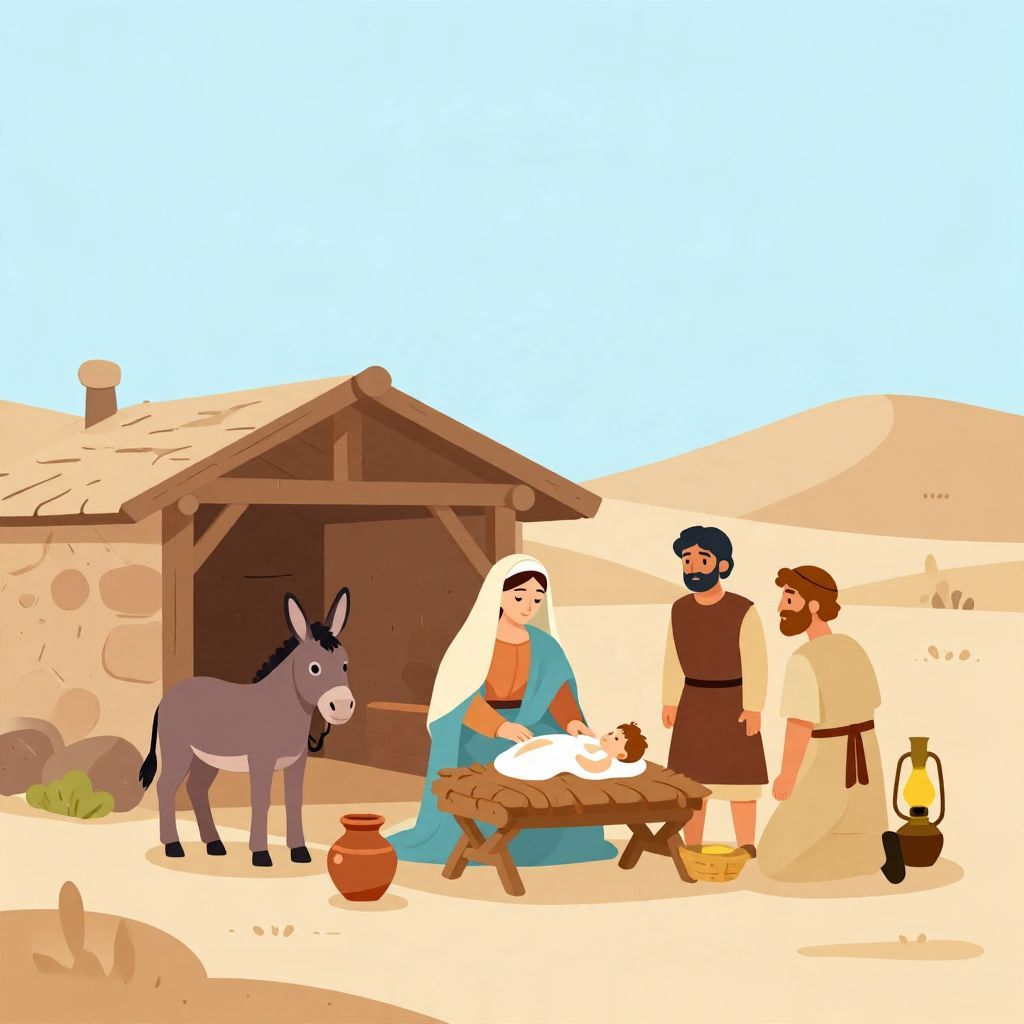
The question of how old the Virgin Mary was when she had Jesus is one of the most asked in Christian history, but the historical answer is not exact. The New Testament does not give Mary’s age, and early Christian tradition offers only later estimates. What historians can say is that Mary was probably a young teenager by the standards of first-century Jewish society.
That means the familiar image of Mary as a very young mother is historically plausible, though not provable in a precise way. To understand why, it helps to look at marriage customs, ancient family life, and how the infancy narratives in the Gospels were written.
How old was the Virgin Mary when she had Jesus?
There is no documented exact age for Mary in the historical sources. Most scholars and church traditions place her somewhere in her early to mid-teens, often around 12 to 16 years old, because girls in first-century Judea commonly married soon after puberty. That estimate is informed by historical context, not by a biblical statement or a surviving record.
What the sources actually say
The canonical Gospels of Matthew and Luke tell the story of Jesus’ conception and birth, but they do not state Mary’s age. They present her as a young woman or virgin betrothed to Joseph, but they are theological texts, not biographical records in the modern sense. As a result, any exact number is an inference rather than a fact directly recorded in the sources.
Why the Bible does not give an age
Ancient texts often assume readers already understand social norms such as marriage age, family roles, and household structure. The Gospel writers were focused on the meaning of Jesus’ birth, not on Mary’s demographic details. Later Christian readers, however, wanted more specificity, which led to traditions and legends that tried to fill in the gaps.
Why historians think Mary was likely a teenager
Historians estimate Mary’s age by comparing the Gospel account with what is known about Jewish marriage patterns in the Roman period. In that world, girls were often betrothed and married at a young age, frequently soon after reaching physical maturity. A betrothal was legally serious and could precede the full marriage ceremony.
Marriage customs in first-century Judea
In many ancient societies, including Jewish communities under Roman rule, marriage was tied to family alliances, household labor, and childbearing. Girls could be promised in marriage before they were fully grown, and the transition from betrothal to marriage could happen quickly. This does not mean every girl married at the same age, but it makes a teenage Mary historically believable.
- Betrothal was a binding stage before living together as husband and wife.
- Marriage age for girls was often earlier than in modern societies.
- Childbearing usually followed soon after marriage, making early motherhood common.
Why “about 12 to 16” is only an estimate
Some Christian traditions and popular retellings have suggested Mary was as young as 12 or 13. Others prefer a slightly older teenage range. Because no contemporary source gives her age, historians avoid a single exact number. The safest conclusion is that she was likely very young by modern standards, but the evidence supports only an approximate range.
How the historical timeline fits together
To estimate Mary’s age, it helps to place the birth of Jesus in historical time. Most historians date Jesus’ birth to sometime before the death of Herod the Great, usually around 4 BCE or a few years earlier. If Mary was a teenager at the time, she would have been living in Roman-ruled Judea during a period of political tension and local expectation.
A simple chronology
- Before Jesus’ birth: Mary is described as betrothed to Joseph.
- Conception and pregnancy: The Annunciation and subsequent pregnancy are central to the Gospel narratives.
- Birth of Jesus: Jesus is born in Bethlehem according to Matthew and Luke.
- Early childhood: The family later appears in the story of Jesus’ youth, though the sources remain sparse.
This timeline matters because it shows that Mary’s age cannot be separated from the customs of the period. A teenage mother in antiquity was not unusual in the same way it would be considered unusual in many modern societies.
What early Christian tradition says about Mary’s age
Later Christian writings and traditions sometimes tried to assign Mary a specific age, often to emphasize her purity, obedience, or exceptional holiness. These traditions are important for understanding devotion, but they are not the same as historical proof. They reflect how later believers imagined the mother of Jesus, not necessarily what can be verified about her life.
Tradition versus history
In historical study, it is important to distinguish between what is attested in early sources and what developed in later devotional culture. The idea of Mary as a very young virgin bride became especially powerful in Christian art, preaching, and liturgy. That image shaped centuries of belief, even though the earliest texts remain silent on her exact age.
Why Mary’s age matters in historical study
Mary’s age is not just a curiosity. It reveals how family life worked in the ancient Mediterranean world and why the Gospel story would have sounded plausible to its first audiences. It also helps modern readers avoid projecting contemporary expectations onto an ancient society where adulthood, marriage, and motherhood often began much earlier.
Social and cultural context
In first-century Judea, women’s lives were closely connected to family structure, inheritance, and household survival. Early marriage could secure alliances and support the continuation of the family line. Understanding this context makes the Gospel narrative more historically grounded, even if many theological questions remain beyond the reach of historical method.
Common misconceptions about Mary’s age
Because the subject is popular, it is easy for legend and certainty to outrun the evidence. Several assumptions appear often in sermons, art, and online discussions, but they should be handled carefully.
- Misconception: The Bible states Mary was 12 or 13.
Reality: The Bible gives no age at all. - Misconception: Historians know her exact birthday.
Reality: No contemporary record survives. - Misconception: Any estimate is pure guesswork.
Reality: The estimate is based on historical context, especially marriage customs.
What can be said with confidence
The most responsible historical answer is that Mary was probably a teenager, likely in the early part of that range, when she gave birth to Jesus. The exact age cannot be proven. What can be proven is that the New Testament and early tradition place her within a social world where young marriage was common and where a very young mother would not have seemed extraordinary.
Why the question still matters today
People continue to ask about Mary’s age because it connects faith, history, and human experience. For believers, it highlights humility and courage. For historians, it is a reminder that sacred stories emerged from real ancient societies with their own customs and assumptions. The question also shows how much of ancient biography must be reconstructed from context rather than direct evidence.
So, how old was the Virgin Mary when she had Jesus? The best historical answer is that she was probably a young teenager, but no source gives an exact age. That uncertainty is part of the history itself. If you want to explore the wider chronology of the New Testament world, you may also be interested in when Jesus was born and who was emperor when Jesus died.