
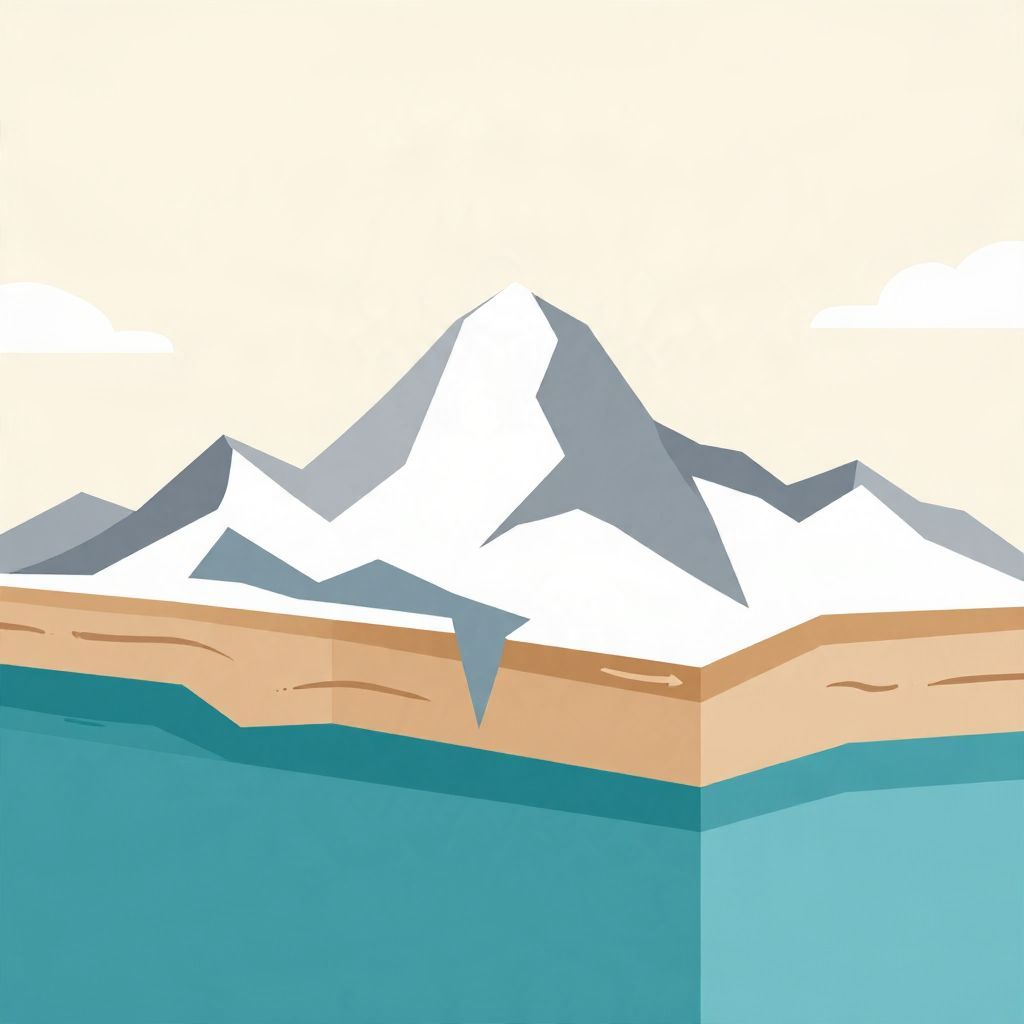
How was Mount Everest formed? The short answer is that Everest rose from the slow collision of two massive tectonic plates: the Indian Plate and the Eurasian Plate. Over tens of millions of years, this collision crumpled Earth’s crust, pushed up the Himalayas, and continues to lift Everest today, even as erosion wears it down.
That makes Everest not just the world’s highest mountain, but a living geological result of plate tectonics. Its story is one of ancient seas, moving continents, immense pressure, and ongoing change.
How Was Mount Everest Formed?
Mount Everest formed when the Indian Plate drifted north and collided with the Eurasian Plate, beginning roughly 50 million years ago. The impact compressed, folded, and thickened the crust, forcing rock layers upward into the Himalayas. Everest’s summit rocks were once part of ancient seabeds, later lifted to extreme heights.
The Geological Story Behind Everest
Before Everest, there was an ocean
Long before the mountain existed, the region that is now the Himalayas lay beneath the Tethys Ocean, a vast body of water between ancient landmasses. Sediments from that ocean floor—mud, sand, and marine organisms—accumulated in layers over millions of years. Some of the rocks found near Everest’s summit are marine limestone, evidence that the mountain’s highest point was once under water.
This is one of the most striking facts about Everest’s formation: the peak is made in part of rocks that began as seafloor deposits. The mountain did not rise from volcanic activity or a single sudden event. It was built by slow but powerful tectonic collision.
The Indian Plate moved north
The Indian Plate was once part of the southern supercontinent Gondwana. After breaking away, it traveled northward at a geologically fast pace. By the time it reached Asia, it was carrying enormous momentum. When it collided with the Eurasian Plate, neither plate could simply sink cleanly beneath the other, so the crust buckled and thickened instead.
This collision is still ongoing. India continues to push into Asia today, which means the Himalayas are still being uplifted, including Everest itself. The mountain is not a finished structure; it is part of an active tectonic zone.
Why Everest became so tall
Everest’s height comes from a combination of crustal shortening, uplift, and stacking. As the plates collided, rock layers were shoved over one another along major faults, and the crust beneath the Himalayas became unusually thick. That thickened crust, buoyed upward like a floating raft on the mantle, helped raise the mountain chain to extraordinary elevations.
In simple terms, Everest is tall because the Earth’s crust was squeezed, folded, and lifted over a very long time. The mountain’s summit is the visible result of deep structural changes below the surface.
What Happened During the Collision?
Compression folded the rock
When the Indian and Eurasian plates met, the crust between them was compressed. Instead of flattening out, rock layers folded and faulted. Some layers were pushed upward, others were thrust over neighboring layers, and the entire region became a zone of intense deformation. This process created the Himalayan mountain belt, of which Everest is the highest point.
The collision did not happen in a single instant. It unfolded over millions of years, with repeated phases of uplift, erosion, and renewed uplift. That long timeline is essential to understanding the mountain’s present shape.
Faults helped build the mountain
Large faults played a major role in Everest’s rise. The Main Central Thrust and related fault systems helped move rock masses upward and rearrange the crust. These structural features are part of why the Himalayas are so steep and geologically complex. Everest stands within a dynamic mountain-building region rather than on a simple, isolated peak.
Because of these faults, the mountain is still geologically active. Earthquakes in the Himalayas are reminders that the crust is under constant stress.
Metamorphism changed the rocks
As the rocks were buried, squeezed, and heated during collision, many were transformed by metamorphism. This means their minerals and textures changed under pressure and temperature without fully melting. Some rocks near Everest record this deep burial before later uplift exposed them again near the summit.
So Everest’s formation is not just about height. It is also about transformation: seabed sediments became hardened, altered mountain rock through immense geological forces.
How Old Is Mount Everest?
The Himalayan collision began roughly 50 million years ago, though the exact timing is debated in geological research because the process happened in stages. Everest itself is younger than the first collision between the plates, since the mountain rose gradually as the crust continued to deform. Its present form is the result of ongoing uplift over tens of millions of years.
That means Everest is both ancient and still changing. Geologically speaking, it is not a fixed object but part of an active mountain system that is still being built.
Why Mount Everest Keeps Changing
Uplift continues today
Everest is still rising, although not in a simple straight line. The India-Asia collision continues to push the Himalayas upward by a few millimeters each year in some areas. The exact rate varies by location and measurement method, but the key point is that the mountain remains tectonically active.
At the same time, erosion removes rock from the summit and slopes. Wind, ice, avalanches, and glaciers constantly wear the mountain down. Everest’s height is therefore the result of a balance between uplift and erosion.
Earthquakes reshape the region
Because the plates are still converging, the Himalayas experience frequent seismic activity. Earthquakes can trigger landslides, alter river courses, and change local topography. These events do not “create” Everest, but they are part of the same tectonic system that formed it.
This ongoing instability helps explain why the mountain range is both spectacular and hazardous.
Mount Everest’s Summit Rocks: A Clue to Its Past
One of the most important clues to Everest’s origin is the rock at its summit. Scientists have identified marine limestone and other sedimentary rocks that formed in an ancient ocean. These rocks were later carried upward by tectonic forces. Their presence is strong evidence that the mountain was built from material that once lay far below sea level.
In other words, Everest’s top is not volcanic lava or freshly created stone. It is ancient ocean floor lifted to the top of the world.
What Mount Everest Is Not
It is easy to misunderstand Everest’s formation because mountains can form in different ways. Everest is not a volcano, and it did not emerge from one explosive eruption. It is also not the result of a single earthquake or a sudden cataclysm. Instead, it formed through continental collision, crustal thickening, and long-term uplift.
That distinction matters because it shows how varied Earth’s mountain-building processes can be. Everest is the product of plate tectonics, not volcanic activity.
Why This Matters Historically and Scientifically
Understanding how Mount Everest formed matters because it reveals how Earth’s surface changes over time. Everest is one of the clearest examples of plate tectonics in action, showing how continents move, oceans disappear, and mountains rise. The mountain also helps scientists study the pace of uplift, erosion, and seismic risk in one of the world’s most active geological regions.
For human history, Everest has also become a symbol of exploration, endurance, and national pride, but its deeper significance lies in the natural history that made it possible. The mountain’s existence is a record of Earth’s ancient past written in stone.
Key Stages in Everest’s Formation
- Ancient marine sediments accumulated on the floor of the Tethys Ocean.
- The Indian Plate broke from Gondwana and drifted north.
- Plate collision with Eurasia began around 50 million years ago.
- Crustal compression folded, faulted, and thickened the region.
- Uplift and metamorphism raised and altered the rocks into the Himalayan range.
- Ongoing tectonic movement continues to raise Everest while erosion reshapes it.
The Bottom Line
Mount Everest was formed by the long collision of the Indian and Eurasian tectonic plates, which uplifted ancient seabed rocks into the Himalayas over tens of millions of years. It remains a living mountain, still rising and eroding at the same time. For more on the deep history of Earth and human encounters with dramatic landscapes, explore related history articles on plate tectonics and the making of continents and the history of Himalayan exploration.