
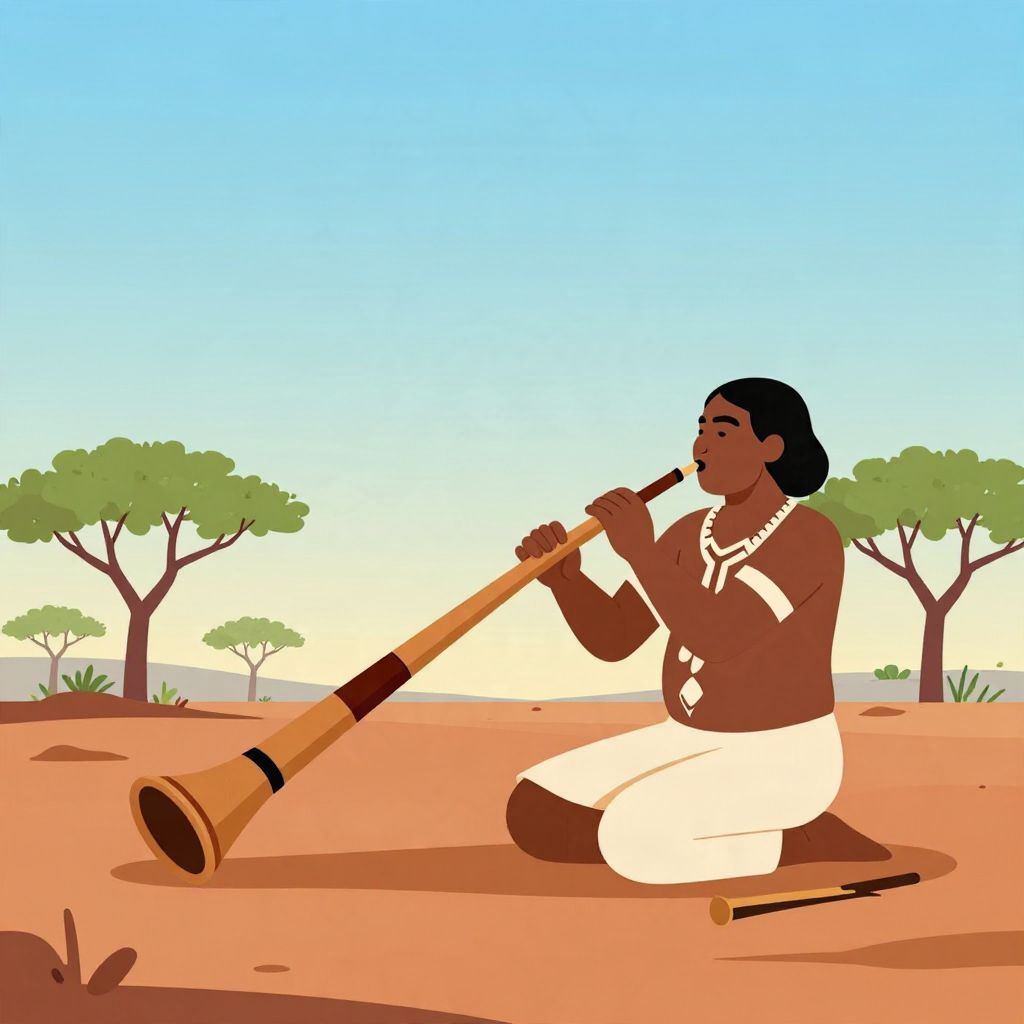
What is a didgeridoo? It is a long wind instrument traditionally associated with Aboriginal Australian cultures, especially in northern Australia. Played by vibrating the lips into a hollow tube, it produces a deep, continuous drone and is often accompanied by rhythmic vocal or percussive effects.
Its history is older and more complex than many popular introductions suggest. The didgeridoo is not a single, uniform “ancient instrument” with one fixed origin story; rather, it belongs to a range of Indigenous musical traditions that developed over time, with strong regional meanings, ceremonial uses, and continuing cultural significance.
What Is A Didgeridoo?
A didgeridoo is a wind instrument made from a hollow tube, usually carved or naturally formed from termite-hollowed wood. The player uses circular breathing to sustain a continuous sound. Traditionally, it is most closely associated with Aboriginal peoples of northern Australia, where it has long been used in song, ceremony, and storytelling.
Origins and Historical Background
Where did the didgeridoo come from?
The didgeridoo originated in northern Australia, particularly in regions such as Arnhem Land, where Aboriginal communities have used similar instruments for generations. Exact dates for its first appearance are not known, because the instrument predates written records and was part of oral cultures. Archaeological and ethnographic evidence suggests a long history, but not a single moment of invention.
It is important to avoid treating the didgeridoo as if it emerged everywhere in Australia at the same time. In fact, its traditional use was strongest in the north and was not historically universal across the continent. Different Indigenous nations had their own musical practices, and some communities did not use the instrument at all.
How was it traditionally made?
Many traditional didgeridoos were made from eucalyptus branches or trunks hollowed out by termites. This natural process produced a ready-made tube that could be cut, cleaned, and shaped. The mouthpiece might be smoothed with wax or resin. Because the instrument depended on local materials, its size, pitch, and tone could vary widely.
The use of termite-hollowed wood is one reason the didgeridoo is so closely tied to northern Australian environments. The instrument’s sound is not just musical; it reflects a relationship between people, land, and ecological knowledge. Makers needed to understand which trees were suitable and how to prepare them for performance.
How the Didgeridoo Was Used in Aboriginal Cultures
Ceremony, song, and social meaning
Traditionally, the didgeridoo was not simply entertainment. In many Aboriginal contexts, it supported ceremonial songs, dances, and ritual events. It often worked alongside clapsticks and singing, helping structure performance and reinforce cultural memory. The instrument’s role could differ by community, but it was generally embedded in broader social and spiritual life.
Because Aboriginal cultures are diverse, there was never one single “didgeridoo tradition.” Some groups used the instrument in male ceremonial settings, while in other contexts its use was more flexible. Any discussion of its history must therefore be careful not to flatten distinct cultural practices into one generalized story.
Why the sound matters
The didgeridoo’s sustained drone has a powerful acoustic effect. Players often use circular breathing, a technique that allows them to inhale through the nose while continuing to push air out through the mouth. This creates an almost uninterrupted tone, which can be layered with rhythmic articulation, vocalization, and changes in resonance.
In performance, the sound can evoke landscape, movement, and ancestral presence. For many listeners, the instrument’s timbre is immediately recognizable, but its meaning is deeper than its sonic novelty. It is part of a living cultural system, not merely an exotic sound object.
Didgeridoo or Yidaki?
Different names, different contexts
“Didgeridoo” is the most common English-language term, but it is not a universal Aboriginal name for the instrument. In some Aboriginal languages, especially in parts of Arnhem Land, the instrument is called yidaki. Other communities use other names. The word “didgeridoo” itself is widely believed to be an English imitation of the instrument’s sound, rather than an Indigenous term.
This matters historically because names shape how objects are understood. Using “didgeridoo” as a catch-all label can obscure local traditions and language diversity. When possible, it is better to use the name preferred by the community being discussed.
Respect and cultural ownership
In recent decades, there has been growing attention to the fact that the instrument is not a generic global novelty but part of Indigenous heritage. Some Aboriginal artists and communities have objected to inappropriate use, commercialization, or misrepresentation of the didgeridoo. These concerns reflect broader issues of cultural ownership and the respectful sharing of traditional knowledge.
How the Didgeridoo Became Known Beyond Australia
From local tradition to global symbol
For much of its history, the didgeridoo was known primarily within Aboriginal communities and nearby regions. During the colonial period, outsiders often misunderstood or ignored Indigenous cultural practices. Over time, however, the instrument became more widely recognized through travel writing, recordings, exhibitions, and later world music markets.
Its global popularity increased in the 20th century, especially as musicians outside Australia began experimenting with it. This brought wider attention, but it also created a risk: the instrument could be detached from the cultures that gave it meaning and reduced to a decorative sound effect.
Modern performance and adaptation
Today, didgeridoos are played in many settings, from traditional ceremonies to concerts, workshops, and fusion music. Some contemporary Aboriginal musicians use the instrument to assert cultural identity, while others adapt it in new artistic directions. Non-Indigenous players also perform it, though this raises questions about cultural respect, context, and authenticity.
The modern history of the didgeridoo is therefore a story of continuity and change. It has remained a living Indigenous instrument while also becoming part of a global musical landscape.
Key Facts About the Didgeridoo
- Instrument type: A wind instrument producing a continuous drone.
- Traditional region: Northern Australia, especially Arnhem Land and surrounding areas.
- Materials: Often termite-hollowed eucalyptus wood, sometimes with wax or resin mouthpieces.
- Playing technique: Circular breathing helps sustain the sound.
- Cultural role: Used in song, ceremony, dance, and storytelling in many Aboriginal traditions.
- Name: “Didgeridoo” is an English term; several Indigenous names exist, including yidaki in some communities.
Common Misconceptions
Was the didgeridoo used everywhere in ancient Australia?
No. Although it is strongly associated with Aboriginal Australia, it was not historically universal across the continent. Its use was concentrated in the north, and different communities had different musical traditions. Treating it as the single instrument of all Aboriginal peoples oversimplifies a very diverse cultural history.
Is it thousands of years old?
Probably, in the broad sense that it belongs to very old Indigenous traditions, but the exact age is difficult to prove. Because the instrument was part of oral cultures and made from perishable materials, direct evidence is limited. Claims of exact dates are usually speculative unless tied to specific archaeological or ethnographic findings.
Is it only a musical instrument?
No. In many contexts, the didgeridoo is also a cultural and ceremonial object. Its meaning can include identity, ancestry, place, and spiritual significance. Reducing it to a novelty instrument misses the historical and cultural depth of its use.
Why the Didgeridoo Still Matters Historically
The didgeridoo matters because it shows how music can carry history. It is tied to Aboriginal knowledge of land, materials, performance, and social practice. Its survival into the present also reflects the resilience of Indigenous cultures despite colonization, displacement, and misunderstanding.
At the same time, the instrument’s global fame has created a tension between appreciation and appropriation. A historically informed view recognizes both its artistic power and its cultural specificity. The didgeridoo is best understood not as a generic “ancient sound,” but as a living expression of Aboriginal Australian heritage.
In short, a didgeridoo is a traditional Aboriginal Australian wind instrument with deep regional roots, a distinctive drone, and enduring cultural significance. Understanding it properly means seeing both its musical form and the history of the people who made, played, and sustained it. If you are interested in related cultural history, you may also enjoy reading about Aboriginal history or Indigenous Australia.