
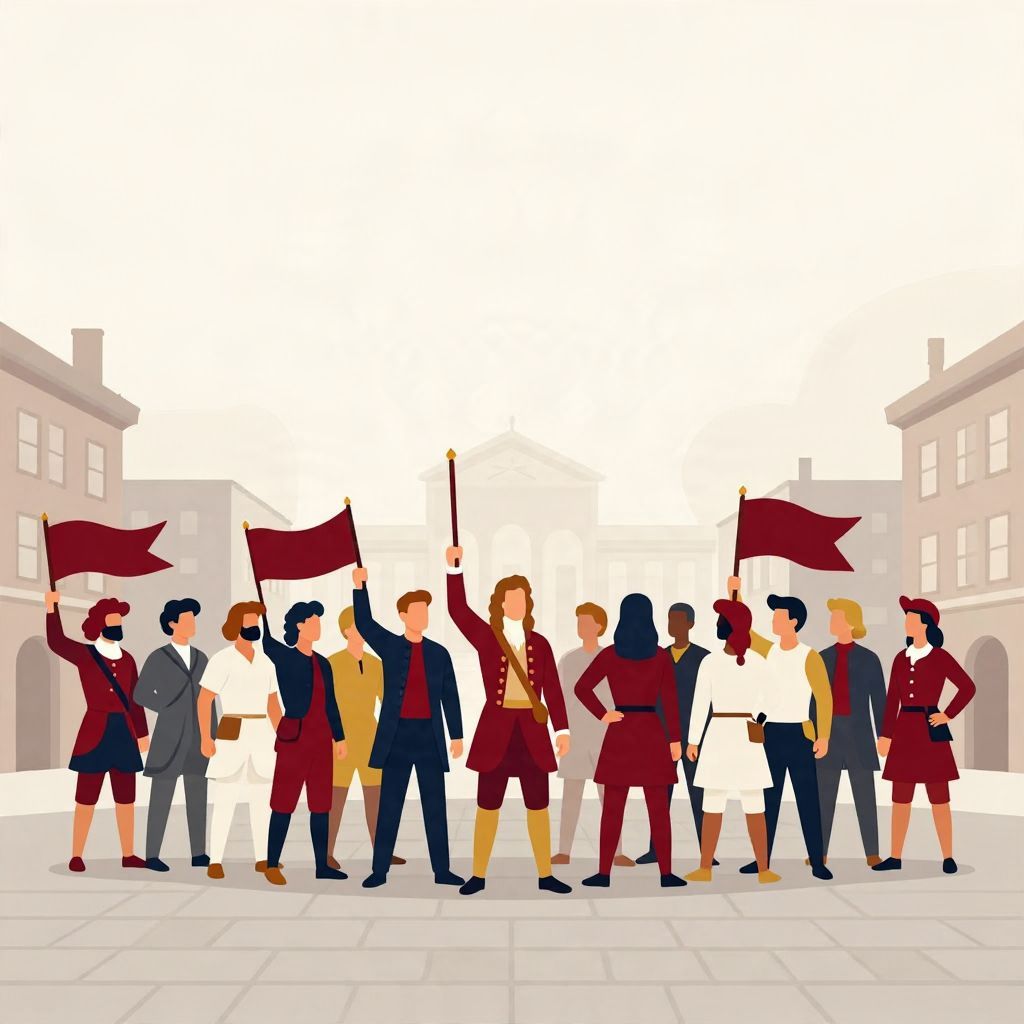
What is revolution in history? The word can mean a sudden, often forceful change in government, society, or political authority. It can also describe a broader transformation in the way people live, work, and think. Historians use the term carefully because not every dramatic change is a revolution, and not every revolution succeeds.
At its core, a revolution usually involves a break with an existing order and an attempt to create something new. That break may be political, social, economic, or technological, and it can happen quickly or unfold over years.
What Is Revolution in History?
A revolution is a major and usually rapid change that overturns an established system. In history, the term most often refers to the overthrow of a government, but it can also describe sweeping social or economic transformation, such as the Industrial Revolution. What makes it revolutionary is the scale of change and the challenge to existing power.
The basic idea
The word comes from the Latin revolutio, meaning a turning around or a return. In early modern Europe, it could refer to a cycle or a dramatic political shift. Over time, the meaning changed. By the eighteenth century, “revolution” increasingly meant a decisive break from the old order rather than a return to it.
In historical writing, revolution is not just any protest or reform. Reform usually tries to improve a system without destroying it. Revolution aims at deeper transformation. That is why revolutions often involve mass mobilization, violence, civil conflict, or the collapse of old institutions.
Political, social, and economic revolutions
- Political revolutions replace rulers, regimes, or state systems.
- Social revolutions transform class relations, citizenship, or everyday life.
- Economic revolutions reshape production, labor, and wealth.
- Technological revolutions alter how societies function through new tools and methods.
These categories often overlap. The French Revolution, for example, was political, social, and ideological at once. The Industrial Revolution changed economies and societies so profoundly that many historians treat it as one of the most important revolutions in modern history.
How Did the Idea of Revolution Develop?
The modern idea of revolution emerged gradually in the early modern period, especially in Europe. Before the eighteenth century, political change was often understood as restoration, rebellion, or dynastic conflict. Over time, people began to imagine that a society could be remade on purpose, not simply restored to a previous state.
From cyclical change to modern upheaval
In older political thought, change was often seen as cyclical: rulers rose and fell, but the basic structure of society remained. In the seventeenth and eighteenth centuries, however, political thinkers and participants in upheavals began to treat revolution as a new kind of event. It was not just disorder. It could be a founding moment for a new political order.
That shift mattered. Once revolution became associated with founding legitimate governments, it gained a powerful place in modern political language. Later movements across Europe, the Americas, Asia, Africa, and the Middle East would invoke revolution to justify independence, equality, nationalism, or social justice.
Why revolutions happen
Revolutions rarely have a single cause. They usually grow from a combination of pressures that make an existing system unstable. Common causes include:
- economic hardship, taxation, or food shortages
- political exclusion and weak legitimacy
- social inequality and resentment of privilege
- war, military defeat, or state crisis
- new ideas that challenge authority
Often, a revolution begins when long-term grievances meet a short-term crisis. A government may appear strong for years and then suddenly collapse when it can no longer manage debt, war, or popular unrest.
What Are the Most Famous Historical Revolutions?
Several revolutions have shaped modern history, though they differed greatly in causes and outcomes. The English Revolution of the seventeenth century, the American Revolution, the French Revolution, the Haitian Revolution, and the Russian Revolution are among the most studied. Each changed political life in lasting ways.
The English Revolution and constitutional change
What some historians call the English Revolution took place in the mid-seventeenth century, during the English Civil Wars, the execution of Charles I in 1649, and the later settlement that limited royal power. Others prefer terms like civil war or the Glorious Revolution of 1688–1689 for specific phases of the transformation. The main result was a stronger constitutional role for Parliament.
This period showed that revolution did not always mean a complete social break. In England, the monarchy survived, but the balance of power changed significantly. That makes it a useful example of how historians debate the meaning of revolution itself.
The American Revolution
The American Revolution began in the 1760s and 1770s as conflict grew between Britain and its North American colonies. Colonists objected to taxation, imperial control, and the absence of representation in Parliament. The war for independence began in 1775, and the United States declared independence in 1776.
Its significance went beyond separation from Britain. The revolution created a new republic and helped spread ideas about popular sovereignty, rights, and written constitutions. At the same time, its ideals did not immediately apply to everyone. Enslaved people, Native peoples, women, and many poor men remained excluded from full political equality.
The French Revolution
The French Revolution began in 1789 and became one of the most influential revolutions in world history. Financial crisis, social inequality, and political deadlock helped trigger the collapse of the old regime. The calling of the Estates-General, the formation of the National Assembly, and the storming of the Bastille symbolized the breakdown of royal authority.
Over the following years, France experienced radical political change, the execution of Louis XVI, war with European powers, and intense internal conflict. The revolution introduced powerful new principles such as citizenship, legal equality, and national sovereignty. It also showed how revolutionary movements can become violent and unstable.
The Haitian Revolution
The Haitian Revolution, beginning in 1791, was the only successful large-scale slave revolt in modern history. Enslaved people in Saint-Domingue rose against the plantation system of the French colony. After years of war, political struggle, and foreign intervention, Haiti declared independence in 1804.
This revolution was extraordinary because it destroyed slavery in the colony and created the first Black republic. It terrified slaveholding societies across the Atlantic world and inspired both hope and repression. Its global importance is often greater than its place in older textbooks suggests.
The Russian Revolution
The Russian Revolution unfolded in 1917 during World War I. The February Revolution overthrew the Romanov monarchy, and the October Revolution brought the Bolsheviks to power under Vladimir Lenin. The upheaval led to civil war, the creation of the Soviet state, and a new communist political order.
Because the Bolsheviks claimed to represent workers and peasants, the Russian Revolution became a model for later revolutionary movements. It also showed how revolution can lead not only to liberation but to a new centralized and often coercive regime.
What Do Historians Mean by “Revolutionary” Change?
Historians do not use the word revolution casually. A movement may be dramatic without being revolutionary in the strict sense. To count as a revolution, a change usually has to alter the foundations of power, legitimacy, or social organization. The exact threshold, however, is debated.
Different historical interpretations
Some historians emphasize class conflict and economic structures. Others focus on political institutions, ideas, or state breakdown. Still others argue that revolutions are made by coalitions of groups with different goals, which can produce unstable alliances and unexpected outcomes.
Because of these differences, one event may be described as a revolution by one scholar and as a rebellion, coup, war, or reform movement by another. The label depends partly on what changed and partly on how the changes are interpreted.
Revolution versus rebellion and coup
- Rebellion is an act of resistance against authority, but it may not replace the system.
- Coup is a sudden seizure of power by a small group, usually within the state.
- Revolution usually implies broader and deeper transformation, often involving mass participation.
This distinction is useful, though not absolute. A coup can trigger revolution, and a revolution may begin as a rebellion. Historical reality is often messier than the labels we use to describe it.
What Causes Revolutions to Succeed or Fail?
Revolutions succeed when old regimes lose legitimacy, when opposition groups can organize effectively, and when the state cannot maintain control. They fail when governments retain military strength, when revolutionary coalitions split, or when foreign powers intervene decisively.
Common factors in revolutionary success
- State weakness after war, fiscal crisis, or administrative collapse
- Broad support from multiple social groups
- Clear leadership or effective organization
- Ideological appeal that gives the movement purpose
- Opportunity created by war, famine, or political scandal
Success does not always mean stability. Many revolutions replace one form of domination with another, or they enter a period of civil war before a new order emerges. The long-term consequences may differ sharply from the original hopes of revolutionaries.
Why Does Revolution Matter in World History?
Revolution matters because it changes the rules by which societies are governed. Revolutions have helped create modern ideas of citizenship, rights, nationalism, democracy, socialism, and anti-colonial independence. They have also produced terror, dictatorship, war, and exile. Their legacy is therefore mixed and often contested.
Long-term consequences
Revolutions can reshape borders, laws, and political identities for generations. They may abolish old privileges, redistribute land, end monarchies, or inspire new constitutions. They can also deepen divisions and create new forms of state power. In that sense, revolution is not simply an event but a process whose effects continue long after the first uprising.
Revolutions also influence memory. Later generations often turn them into symbols, celebrating them as moments of liberation or condemning them as sources of chaos. That is why revolution remains one of the most powerful words in history.
In short, a revolution is a profound break with the past that seeks to create a new political or social order. Whether it succeeds or fails, it leaves a lasting mark on history. For related reading, see one consequence of the October Revolution and when the Revolutionary War ended.