
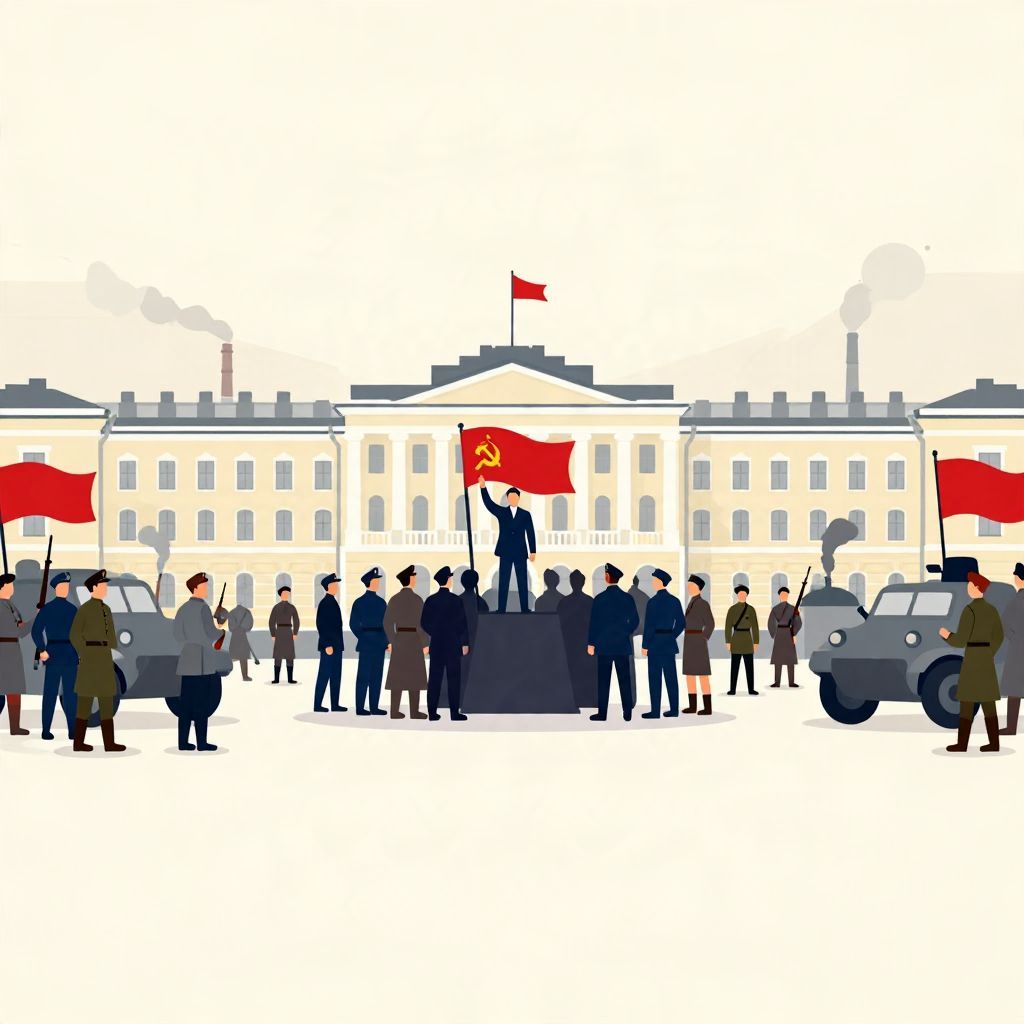
What was one consequence of the October Revolution? In the short term, the most important consequence was the Bolsheviks’ seizure of power in Russia and the creation of a new one-party socialist state. That change ended the Provisional Government, pulled Russia out of World War I, and set off a civil war that would reshape the former empire.
The October Revolution of 1917 was not a single isolated event but the climax of months of political collapse, popular unrest, and war-weariness in revolutionary Russia. Its consequences were immediate and far-reaching, affecting Russia’s government, economy, society, and eventual role in world history.
What Was One Consequence Of The October Revolution?
One major consequence of the October Revolution was the rise of Bolshevik rule and the establishment of Soviet power in Russia. After seizing key centers in Petrograd in late October 1917, the Bolsheviks replaced the Provisional Government and began building a new state based on socialist ideology, centralized authority, and party control.
How The Bolsheviks Took Power
The October Revolution took place in Petrograd, then the capital of Russia, in late October 1917 by the Julian calendar used in Russia at the time, which corresponds to early November in the modern Gregorian calendar. Led by Vladimir Lenin and organized by Leon Trotsky and the Bolshevik Party, the takeover was swift compared with the larger upheavals of 1917.
The collapse of the old order
By 1917, the Russian Empire was under severe strain. World War I had caused military losses, food shortages, inflation, and political instability. In February 1917, the tsar had already abdicated, and the Provisional Government that followed struggled to maintain authority. It continued the war, which made it increasingly unpopular with workers, soldiers, and peasants.
Why the Bolsheviks succeeded
The Bolsheviks gained support by promising “peace, land, and bread.” This message was powerful because it addressed the immediate concerns of ordinary Russians: an end to war, redistribution of land, and relief from hunger. Their disciplined party structure also helped them act decisively when the opportunity came.
Immediate Political Consequences
The most direct result of the October Revolution was the overthrow of the Provisional Government and the transfer of power to Bolshevik-led soviets, or councils. The new government quickly issued decrees on peace and land, signaling a break with the old regime and a new political direction for Russia.
End of the Provisional Government
The Provisional Government had been intended as a temporary authority until elections could determine Russia’s future. Once the Bolsheviks took control, that transitional experiment ended. In practice, power increasingly concentrated in the hands of the Bolshevik leadership rather than in broad democratic institutions.
One-party rule begins
Although other socialist groups initially existed in revolutionary politics, the Bolsheviks moved to dominate the state. Over time, opposition parties were suppressed or marginalized, and the new regime developed into a one-party system. This was a defining consequence because it shaped Soviet politics for decades.
Russia Leaves World War I
Another major consequence was Russia’s withdrawal from World War I. The Bolsheviks had promised peace, and they pursued it quickly. In March 1918, the Soviet government signed the Treaty of Brest-Litovsk with Germany and its allies, accepting harsh territorial losses in exchange for ending Russia’s participation in the war.
Why peace mattered so much
For many Russians, the war had become unbearable. Soldiers were exhausted, and the economy was breaking down under wartime pressure. Ending the war fulfilled one of the Bolsheviks’ central promises, but it also angered opponents who saw the treaty as a humiliating surrender of land and resources.
Territorial and political costs
The treaty removed Russia from the conflict but at a steep price. Large areas of the former empire were lost or placed under German influence. This fueled resentment and helped deepen the chaos that followed, especially as different groups fought over what Russia should become.
The Russian Civil War And Violence
Perhaps the most destructive consequence of the October Revolution was the Russian Civil War, which began in 1918 and lasted until about 1921. The Bolshevik takeover did not bring immediate stability; instead, it triggered armed resistance from monarchists, liberals, rival სოციალისტ groups, regional nationalists, and foreign intervention forces.
Red Army versus White forces
The Bolsheviks organized the Red Army to defend the revolution. Their opponents, often grouped loosely as the “Whites,” were not a single unified movement, but they shared opposition to Bolshevik rule. The war was brutal, involving military campaigns, executions, famine, and widespread suffering among civilians.
Terror and coercion
As the civil war intensified, the Bolsheviks used coercive methods to hold power. The Cheka, the early Soviet secret police, targeted perceived enemies of the revolution. This period helped establish a pattern of political repression that became a lasting feature of Soviet governance.
Social And Economic Transformation
The October Revolution also transformed daily life. The Bolsheviks aimed to remake society by abolishing old privileges and placing industry, land, and political power under state direction. Some changes were immediate; others developed over years as the new regime consolidated control.
Land and property changes
One early measure was the redistribution of land from landlords to peasants, though the process was uneven and often chaotic. In cities, factories came under increasing state influence. The Bolsheviks believed that controlling land and production was necessary to build socialism and prevent the return of the old elite.
Changes in class and status
Revolutionary ideology rejected aristocratic privilege and sought to elevate workers and peasants. In practice, however, the new system created its own hierarchy, with party officials and state administrators gaining influence. The social order changed dramatically, but equality remained an aspiration more than a reality.
Why The October Revolution Mattered Beyond Russia
The consequences of the October Revolution were not limited to Russia. The creation of the world’s first self-described socialist state had global significance. It inspired revolutionary movements, alarmed governments, and helped shape the politics of the 20th century.
A model for revolutionary movements
For supporters around the world, the Bolshevik victory suggested that a disciplined revolutionary party could overthrow an established state. Communist parties later drew on the Russian example, even when local conditions were very different. The revolution became a symbol of radical political possibility.
Fear of revolution abroad
At the same time, many governments and elites feared that Bolshevism would spread. The revolution contributed to anti-communist politics in Europe, North America, and elsewhere. In this sense, its consequences included not only new revolutionary movements but also stronger efforts to resist them.
Long-Term Consequences For The Soviet Union
The October Revolution led directly to the formation of the Soviet state, which eventually became the Union of Soviet Socialist Republics in 1922. That state would endure until 1991. The revolution therefore was not only a takeover in 1917; it was the starting point for a new political order that lasted much of the 20th century.
Centralized government
The Bolsheviks built a highly centralized system in which the Communist Party controlled the state. This structure allowed rapid mobilization of resources, but it also limited political freedom and concentrated power at the top. The foundations of later Soviet rule were laid during the revolutionary years.
Economic planning and state control
Over time, the Soviet government expanded state ownership and planning. While policies changed under different leaders, the principle that the state should direct the economy remained central. This was one of the most enduring consequences of the revolution, shaping Soviet life for generations.
How Historians Understand The Consequences
Historians generally agree that the October Revolution was a turning point, but they differ on how to judge it. Some emphasize the revolution’s role in ending autocracy and opening the way to social change. Others stress the violence, repression, and authoritarianism that followed. Both views are important for understanding its legacy.
Revolution and dictatorship
One common interpretation is that the revolution began with promises of liberation but produced a new form of dictatorship. Another argues that the civil war, foreign intervention, and state collapse pushed the Bolsheviks toward harsh methods. These explanations are not mutually exclusive; the historical record shows both ideological commitment and wartime coercion.
Not a simple success or failure
The October Revolution cannot be reduced to a single outcome. It ended one political order, created another, and unleashed forces that transformed Russia and the wider world. Its consequences included peace with Germany, civil war, social upheaval, and the birth of the Soviet state.
Conclusion
One consequence of the October Revolution was the Bolsheviks’ rise to power and the creation of a Soviet government that replaced the Provisional Government. That shift ended Russia’s participation in World War I, triggered civil war, and set the stage for decades of communist rule. For a broader look at the revolutionary year, see what happened in 1917 and explore how later upheavals changed the modern world in other major historical turning points.