
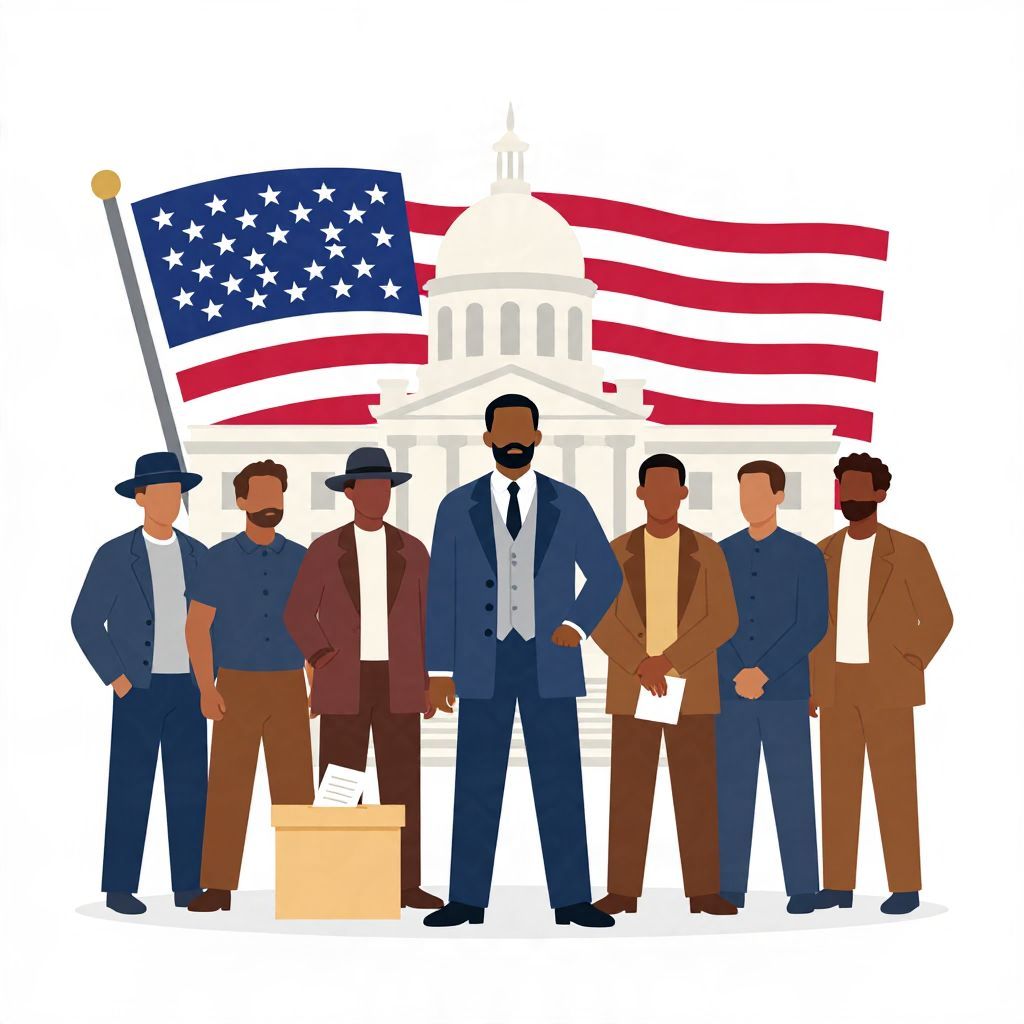
What is the Fifteenth Amendment, and why does it matter in American history? Ratified in 1870, the Fifteenth Amendment to the U.S. Constitution prohibited the federal government and the states from denying a citizen the right to vote because of “race, color, or previous condition of servitude.” It was one of the Reconstruction Amendments passed after the Civil War to redefine citizenship and political rights.
Its promise was momentous, but its enforcement was uneven. The amendment did not end racial discrimination in voting, and many Black Americans in the South were later blocked by violence, intimidation, literacy tests, poll taxes, and other barriers. Even so, it became a foundational constitutional guarantee in the long struggle for voting rights.
What Is the Fifteenth Amendment?
The Fifteenth Amendment is a constitutional amendment adopted in 1870 that forbids the United States and the states from denying the right to vote on account of race, color, or a person’s previous condition of servitude. In practical terms, it aimed to protect Black male suffrage after the Civil War, though it did not guarantee voting rights for everyone or prevent later discrimination.
Background: Why Was It Needed?
The amendment emerged from the upheaval of the Civil War and the end of slavery. Before the war, voting rights were largely controlled by the states, and most enslaved people could not vote because they were enslaved and because many states restricted suffrage by race. After emancipation, the question became whether formerly enslaved men would be recognized as political citizens.
Reconstruction and the struggle over citizenship
During Reconstruction, Congress and the federal government tried to rebuild the South and define freedom after slavery. The Thirteenth Amendment abolished slavery in 1865, and the Fourteenth Amendment in 1868 established national citizenship and equal protection under the law. The Fifteenth Amendment followed because lawmakers knew that citizenship alone did not automatically secure political power.
For many Republicans in Congress, voting rights were essential to protecting the gains of emancipation. They believed that if Black men could vote, they could help defend civil rights, support Reconstruction governments, and resist efforts to restore white supremacy. Opponents, especially many white Southern Democrats and some Northern conservatives, argued that voting rights should remain a state matter.
How Did the Fifteenth Amendment Become Law?
The amendment was proposed by Congress in 1869 and ratified by the states in 1870. It was part of a broader constitutional transformation after the Civil War, when the nation was trying to settle the meaning of freedom, equality, and federal authority. Ratification required approval by three-fourths of the states, and the political balance of Reconstruction made that possible.
Key dates and sequence
- 1865 – The Thirteenth Amendment abolishes slavery.
- 1868 – The Fourteenth Amendment establishes national citizenship and equal protection.
- 1869 – Congress proposes the Fifteenth Amendment.
- 1870 – The amendment is ratified and becomes part of the Constitution.
Congressional Republicans were not united on every detail, but they agreed that voting rights had to be protected if Reconstruction was to succeed. The amendment was also shaped by political calculation: Republicans hoped newly enfranchised Black voters would support the party that had led the Union war effort and emancipation.
What Does the Amendment Actually Say?
The core language of the Fifteenth Amendment is brief but significant. It says that the right to vote cannot be denied or abridged by the United States or any state “on account of race, color, or previous condition of servitude.” It also gives Congress the power to enforce the amendment through legislation.
Why the wording mattered
The phrase “on account of race, color, or previous condition of servitude” was designed to stop explicit racial exclusion, especially against Black men and formerly enslaved people. But the amendment did not mention sex, income, literacy, or other barriers. That omission mattered greatly, because states later used race-neutral language and administrative rules to suppress Black voting without openly violating the text.
Who Supported and Opposed It?
Support for the amendment came primarily from Radical and moderate Republicans in Congress, Black activists, and many formerly enslaved people who had fought for freedom and political rights. Black leaders understood that the vote was not symbolic; it was a tool for safety, representation, education, labor rights, and access to justice.
Opposition came from many white Southerners who saw Black suffrage as a threat to the racial order, and from some people in the North who feared federal intervention in state elections. Some critics also argued that the amendment did not go far enough because it protected only against racial discrimination and not against sex discrimination.
The question of women’s suffrage
The Fifteenth Amendment did not grant women the vote. This led to a painful split among some suffrage activists. Some supported the amendment as a necessary step for Black men, while others opposed it because it excluded women. That conflict helped shape the women’s suffrage movement in the decades that followed and showed that voting rights in the United States developed unevenly and often controversially.
What Happened After Ratification?
In the short term, the Fifteenth Amendment helped expand Black political participation, especially in the South during Reconstruction. Black men voted, held office, and influenced state and local governments. For a brief period, interracial democracy became a real political force in parts of the former Confederacy.
But the amendment’s promise was quickly undermined. After Reconstruction weakened and federal enforcement declined, white supremacist groups used terror and intimidation to suppress Black voters. Southern states then built systems of disfranchisement that included literacy tests, grandfather clauses, poll taxes, white primaries, and discriminatory registration practices.
Why the amendment was not enough on its own
The Fifteenth Amendment prohibited racial denial of the vote, but it did not automatically create effective enforcement. Courts often interpreted it narrowly, and federal willingness to protect Black voting rights faded in the late nineteenth century. As a result, the constitutional protection existed on paper while millions of Black citizens were excluded in practice.
This gap between law and reality is one of the most important facts about the amendment. It shows that constitutional rights depend not only on wording, but also on enforcement, political power, and public commitment.
How Was It Enforced Over Time?
For decades, enforcement was weak. The federal government occasionally acted against election fraud or intimidation, but those efforts were inconsistent. In the late nineteenth and early twentieth centuries, Supreme Court decisions and political compromise often allowed states to keep discriminatory systems in place.
Only much later did the federal government take stronger action. The modern civil rights movement helped force change, and the Voting Rights Act of 1965 became the most important federal law protecting voting rights in the United States. It was built in part on the constitutional foundation laid by the Fifteenth Amendment.
Long-term significance
The Fifteenth Amendment became central to later voting rights struggles. It gave Congress constitutional authority to challenge racial discrimination in elections and provided a legal basis for later civil rights legislation. It also stands as a reminder that formal equality can coexist with practical exclusion unless institutions are willing to enforce rights.
Common Misunderstandings About the Fifteenth Amendment
One common misunderstanding is that the amendment instantly secured universal voting rights for Black Americans. In reality, it prohibited one specific form of discrimination but did not stop other methods of suppression. Another misunderstanding is that it applied to all citizens equally. It did not address sex discrimination, and women of all races remained excluded from the vote until the Nineteenth Amendment in 1920.
What it did and did not do
- It did ban denial of the vote based on race, color, or prior slavery.
- It did empower Congress to enforce the rule.
- It did not guarantee voting rights for women.
- It did not stop later voter suppression tactics that avoided explicit racial language.
Why the Fifteenth Amendment Still Matters
The Fifteenth Amendment remains a landmark in the history of democracy in the United States. It marked a constitutional rejection of racial exclusion from voting and affirmed that political rights were a national concern, not just a state privilege. Even though its early enforcement failed badly, it helped establish the principle that race cannot lawfully determine who gets to participate in elections.
Its history also reveals a broader truth: rights can be written into law long before they are fully realized in society. The amendment’s legacy is therefore both inspiring and cautionary. It represents a major victory of Reconstruction, but also the beginning of a long struggle to make voting rights real for all citizens.
In short, the Fifteenth Amendment was a turning point in American constitutional history: it outlawed racial discrimination in voting, expanded the meaning of citizenship after the Civil War, and laid the groundwork for later battles over democracy. To understand the Reconstruction era more fully, readers may also want to explore the Thirteenth Amendment and the Fourteenth Amendment.