
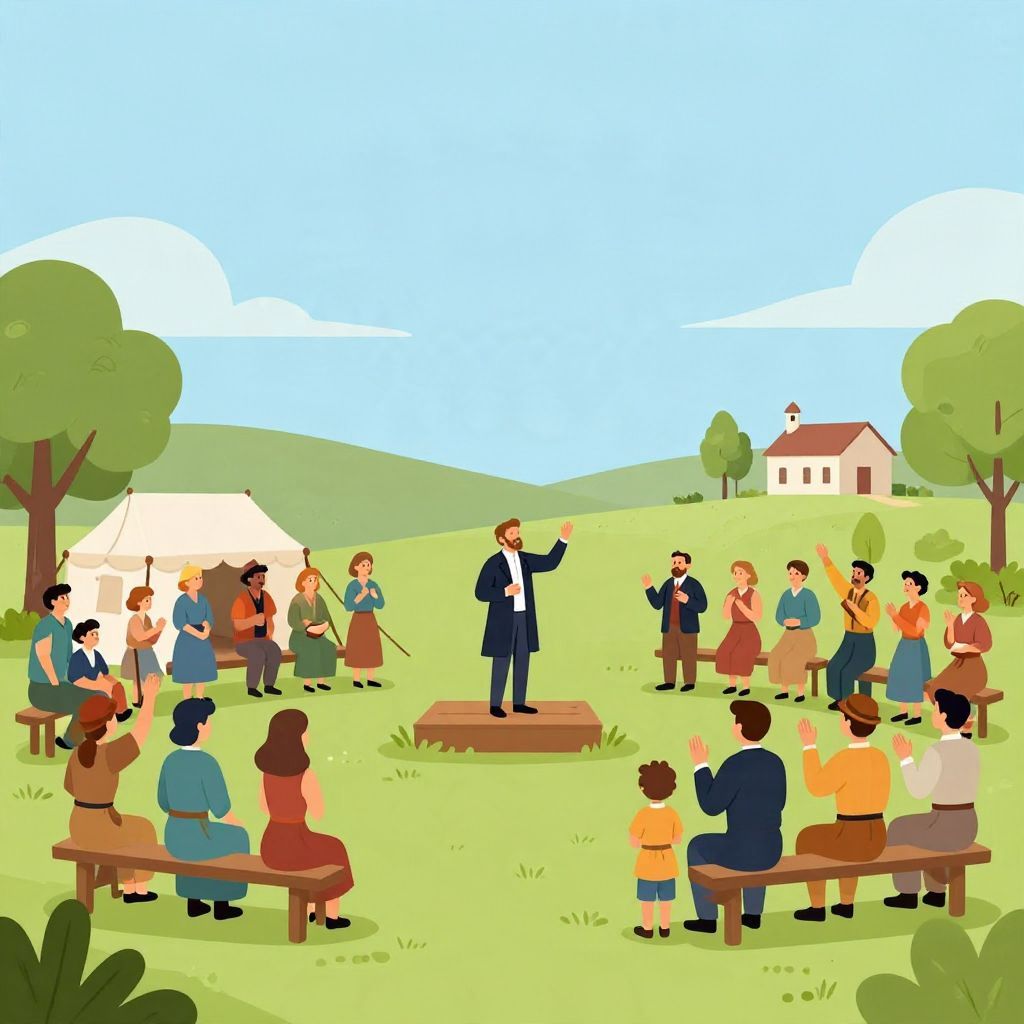
The Second Great Awakening was a major Protestant religious revival that swept the United States in the late 18th and early 19th centuries. It reshaped American religion by emphasizing personal conversion, emotional preaching, and the idea that ordinary people could experience faith directly.
It also had wide social consequences. The movement helped inspire reform efforts such as temperance, abolitionism, and women’s activism, while strengthening new denominations and expanding religion on the American frontier.
What Is The Second Great Awakening?
The Second Great Awakening was a wave of evangelical Protestant revivalism in the United States, roughly from the 1790s through the 1840s. It stressed individual repentance, salvation, and active moral reform. Unlike older, more formal church traditions, it spread through camp meetings, itinerant preachers, and emotionally charged sermons.
Background: Why Did It Happen?
The movement emerged in a young republic undergoing rapid change. After the American Revolution, many Americans worried that republican freedom might weaken moral discipline and religious commitment. At the same time, westward expansion, population growth, and new transportation routes carried settlers into frontier regions where established churches were often weak or absent.
Religious life in the early United States was also changing because of the First Great Awakening in the mid-18th century and the broader Protestant emphasis on personal faith. By the late 1700s, many ministers believed that churches needed renewal. The Second Great Awakening answered that concern by making conversion a public, urgent, and repeatable experience.
Origins and Early Centers of Revival
The revival did not begin in one single place. It developed in several regions at roughly the same time, especially in New England, Kentucky, Tennessee, and upstate New York. Historians often point to the late 1790s and early 1800s as the movement’s formative years, though its influence continued for decades.
Kentucky and the Frontier Camp Meetings
One of the most famous early revivals took place in Kentucky, where large outdoor gatherings drew thousands of people. The Cane Ridge Revival of 1801 is often treated as a landmark event. Preachers from different denominations spoke to huge crowds, and worship included singing, shouting, prayer, and emotional conversion experiences. These meetings became a model for frontier revivalism.
New England and the “New Measures”
In New England, revivalism took a different form. Ministers such as Lyman Beecher and later Charles Grandison Finney promoted methods designed to encourage immediate response from listeners. Finney, especially in the 1820s and 1830s, became known for “new measures,” including public calls for conversion and revival meetings structured to produce visible religious commitment.
Key Beliefs and Practices
The Second Great Awakening was not a single church or doctrine, but a style of Protestant religion. It cut across several denominations, including Methodists, Baptists, Presbyterians, and others. Its central message was that people could choose salvation through repentance and faith, rather than relying only on inherited church membership or social status.
Personal Conversion
Revival preachers taught that a person needed a conscious conversion experience. This emphasis made religion more individual and emotional. Many converts described a dramatic sense of guilt, followed by relief, joy, and a new moral purpose. That experience became a powerful marker of authentic faith.
Emotional Preaching and Mass Gatherings
Revival meetings often featured passionate sermons, hymn singing, and intense public responses. Camp meetings were especially important on the frontier because they could gather scattered communities for several days of worship. These events were not merely religious services; they were social occasions that helped create networks among settlers.
Democratization of Religion
The movement reflected a broader democratic spirit in early American life. It suggested that ordinary people, not just elites, could interpret scripture, experience grace, and take part in reform. This helped weaken older distinctions between educated clergy and lay believers and encouraged the growth of voluntary religious societies.
Important Leaders and Denominations
Several ministers and denominations played major roles in the revival. No single leader controlled the movement, but some figures became especially influential in shaping its direction and methods.
- Charles Grandison Finney — a leading revivalist in the 1820s and 1830s, known for energetic preaching and organized revival techniques.
- Lyman Beecher — a prominent New England minister who supported revival and moral reform.
- Barton W. Stone and Alexander Campbell — leaders associated with the Restoration Movement, which sought to return Christianity to New Testament simplicity.
- Methodist and Baptist preachers — these denominations expanded rapidly because their flexible organization and traveling ministers suited frontier conditions.
Methodists and Baptists grew especially quickly during this period. Their emphasis on lay participation, local congregations, and itinerant preaching made them well adapted to rural and expanding communities. Presbyterians also participated, though they sometimes debated how emotional revival should be managed.
How the Second Great Awakening Changed American Society
The revival was not only a religious event. It helped reshape American culture, politics, and reform. By teaching that individuals could improve themselves and society, it encouraged a moral activism that extended beyond the church.
Reform Movements
Many revivalists believed that conversion should lead to social improvement. This outlook helped fuel reform campaigns in the 19th century, including temperance, prison reform, education reform, and later abolitionism. Not every revivalist supported every reform, but the movement created a moral language that reformers could use.
Women and Religious Activism
Women played a significant role in the revival and in the reform movements that followed. Although most churches remained male-led, revival culture gave women more opportunities to pray publicly, join missionary and benevolent societies, and support moral campaigns. In some cases, religious activism became an entry point into broader public life.
Slavery and Abolition
The relationship between the Second Great Awakening and slavery was complex. Some Christians used revivalist morality to argue against slavery and support abolition. Others defended slavery or avoided the issue. Over time, however, evangelical reform helped produce a stronger antislavery movement, especially in the North. The same religious energy that inspired personal salvation could also be directed toward social sin.
Regional Differences and Limits
Although the Second Great Awakening was widespread, it did not look the same everywhere. In New England, it was often tied to educated ministers and organized congregations. On the frontier, it was more spontaneous and dramatic. In the South, revivalism spread widely but often coexisted with slavery and a different social order.
It is also important not to exaggerate its reach. Not all Americans participated, and not all churches welcomed revival methods. Some religious leaders criticized emotional excess, disorder, or what they saw as manipulation. The movement’s influence was broad, but it was never universally accepted.
Timeline of the Second Great Awakening
The movement unfolded over several decades rather than a single moment. A simplified chronology helps show its development:
- Late 1790s–early 1800s: Early revival activity appears in New England and on the frontier.
- 1801: The Cane Ridge Revival in Kentucky becomes a famous example of camp-meeting religion.
- 1810s–1820s: Revivalism expands across the expanding United States; Methodists and Baptists grow rapidly.
- 1820s–1830s: Charles Grandison Finney and other revivalists popularize new methods of evangelism.
- 1830s–1840s: Revival energy feeds a wider culture of reform, including temperance and abolitionist activism.
Why Historians Consider It Important
Historians see the Second Great Awakening as one of the most influential religious movements in American history because it changed both belief and behavior. It helped make evangelical Protestantism a dominant force in the United States and encouraged a style of religion centered on personal choice, emotional experience, and moral responsibility.
It also shaped the nation’s public life. The movement strengthened voluntary associations, encouraged reform, and influenced debates over slavery, education, and social order. In that sense, it was not just a church revival but part of the making of 19th-century American society.
What Is The Second Great Awakening in Simple Terms?
In simple terms, the Second Great Awakening was a religious revival that told Americans they could be personally converted and then help improve the world. It spread through dramatic preaching and frontier meetings, grew many Protestant churches, and left a lasting mark on reform movements and American culture.
Its legacy can still be seen in the influence of evangelical religion, the importance of revival-style worship, and the long connection in American history between faith and reform. For readers interested in related topics, a useful next step is to explore the First Great Awakening and the history of abolitionism in the United States.