
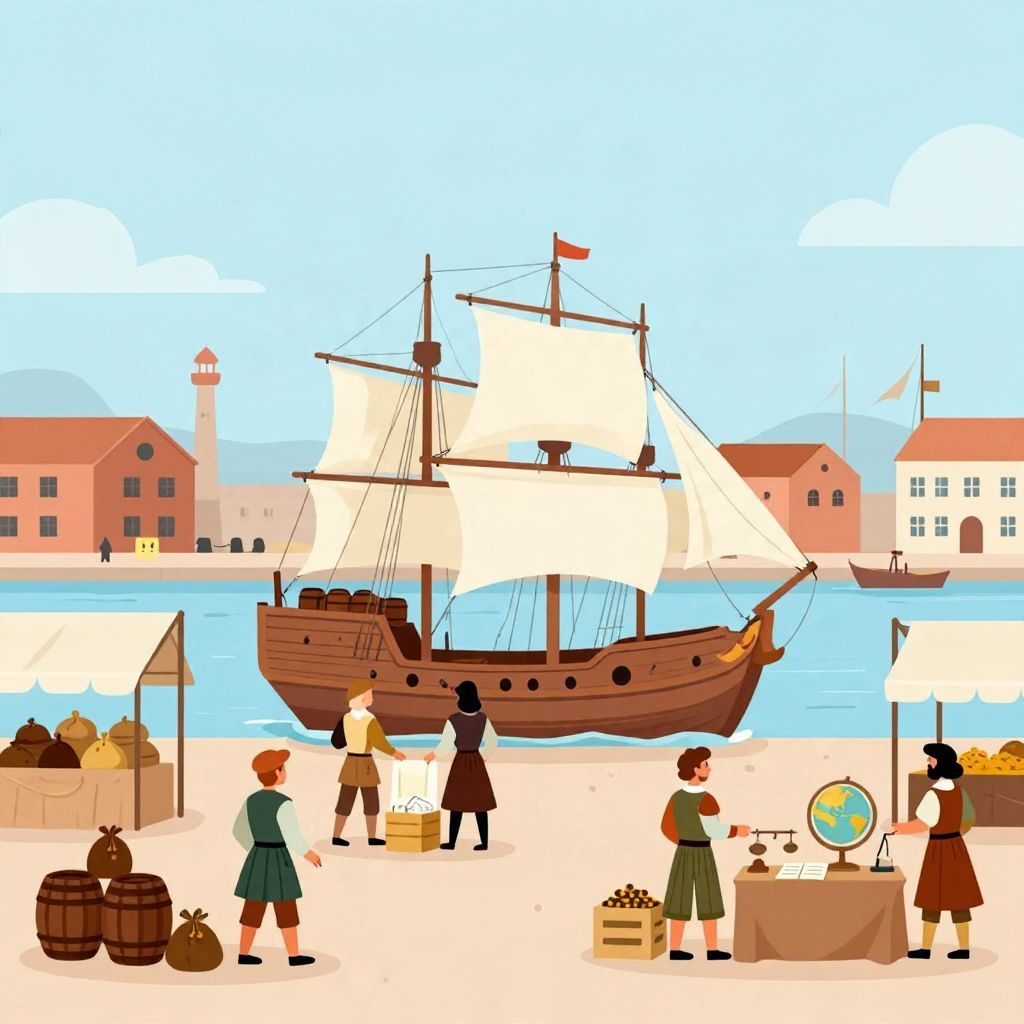
The Commercial Revolution was a long period of economic change in Europe that began in the later Middle Ages and intensified from the 15th to the 18th centuries. It is usually used to describe the expansion of trade, banking, credit, and global commerce that connected Europe more tightly to Africa, Asia, and the Americas.
It did not happen all at once, and historians use the term in slightly different ways. In general, though, it marks the shift from a largely local, land-based economy toward a more interconnected commercial world shaped by merchants, states, ships, and money.
What Was the Commercial Revolution?
The Commercial Revolution was the transformation of European trade and finance between roughly the 11th and 18th centuries, especially after 1500. It involved the growth of long-distance trade, new banking practices, larger markets, joint-stock companies, and a more powerful merchant class. These changes helped lay the foundations of modern capitalism and the later Industrial Revolution.
Background: Why Did Commerce Expand?
Commerce grew because Europe’s population, towns, and demand for goods increased after the early Middle Ages. As agriculture recovered and cities expanded, more people wanted cloth, salt, metal goods, spices, sugar, and luxury items. At the same time, improved shipping and finance made it easier to move goods over long distances.
Medieval roots
The Commercial Revolution did not begin from nothing in the 1500s. Its roots lay in the revival of trade after about 1000 CE, when Italian cities such as Venice and Genoa became major trading centers. Fairs in places like Champagne and the growth of Hanseatic trade in northern Europe also helped create a commercial network before the age of overseas empires.
Urban growth and specialization
As towns grew, people increasingly depended on markets rather than producing everything at home. Rural areas began specializing in certain crops or goods, while urban artisans produced textiles, tools, and finished products. This greater specialization made exchange more important and encouraged merchants to organize transport, storage, and credit.
How Did the Commercial Revolution Change Europe?
It changed Europe by enlarging trade networks, increasing the use of money, and making commerce central to political power. Monarchs, merchants, and investors all benefited in different ways. States wanted customs revenue and strategic goods; merchants wanted profit; and investors wanted safer, more organized ways to finance risky voyages and shipments.
Global trade routes expanded
After the late 15th century, European exploration linked the Atlantic world with older Indian Ocean and Mediterranean trade systems. Portuguese routes around Africa, Spanish expansion across the Atlantic, and later Dutch, English, and French commercial activity created a much larger trading world. Goods such as silver, sugar, tobacco, tea, spices, textiles, and enslaved people moved through these networks.
Money and credit became more important
Large-scale trade required more than barter. Merchants increasingly used bills of exchange, insurance, partnerships, and banking services to manage risk and move capital. Italian banking houses had pioneered many of these practices in the late medieval period, and by the early modern era they had spread more widely across Europe.
Markets became more integrated
Over time, prices and supply in one region could affect another more quickly than before. A poor harvest, war, or shipping disruption in one area might raise prices elsewhere. This did not create a perfectly unified economy, but it did make Europe more commercially connected than in earlier centuries.
Key Causes of the Commercial Revolution
Several developments pushed commercial growth forward at the same time. No single cause explains the entire process, but together they created a new economic environment.
- Population growth: More people meant more demand for food, cloth, and everyday goods.
- Urbanization: Towns concentrated consumers, craftsmen, and merchants.
- Maritime innovation: Better ships, navigation, and cartography improved long-distance travel.
- State support: Governments granted charters, protected trade routes, and taxed commerce.
- Colonial expansion: European empires opened access to new lands, labor systems, and commodities.
- Financial innovation: Credit, insurance, and joint investment reduced risk and increased scale.
Important Features of the Commercial Revolution
Mercantilism and state power
Many European rulers embraced mercantilist ideas, though not always in a single, consistent form. Mercantilism held that national power depended on accumulating wealth, especially precious metals and favorable trade balances. States tried to support exports, control colonies, and use tariffs or monopolies to strengthen themselves.
Joint-stock companies
One of the most important innovations was the joint-stock company, in which many investors pooled money for a trading venture. This spread risk and allowed larger enterprises than a single merchant could finance alone. The Dutch East India Company, founded in 1602, and the English East India Company, founded in 1600, became famous examples.
Commercial agriculture
Farming also changed. In some regions, landowners and tenant farmers produced for sale rather than only for local use. This “commercialization” of agriculture helped feed growing towns and created profits for landlords and merchants, though it also increased inequality in many places.
The rise of consumer culture
As imported goods became more available, many Europeans developed new tastes for sugar, coffee, tea, cotton textiles, and other consumer items. This was not universal or equal across society, but it signaled a shift toward a more market-oriented way of life. Consumption itself became part of economic growth.
Who Benefited, and Who Did Not?
The Commercial Revolution created wealth for merchants, shipowners, bankers, and some states, but its benefits were uneven. Port cities and commercial elites often prospered, while many rural workers saw little improvement. In some cases, commercial growth depended on coercion, conquest, and slavery.
Merchants and financiers
Merchants gained status because they controlled goods, credit, and information. Banking families and trading companies could accumulate great wealth and influence. In some cities, commercial elites became politically powerful and helped shape government policy.
Laborers and enslaved people
Commercial expansion also had a darker side. The Atlantic slave trade forcibly transported millions of Africans across the ocean between the 16th and 19th centuries. Their labor helped produce sugar, tobacco, cotton, and other commodities that fueled European profits and consumption. Any account of the Commercial Revolution must include this violence and exploitation.
Peasants and workers
For many ordinary people, commercialization meant greater dependence on wages, markets, and prices they could not control. Some benefited from new opportunities, but others faced hardship from enclosure, taxation, debt, or unstable food prices. Economic change was not automatically progress for everyone.
Commercial Revolution and the Age of Exploration
The Commercial Revolution is closely tied to European exploration, but the two are not identical. Exploration opened new sea routes and markets; commerce then organized those routes into durable systems of trade and profit. The search for spices, gold, silver, and Asian goods was a major motive for overseas expansion.
Silver and global exchange
American silver, especially from mines in present-day Mexico and Peru, became one of the most important global commodities of the early modern period. It flowed through Europe and across the Pacific to Asia, especially China, where silver demand was strong. This helped connect the Atlantic and Pacific worlds in a truly global economy.
Colonial plantations
European colonies in the Caribbean and the Americas became sites of plantation agriculture, producing sugar, tobacco, indigo, and later cotton. These systems relied heavily on enslaved labor and large-scale export production. They were central to commercial growth, even though they caused immense human suffering.
When Did the Commercial Revolution End?
There is no exact ending date. Many historians see the Commercial Revolution as continuing into the 18th century and blending gradually into the Industrial Revolution. By then, manufacturing, finance, and empire were increasingly linked, and commercial capitalism had become a defining feature of European economies.
Because the term is broad, some scholars use it mainly for the period from about 1500 to 1700, while others extend it earlier or later. The important point is that commerce did not simply “replace” older economic life; it grew alongside agriculture, warfare, and state-building, reshaping all of them over time.
Why Does the Commercial Revolution Matter?
The Commercial Revolution matters because it helped create the modern economic world. It expanded trade across continents, strengthened banking and credit, encouraged state intervention in the economy, and linked consumer demand to global production. It also helped shift wealth and power toward merchants and commercial states.
At the same time, it reminds us that economic growth often depended on inequality, empire, and forced labor. The Commercial Revolution was not just a story of innovation and opportunity; it was also a story of conquest, exploitation, and the creation of a global system whose effects are still visible today.
In short, the Commercial Revolution was the long transformation that turned European commerce from a regional network into a global system. If you want to explore the broader world it helped create, related topics include the Age of Exploration, mercantilism, and the Atlantic slave trade.