
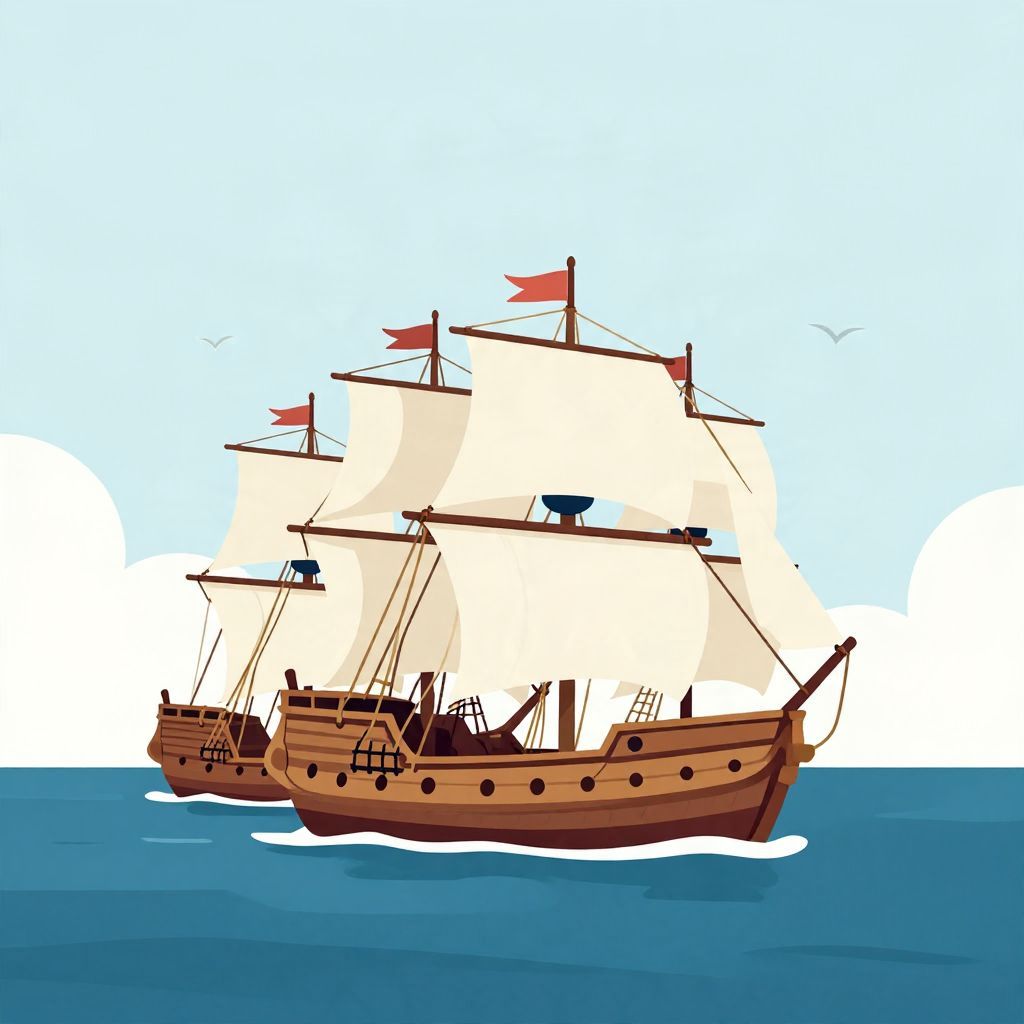
“What year did Columbus sail the ocean blue?” is a famous history question, and the short answer is 1492. That was the year Christopher Columbus crossed the Atlantic under the sponsorship of Spain’s Catholic Monarchs, Ferdinand and Isabella. The phrase comes from a later rhyme, not from Columbus himself, but the date it points to is historically important.
Columbus’s voyage did not “discover” a new world in the absolute sense—people already lived in the Americas, and other seafaring peoples had crossed oceans before him. But 1492 did mark the beginning of sustained European contact with the Caribbean and, soon after, much of the Americas.
What year did Columbus sail the ocean blue?
Christopher Columbus sailed across the Atlantic in 1492. He left Spain in August of that year and reached the Caribbean in October. The voyage is remembered because it opened a new phase of transatlantic exploration, colonization, and exchange between Europe, Africa, and the Americas.
The exact date of Columbus’s voyage
Columbus departed from Palos de la Frontera in Spain on August 3, 1492. After a stop in the Canary Islands, his expedition crossed the Atlantic and first made landfall in the Bahamas on October 12, 1492. So if the question asks for the year, the answer is 1492; if it asks for the landing date, it is October 12, 1492.
Why people remember 1492
The year 1492 is famous not only because of Columbus but because it was a turning point in Spanish and world history. In the same year, Spain completed the conquest of Granada, ending the long Reconquista, and Columbus’s voyage began Spain’s overseas expansion. That combination helped reshape politics, trade, religion, and empire-building for centuries.
Why did Columbus sail west?
Columbus believed he could reach Asia by sailing west across the Atlantic. He underestimated the size of the Earth and thought the journey to the riches of Asia would be shorter than it really was. His goal was to find a new route to the markets of the East—especially spices, silk, and other valuable goods—without traveling around Africa.
The search for a route to Asia
In the late 15th century, European powers were eager to expand trade. The overland routes to Asia were costly and politically complicated, and Portuguese explorers were already working their way around Africa. Columbus proposed a westward route that, in his view, would bring Spain direct access to Asian wealth and prestige.
Spain’s role in the voyage
Columbus did not sail as a lone adventurer. He needed royal backing, ships, crew, and financing. After years of negotiation, Ferdinand and Isabella agreed to support him. Their sponsorship reflected both ambition and competition: Spain wanted to strengthen its position against rival powers and to expand Christian influence.
What happened on the voyage?
Columbus sailed with three ships: the Niña, the Pinta, and the Santa María. The expedition crossed the Atlantic, reached islands in the Caribbean, and explored parts of the region. Columbus believed he had reached islands near Asia, but he had actually arrived in the Americas.
A brief timeline of the first voyage
- August 3, 1492: Columbus departs Spain.
- August 9, 1492: He reaches the Canary Islands for final preparations.
- September 6, 1492: The expedition leaves the Canaries for the open Atlantic.
- October 12, 1492: Landfall in the Bahamas.
- Late 1492: Columbus explores nearby islands, including Cuba and Hispaniola.
Why the voyage mattered so much
The voyage connected two hemispheres that had developed separately for thousands of years. The consequences were enormous: new trade networks, the spread of diseases, the forced movement of people, the rise of colonial empires, and profound changes to Indigenous societies across the Americas. The effects of 1492 were not immediate for everyone, but they were lasting and global.
Did Columbus really “discover” America?
Not in the literal sense. The Americas were already home to millions of Indigenous people with complex societies, governments, and trade systems. Columbus also was not the first non-Indigenous person to reach the Americas; Norse voyagers, including Leif Erikson, reached parts of North America centuries earlier. The phrase “discovered America” is therefore historically misleading.
Why the old phrase persists
For a long time, European histories centered Columbus because his voyage led to sustained contact between Europe and the Americas and became a symbol of European expansion. Modern historians usually avoid saying he “discovered” America without qualification, because that wording erases the people who already lived there and oversimplifies earlier contacts.
Columbus and the Caribbean peoples
Columbus’s first encounters were with Indigenous peoples of the Caribbean, including the Taíno. These meetings were not equal exchanges. They quickly became tied to coercion, exploitation, and violence as Spanish colonial rule expanded. Understanding 1492 requires seeing both the voyage itself and the human cost that followed.
The story behind the phrase “sail the ocean blue”
The line “In fourteen hundred ninety-two, Columbus sailed the ocean blue” is a later educational rhyme used to help children remember the date. It is not a historical quote from Columbus’s time. The rhyme became popular because it is catchy and easy to memorize, which is why many people learn the year before they learn the deeper history.
Why the rhyme is memorable
The phrase works because it compresses a major historical event into a simple verse. But simplicity can be misleading. The real story includes navigation, imperial competition, Indigenous history, and the beginning of a long era of conquest and exchange. The rhyme tells you the date; history explains the consequences.
What happened after 1492?
Columbus made several more voyages across the Atlantic, but the first one in 1492 is the most famous because it opened the door to permanent European involvement in the Americas. Spain soon claimed territories, and other European powers followed. Over time, exploration turned into colonization, and colonization reshaped the Atlantic world.
Immediate consequences
- More voyages: Columbus returned to the Caribbean and continued exploring.
- Colonial claims: Spain asserted control over lands and peoples.
- Exchange of goods and organisms: Crops, animals, and diseases moved across the Atlantic.
- Conflict and conquest: Indigenous communities faced warfare, forced labor, and political disruption.
Long-term historical significance
1492 is often treated as a dividing line between medieval and early modern history, especially in European textbooks. That is partly because it marks the start of a new Atlantic era. But from a global perspective, it is better understood as one major moment in a much larger story of exploration, empire, and intercontinental contact.
Why historians treat Columbus carefully today
Columbus is a historically important figure, but he is also controversial. For centuries he was celebrated mainly as a heroic explorer. Today, historians stress a more balanced view: he was an ambitious navigator whose voyage changed world history, but the expansion that followed brought suffering to many Indigenous peoples. Both facts matter.
Balancing achievement and consequence
Historical understanding improves when we avoid one-sided stories. Columbus’s voyage was remarkable in navigational and political terms, yet it was also the beginning of a violent colonial process. A responsible answer to “What year did Columbus sail the ocean blue?” therefore includes not only 1492 but also the broader context of what that year meant.
So the direct answer is 1492, specifically with Columbus’s Atlantic crossing beginning in August and his first landfall on October 12. But the deeper story is about the start of a new Atlantic world—one shaped by exploration, empire, and profound change for the people who already lived there. If you want to explore more historical turning points, you may also enjoy browsing broader history topics or reading about American imperialism.