
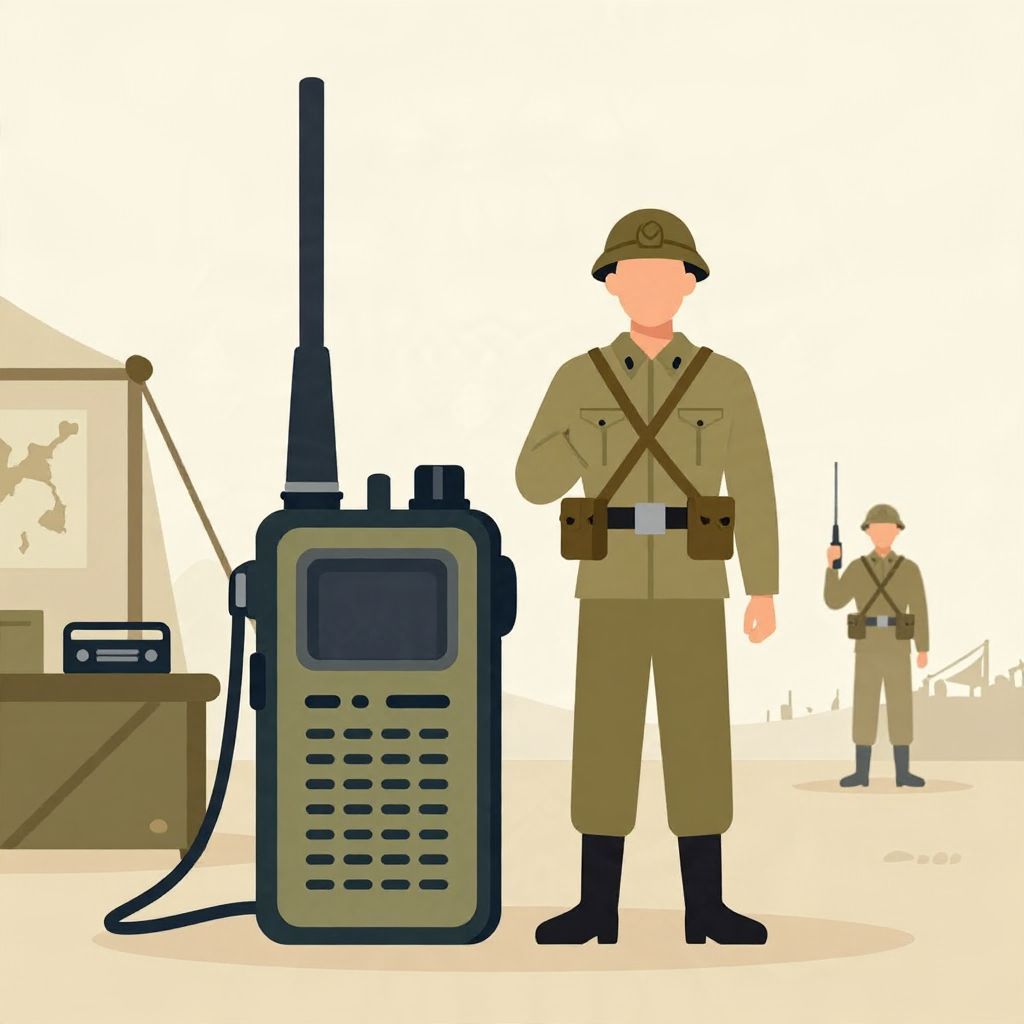
When were walkie talkies invented? The short answer is that the technology emerged in the late 1930s and early 1940s, during the buildup to and course of World War II. The first practical handheld two-way radios were developed in military research programs, with several inventors and companies contributing to what later became the walkie-talkie.
Because “walkie-talkie” is a popular name rather than a single patentable invention, the exact date depends on what you mean by the term: the earliest portable two-way radios appeared before the war, while the familiar handheld battlefield radios were perfected during it.
When were walkie talkies invented?
Walkie talkies were invented in the late 1930s and early 1940s, with the most important breakthroughs coming around 1940–1941. The first practical portable two-way radios were developed for military use, especially by Motorola engineer Donald L. Hings in Canada and by Alfred J. Gross, Henryk Magnuski, and others in the United States. The device became widely known during World War II.
The story behind the invention
The walkie-talkie did not appear all at once from a single inventor. It grew out of radio engineering advances in the 1930s, when smaller vacuum tubes, better batteries, and improved transmitters made portable voice communication possible. Military planners wanted a radio that soldiers could carry into the field and use while moving, not just from a vehicle or fixed station.
That need became urgent as modern warfare grew more mobile. Tanks, infantry units, and reconnaissance teams needed fast communication over short distances. The result was a family of portable radios that were heavy by modern standards but revolutionary for their time.
Donald Hings and the Canadian “packset”
One of the earliest important figures was Donald L. Hings, a Canadian inventor who developed a portable radio system in the late 1930s. His device was often called a packset because it could be carried on the back. Hings’ work helped establish the idea of a lightweight field radio that one person could transport and operate.
Hings’ contribution is significant because it shows that the walkie-talkie was not a sudden wartime novelty. It was the product of experimentation in portable radio communications before the United States entered World War II.
Motorola, Alfred Gross, and the U.S. military
In the United States, radio engineer Alfred J. Gross and others worked on early two-way portable sets. At the same time, the company that would become known as Motorola, then the Galvin Manufacturing Corporation, was developing military radio equipment. Engineer Henryk Magnuski played a major role in creating the SCR-300, one of the best-known backpack radios of the war.
The SCR-300, introduced in 1940 and used by U.S. forces during World War II, was not a tiny handheld device like a modern walkie-talkie. It was a backpack radio, but it was portable, voice-capable, and designed for battlefield use. It is often treated as a direct ancestor of the walkie-talkie.
Why the invention happened when it did
Several technologies had to come together before walkie-talkies were practical. Radio sets needed to shrink in size, batteries had to become more usable in the field, and engineers had to solve problems of weight, frequency stability, and voice clarity. Before the 1930s, radios were generally too bulky for a soldier to carry comfortably while moving.
World War II accelerated everything. Governments funded communications research, and military demand pushed companies to build rugged portable radios quickly. In that sense, the walkie-talkie was both an invention and a wartime solution to a strategic problem.
Key technical ingredients
- Miniaturized components made radios smaller and lighter.
- Improved batteries allowed field use away from fixed power sources.
- Frequency modulation and better receivers improved voice transmission.
- Military funding sped up research and production.
What was the first walkie-talkie?
There is no single universally agreed “first walkie-talkie,” because the term can mean different things. If you mean the earliest portable two-way radio concept, then several prewar and early-war devices qualify. If you mean the familiar handheld radio with a push-to-talk button, that design matured later, especially in postwar civilian and police use.
Historians usually distinguish between portable military radios and the smaller handheld consumer walkie-talkies that became common after the war. The first category emerged in the late 1930s and early 1940s; the second became widespread in the 1950s and beyond.
Walkie-talkie versus backpack radio
Popular memory often lumps all early portable radios together. But technically, many wartime sets were backpack units rather than true one-handed handhelds. The classic “walkie-talkie” image—a compact device you can hold and carry while walking—developed gradually from these earlier military radios.
That is why the answer to “when were walkie talkies invented” is best given as a range rather than a single year. The invention was a process, not a one-day breakthrough.
How World War II shaped the walkie-talkie
World War II gave portable two-way radios their defining role. Infantry units needed immediate communication over short distances, especially in fast-moving operations where telephone lines could be cut and messengers could be delayed. Portable radios improved coordination between commanders, artillery, tanks, and front-line troops.
The military value of the device was enormous. It helped make battlefield communication more flexible and responsive, and it influenced how modern armies organized command and control. In that sense, the walkie-talkie was not just a gadget; it was part of a broader transformation in warfare.
From military tool to civilian device
After the war, the same basic idea moved into civilian life. Police departments, construction crews, event organizers, and emergency services adopted portable two-way radios. Over time, the technology became smaller, cheaper, and more reliable, eventually reaching families, hikers, and children’s toys.
The civilian walkie-talkie of the mid-20th century was a descendant of wartime engineering. What had once been a military necessity became a common communication tool.
When did the word “walkie-talkie” appear?
The phrase “walkie-talkie” is a later popular label, and its exact origin is somewhat fuzzy. It likely emerged in English-language usage in the 1940s, when portable radios were becoming familiar to the public. The name captures the device’s purpose: you can walk while you talk.
Because the term was informal, it was not always used consistently in technical documents. Military and engineering records often preferred model numbers or descriptive terms such as “portable radio,” “handie-talkie,” or “packset.”
Why the name matters
The name “walkie-talkie” helped turn a technical military device into a recognizable everyday object. It was catchy, easy to remember, and accurate enough for public use. That popular language helped the device spread into postwar culture.
Important dates in the invention of walkie-talkies
Here is a simple chronology of the invention’s development:
- Late 1930s — Engineers in Canada and the United States begin developing practical portable two-way radios.
- 1940 — Major wartime radio projects advance, including portable military sets such as the SCR-300.
- 1941–1945 — Walkie-talkie-style radios are used widely in World War II.
- Post-1945 — Civilian and commercial versions spread into police, industry, and public use.
- 1950s onward — Smaller, more affordable handheld models become common.
Why there is no single inventor
Unlike some inventions that can be tied to one patent or one person, the walkie-talkie was assembled from many advances. Inventors, engineers, and manufacturers each solved part of the problem. One person may have designed an early portable set, another improved the circuitry, and another refined the battlefield model.
That is why historical accounts sometimes emphasize different names. The most accurate answer is that the walkie-talkie was developed collectively, with its key breakthroughs occurring in the years just before and during World War II.
What the invention changed
The walkie-talkie changed communication by making voice contact mobile. Before it, portable field communication was limited or awkward. After it, soldiers, police officers, workers, and organizers could coordinate in real time while moving around.
Its broader legacy can be seen in modern wireless communication. While today’s smartphones use far more advanced technology, the walkie-talkie helped normalize the idea that people could carry a personal communication device with them wherever they went.
So, when were walkie talkies invented?
Walkie-talkies were invented in the late 1930s and early 1940s, with the most important wartime developments around 1940–1941. If you want the shortest historically careful answer, that is the best one. But the fuller story is that the walkie-talkie emerged through several inventions, military needs, and engineering improvements rather than one single moment.
That makes the walkie-talkie a classic 20th-century wartime invention: born from prewar experimentation, shaped by World War II, and transformed afterward into a familiar part of everyday life.