
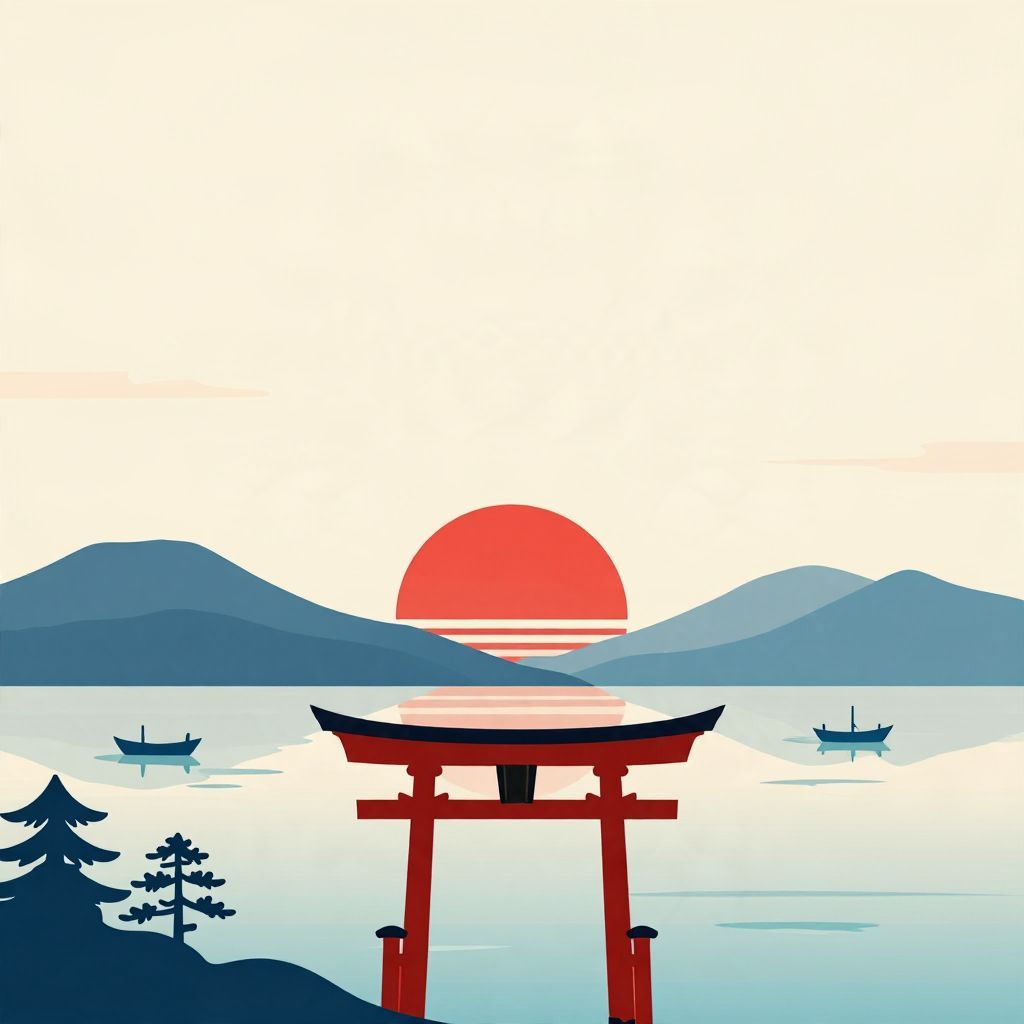
Japan is often called the Land of the Rising Sun because, from the perspective of China and the Asian mainland, the Japanese archipelago lies to the east, where the sun appears to rise. The phrase is not just poetic: it became tied to Japan’s own name and identity through early diplomatic language and long-standing cultural symbolism.
The title reflects geography, language, and history together. Over time, it came to represent Japan in both domestic and foreign usage, eventually becoming one of the country’s most enduring nicknames.
Why Is Japan Called the Land of the Rising Sun?
Japan is called the Land of the Rising Sun because it lies east of the Asian mainland, in the direction where the sun rises. The name is linked to the Chinese characters 日本 (“origin of the sun”), read in Japanese as Nihon or Nippon. It reflects both geography and the way early East Asian states described Japan.
The Geographic Reason: Japan Lies to the East
The simplest explanation is geographic. For people in China, Korea, and other parts of continental East Asia, Japan is located across the sea to the east. In a world shaped by solar symbolism, east was naturally associated with sunrise. Japan’s islands were therefore understood as the place where the sun appears first.
This idea was especially meaningful in premodern East Asia, where political order, cosmology, and geography were closely connected. Directions could carry symbolic value, and the east often represented beginnings, brightness, and renewal. Japan’s position made it an easy candidate for the image of the rising sun.
Why the east mattered in East Asian thought
- The sun rises in the east, making eastern lands symbolically important.
- Japan sits east of the Asian mainland, across the sea from China and Korea.
- Early states often used directional language to describe neighboring lands and their place in the world.
The Name “Nihon” and Its Historical Meaning
The Japanese name for the country, Nihon or Nippon, is usually written with the characters 日本. These mean “origin of the sun” or “source of the sun.” The name likely emerged in use around the late 7th or early 8th century, when Japan was formalizing its relations with the Chinese imperial court.
Before this, Japan was known by different names in Chinese records, including Wa, an older term used by Chinese writers for the islands and their peoples. The shift toward “Japan” as a name and “land of the sun’s origin” as an identity was part of a broader effort by Japanese rulers to present their state in a more independent and prestigious way.
From “Wa” to “Nihon”
The older name Wa appears in Chinese historical sources, but it was not the preferred self-designation of Japanese rulers. By the Asuka and early Nara periods, Japanese elites were adopting new political language and court styles influenced by China. The name 日本 helped express a new identity: a country positioned at the eastern edge of the known world, where the sun begins its course.
Historical Context: Diplomacy with China and the Sui-Tang World
The phrase became especially important during Japan’s early state formation in the 6th to 8th centuries. At that time, East Asia was dominated culturally and politically by powerful Chinese dynasties, first the Sui and then the Tang. Japanese rulers sought recognition, learning from Chinese institutions while also asserting their own status.
According to later tradition, a Japanese envoy described his country as the place where the sun rises relative to China. Whether the exact wording of that diplomatic exchange is fully recoverable from the surviving sources is uncertain, but the general historical process is clear: Japan was defining itself in relation to the Chinese world order.
Why a new name mattered
- It helped Japan present itself as a distinct political entity.
- It aligned with East Asian cosmological language about the sun and direction.
- It supported diplomatic equality or at least greater independence from China.
Was the Phrase Invented by the Japanese?
Not entirely in the modern sense. The idea of Japan as the “origin of the sun” developed through interaction between Japanese and Chinese court culture. Chinese writing supplied the characters, while Japanese rulers and scholars adopted and adapted them. The result was a name that made sense both geographically and symbolically.
It is important to distinguish between the historical name and later romanticized explanations. Japan did not simply receive a nickname from outsiders; it also embraced and reshaped the idea as part of its own national identity. In that sense, the phrase became both an external description and an internal self-image.
The Imperial Connection and the Sun Goddess
Japan’s association with the sun was strengthened by mythology and imperial ideology. In the Kojiki and Nihon Shoki, early chronicles compiled in the 8th century, the imperial line is linked to the sun goddess Amaterasu. These texts are not straightforward historical records, but they are vital for understanding how the Japanese court explained its authority.
Because the emperor was associated with divine descent from the sun goddess, solar imagery carried political meaning as well as poetic value. The phrase “Land of the Rising Sun” therefore resonated deeply with Japan’s own mythic and imperial traditions, even though the nickname itself is not identical to the mythology.
Myth and history are not the same
It would be inaccurate to say Japan was called the Land of the Rising Sun only because of the Amaterasu myth. The name’s historical roots lie in geography and diplomatic language. Still, the myth reinforced the symbolism of the sun and helped make the phrase feel natural and authoritative within Japanese culture.
How the Phrase Spread in the Outside World
Over time, the idea of Japan as the Land of the Rising Sun spread beyond East Asia. European travelers, traders, and missionaries encountered the country through Asian and later global networks. In English and other European languages, “Land of the Rising Sun” became a familiar poetic translation of Japan’s self-name and symbolic identity.
The phrase was especially useful because it was vivid and easy to remember. It captured both Japan’s eastern location and its cultural association with the sun. In the modern era, the image appeared in literature, diplomacy, and popular culture, eventually becoming one of the most recognizable descriptions of the country.
Japan’s National Symbolism in the Modern Era
In modern times, the sun has remained central to Japanese national imagery. The Japanese flag, the Hinomaru, features a red disc representing the sun. The military and state symbolism of the 19th and 20th centuries also drew on solar imagery, though those uses were shaped by modern nationalism and empire in ways that go beyond the older historical meaning.
It is worth noting that the phrase “Land of the Rising Sun” is older than modern nationalism, but modern governments and institutions helped popularize it further. As Japan emerged as a modern nation-state, the name and symbol became even more visible in official and cultural contexts.
Common Misunderstandings About the Phrase
People sometimes assume the nickname is a purely romantic invention or a modern marketing slogan. In fact, it has deep historical roots. Others think it refers to Japan being the first place on Earth to see the sun every day, which is not literally true in a global sense. The phrase is relative: it depends on the viewpoint of observers in continental Asia.
Another misunderstanding is that the phrase is only about the flag. While the flag reinforces the solar image, the nickname predates modern national symbols. Its origins lie in the combination of geography, language, and early statecraft.
What the phrase does and does not mean
- It does mean Japan lies east of the Asian mainland and was named in relation to the rising sun.
- It does mean the phrase became part of Japanese identity and diplomacy.
- It does not mean Japan is literally the first place on Earth to see sunrise every day.
- It does not mean the nickname came from a single moment or a single person alone.
Why the Name Endured
The phrase endured because it was memorable, meaningful, and flexible. It worked as geography, poetry, and political identity at the same time. Few national nicknames combine all three so effectively. For Japan, the image of the rising sun connected ancient cosmology, court history, and modern symbolism into one enduring expression.
That durability also explains why the phrase remains in use today. It is not merely a tourist slogan; it is a historical shorthand for how Japan was understood in East Asia and how Japan came to understand itself.
Conclusion
Japan is called the Land of the Rising Sun because its position east of the Asian mainland made it the land where the sun rises from the perspective of neighboring civilizations, and because the country adopted the name 日本, “origin of the sun,” as part of its early historical identity. The phrase reflects geography, diplomacy, and symbolism all at once. For more on Japanese cultural history, you may also enjoy what the Land of the Rising Sun means and when Japanese New Year is celebrated.